Thursday, September 21, 2006

Space shuttle glides to a safe landing



By MIKE SCHNEIDER, Associated Press Writer 1 hour, 1 minute ago
CAPE CANAVERAL, Fla. - Space shuttle Atlantis and its six astronauts glided to a safe landing in darkness early Thursday, ending a 12-day mission whose smooth success was briefly upstaged by the high drama caused by mysterious floating debris.

"Nice to be back. It was a great team effort," said commander Brent Jett immediately after touchdown at
Kennedy Space Center' name=c1> SEARCHNews News Photos Images Web' name=c3> Kennedy Space Center at 6:21 a.m. EDT.
More than 1 1/2 hours after landing, the astronauts, all wearing broad grins, left the shuttle to greet
NASA' name=c1> SEARCHNews News Photos Images Web' name=c3> NASA administrator Michael Griffin and other agency officials. Then they walked under Atlantis to inspect the shuttle's heat shield.
"It's really a beautiful day in Florida, a great way to end a mission," said Jett. "It was a pretty tough few days for us, a lot of hard work, a great team effort to get the station assembly restarted on a good note."
Jett and his crew did the first construction work on the international space station since the Columbia disaster 3 1/2 years ago. The astronauts performed three grueling spacewalks and took on other heavy-lifting tasks in one of the most challenging missions ever, adding a 17 1/2-ton truss addition with giant solar wings that will help power the orbiting lab.
The landing 48 minutes before sunrise was a day later than planned because NASA ordered up extra inspections of the spacecraft's delicate skin to make sure it was safe to come home. The fear was that a mysterious piece of debris spotted floating nearby on Tuesday might have hit the spacecraft. Astronauts later saw other debris.
It was a flying piece of foam insulation that knocked a hole in Columbia causing its demise in 2003, killing seven astronauts. Since then, NASA has developed new equipment and practices to guard against and watch out for similar damage to the sensitive space shuttle.
Those new techniques were used to make sure Atlantis was safe to return. After numerous cameras took pictures above and below Atlantis, some of them maneuvered robotically by the shuttle astronauts, NASA proclaimed the spacecraft damage-free.
"We've seen a new standard in NASA vigilance," said shuttle program manager Wayne Hale.
NASA officials said their best guess was that the most worrisome debris was a plastic filler from the thermal tiles which protect the shuttle from blasting heat. Four other unidentified objects, including a possible garbage bag, floated near the shuttle over the next day.
In a news conference, Griffin downplayed the litter in space, saying debris can slip out of the shuttle cargo bay because people are not perfect. He and launch director Mike Leinbach said Atlantis came back as clean, if not cleaner, than Discovery in its two previous landings.
The unplanned drama threatened to overshadow what had been a nearly flawless mission filled with strenuous spacewalks and rigorous robotics work that placed the space station back on a path to completion after its long hiatus. The crew of five men and one woman were the longest-trained in NASA history, because they were originally supposed to fly to the space station in 2003. But the Columbia accident kept them grounded.
The mission was the first of 15 tightly scheduled flights needed to finish constructing the half-built space lab by 2010.
"We are rebuilding the kind of momentum that we have had in the past and that we need if we're going to finish the space station," said Griffin.
NASA and its international partners of Russia, Europe, Canada and Japan must finish building the space station before the U.S. space agency ends the shuttle program in 2010 with plans to return to the moon in a new vehicle. The massive, 25-year-old shuttles are the only spaceships large enough to haul construction parts to the space lab.
The next flight in the construction sequence is set for December.
The mission was bookended by delays. The launch was scrubbed four times in two weeks because of a launch pad lightning bolt, Tropical Storm Ernesto and problems with the electrical system and a fuel gauge. Griffin called those snags "just routine life in the space business."
With all the postponements, NASA negotiated with the Russians to squeeze out one last chance in its launch window. The Russians were worried the trip would interfere with their Soyuz trip to the space station with a paying customer, Iranian-born space tourist Anousheh Ansari, a Dallas businesswoman. The Soyuz lifted off Monday, just hours after Atlantis had undocked from the space station.
Less than 24 hours after Atlantis undocked, an oxygen generator on the space station overheated and spilled a toxic irritant, forcing the three-man crew to don masks and gloves in the first emergency ever declared aboard the 8-year-old orbiting outpost.
___
On the Net:
NASA: http://us.rd.yahoo.com/dailynews/ap/ap_on_sc/storytext/space_shuttle/20362963/SIG=10tpccdlk/*http://spaceflight.nasa.gov

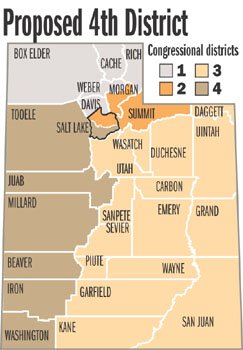
Huntsman unveils map proposing 4 districts


By Bob Bernick Jr. and Suzanne StruglinskiDeseret Morning News
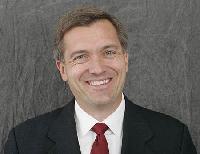
Gov. Jon Hunstman Jr. unveiled a new four-congressional district map Wednesday as negotiations continue in Washington to grant Utah an additional seat in the U.S. House of Representatives.

"It is imperative that we come together and do what is best for Utah. Clearly, it is in our best interest to gain a much needed and deserved fourth seat," Huntsman said Wednesday. "This map is consistent with my pledge of fairness made last week to the Judiciary Committee of the House of Representatives." Committee Chairman James Sensenbrenner, R-Wis., wants to change a pending bill that would give Utah a fourth House seat that is at-large until the 2010 Census, instead creating four distinct geographic districts that would be established by the state. Huntsman testified before the committee last week in Washington, saying while he preferred the at-large option, redistricting could be done fairly. "Whether we like it or not, that legislation granting Utah a fourth congressional seat can only make it through the House Judiciary Committee with an amendment striking the 'at-large' election provision," said Rep. Chris Cannon, R-Utah. "I have made it clear, and I think many Utahns agree, that what matters is that we get the additional seat we deserve and for which we have fought so hard." The Utah seat is a political compromise in a bill that grants a vote in the House for the District of Columbia, where residents currently do not have a voting member in the House or Senate. Del. Eleanor Holmes Norton, D-D.C. is still working on a compromise to get the bill through, according to her office. Cannon encouraged the governor and Utah's state legislative leaders to work with Rep. Jim Matheson, D-Utah, "to provide the assurances he apparently needs in order to embrace a process that will lead to a fair reapportionment."

document.writeln(AAMB6);
document.write(''); "We should not lose this opportunity to gain the fourth seat we so clearly deserve due to the partisan interests of any member of the delegation," Cannon said. But Matheson says it's up to the Republicans to make sure this bill goes through and he is not the one preventing it from moving forward. "I have always said Utah deserves an additional voice in Congress," Matheson said in a statement. "Utah should have been given a fourth seat after the 2000 Census. I've supported bipartisan legislation that would accomplish the goal. That compromise bill took partisanship out of the mix, and it seemed likely to move forward, until one member of Congress blocked the bill's progress. If it gets unstuck, I look forward to voting for it. But clearly the ball is in the majority party's court." Matheson spokeswoman Alyson Heyrend said Matheson would vote for a bill giving Utah a fourth seat, whether it creates a fourth district or an at-large position. She said it was "way too hypothetical" to comment on the maps released by the governor Wednesday. "Congress isn't going to pass any maps, that is putting the cart before the horse," Heyrend said. "The Utah Legislature does the redistricting." She said Matheson's office knew nothing about the maps until the governor's press release came out. "Who knows what the Utah Legislature will do," Heyrend said. Meanwhile back in Utah, Huntsman, state House Speaker Greg Curtis and Senate President John Valentine, all Republicans, quickly met Wednesday to give preliminary approval to a four-district alternative. Oddly enough, it was not the four-district plan that was formally adopted by the 2001 GOP-controlled Legislature and former GOP Gov. Mike Leavitt. Leaders adopted a four-district plan then just in case Utah won its U.S. Supreme Court challenge to the U.S. Census data from which North Carolina, not Utah, was given an extra U.S. House seat. Utah ultimately lost that court challenge, and so a new three-district redistricting plan was adopted. Todd Taylor, executive director of the Utah Democratic Party, was not pleased with what he saw under the new four-district plan Wednesday. "First off, on its face, it is illegal," said Taylor, who has led state Democrats through two previous statewide redistricting efforts, in 1991 and in 2001. Court-tested redistricting law says that each district's population can vary only by 0.5 percent from other districts', Taylor said. The four districts put forward by GOP leaders Wednesday show population variations of 2.39 percent, 2.52 percent, 4.21 percent and 0.70 percent, respectively. "This shows Utah's Republicans going back to their old tendencies," Taylor said. "They either dump all the Democrats they can into one district, or they break up all the Democrats they can into all the districts." Curtis said: "We were told to draw up a map that was very fair to Congressman Matheson. We did that. Of the 15 Utah House seats that Democrats hold in Salt Lake County, the new 2nd District has 14 of them. I told the governor I don't know how we could have drawn it any more Democratic." Taylor said despite artificial deadlines that GOP leaders in Washington may have put on Utah to suggest a four-district plan, this is not the way to go about it. "As bad as the four-seat plan adopted" in 2001 "may have been, at least there was an open hearing process. They come up with this map in one day with no hearings at all. I got my map from a newspaper reporter," Taylor said. There will still be public hearings and "tweaking" of the boundaries to get each of the four new districts' populations below 0.5 percent deviation, Curtis said. The four-district plan GOP leaders put together Wednesday may actually put more Democrats into Matheson's new 2nd District than he has in his current 2nd District, which takes in the eastern part of Salt Lake County and counties to the east, south and southwest. His is one of the largest geographic districts in the nation. Under the new four-district plan, Matheson would pick up more of the west side of the county, all of Summit County (which he has now) and then north into Morgan County. The county's west side and the 7,100 residents in Morgan County would be new for him. While Matheson would pick up new constituents in Morgan County and the west side of Salt Lake County, he probably would be better off in his Democrat/Republican ratio. But, by making a safe Democratic seat, Republicans could also be making the other three seats even more secure for Republicans — and thus for a decade or more making it nearly impossible for Democrats to capture a second Utah congressional seat. "I don't know how to answer that complaint," Curtis said. "I guess Todd Taylor just is having a bad day and won't be happy with anything we do."
E-mail: bbjr@desnews.com; suzanne@desnews.com

Alleged 9/11 planner faces Gitmo hearing


By ANDREW SELSKY, Associated Press 2 hours, 42 minutes ago
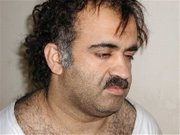
GUANTANAMO BAY NAVAL BASE, Cuba - Khalid Sheikh Mohammed, accused of masterminding the Sept. 11 attacks, and other alleged terrorists linked to major attacks against the U.S. are expected to face hearings at the Guantanamo prison camp within three months, a military official said Wednesday.
Fourteen "high-value" detainees — including the alleged plotter of the USS Cole' name=c1> SEARCHNews News Photos Images Web' name=c3> USS Cole bombing and the alleged coordinator of the 1998 bombings of the U.S. Embassies in Kenya and Tanzania — will be invited to appear at hearings, held to determine whether they're enemy combatants, said Navy Capt. Phil Waddingham, director of the Office for the Administrative Review of the Detention of Enemy Combatants.
If Mohammed appears, it would mark the first time he has been seen since he was captured more than three years ago in Pakistan. Detainees can refuse to appear but the tribunals — held in small rooms inside a prefab building here — will be held regardless, Waddingham told reporters.
Mohammed and the 13 other top alleged terrorists were recently transferred from
CIA' name=c1> SEARCHNews News Photos Images Web' name=c3> CIA custody to this isolated
U.S. Navy' name=c1> SEARCHNews News Photos Images Web' name=c3> U.S. Navy base in southeast Cuba,
President Bush' name=c1> SEARCHNews News Photos Images Web' name=c3> President Bush announced on Sept. 6.
Army Brig. Gen. Edward A. Leacock, the deputy commander of Guantanamo, said the 14 new detainees are being treated humanely. Authorities have said they are being held in a maximum-security area but Leacock refused to say precisely where.
"They're all adapting well to their new environment," Leacock said in an interview with reporters here, adding that they're fed three times a day, have recreational opportunities and have opportunities to pray five times per day.
They are being checked for medical and dental problems and have been given materials to write letters, which — after they are censored by the military — will be given to the Red Cross for mailing, Leacock said. The Red Cross announced in Geneva Wednesday they will come to Guantanamo to visit the 14 new detainees next week.
Waddingham told reporters visiting Guantanamo that preparations were being made for the Combatant Status Review Tribunals for Mohammed and the other 13 detainees. They would be open to the press, he said.
"I am expecting the CSRTs to begin in two or three months," he said.
Every one of the other roughly 450 detainees at Guantanamo, who began arriving in 2002, have already undergone the tribunals. The tribunals for the 14 new arrivals will be held almost certainly using the same procedures, Waddingham said.
The tribunals are conducted by a three-member military panel, which examines evidence against a detainee, can speak to witnesses, and determines if the detainee is an enemy combatant and should be held. The detainee is represented by U.S. military counsel.
Those judged not to be enemy combatants are generally transferred out of Guantanamo to their home countries. Those determined to be enemy combatants stay locked up here. They then face annual Administrative Review Boards that examine whether they still pose a threat to the United States or have intelligence value.
Congress and the Bush administration are currently working on guidelines on how detainees should be interrogated and put on trial. Ten Guantanamo detainees have been charged with crimes but their military trials were put on hold after the Supreme Court last June ruled that the tribunals were illegal — partly because the Bush administration had set them up without Congressional approval.
Mohammed is believed to be the No. 3 al-Qaida leader before he was captured in Pakistan in 2003. Ramzi Binalshibh, who allegedly helped plan the Sept. 11 attacks and allegedly was a lead operative for a foiled plot to crash aircraft into London's Heathrow Airport, is also among the 14 captives. Abu Zubaydah, who was believed to be a link between
Osama bin Laden' name=c1> SEARCHNews News Photos Images Web' name=c3> Osama bin Laden and many al-Qaida cells before he was captured in Pakistan in 2002, is also among the 14.
The Combatant Status Review Tribunals will also be held for them, Waddingham said. The 14 terrorism suspects are undergoing "orientation" and not being interrogated, Army Gen. Bantz J. Craddock told a group of reporters at the
Pentagon' name=c1> SEARCHNews News Photos Images Web' name=c3> Pentagon.
Craddock, who oversees U.S. military operations in Latin America and the Caribbean as commander of U.S. Southern Command, said estimated the 14 would be made available to the Red Cross around Oct. 1, but not before they completed their orientation.
In Geneva on Wednesday, the chief spokesman for the ICRC, Antonella Notari, said officials plan to arrive Sept. 25 for a scheduled two-week visit to Guantanamo. The ICRC is the only neutral agency with full access to Guantanamo detainees.

Wednesday, September 20, 2006

What is Signals Intelligence?


Thai army calls military rule temporary


By Nopporn Wong-Anan 1 hour, 46 minutes ago
BANGKOK (Reuters) - Thailand's army chief vowed on Wednesday to wipe the political slate clean and return "power to the people" as soon as possible after a bloodless coup against billionaire Prime Minister Thaksin Shinawatra.


Commander-in-chief General Sonthi Boonyaratglin, who had repeatedly dismissed a coup as a way out of a prolonged political stalemate, took power late on Tuesday as head of an interim 'Political Reform Council' run by the military.
"I would like to assure that the Council has no intention of running the country by itself and will return power, under the constitutional monarchy, to the people as soon as possible," he said in a national television address on Wednesday morning.
The Thai baht, one of Asia's strongest currencies this year, suffered its biggest fall in three years within hours of tanks surrounding Government House. Fitch Ratings and Standard & Poor's put Thailand's credit rating on review for possible downgrades.
The stock market was closed on the orders of the coup leaders, who declared a national holiday on Wednesday. Market officials confirmed it would reopen on Thursday.
Commercial banks and some businesses were shuttered in Bangkok, and foreign car manufacturers such as Japan's Nissan Motor Co, one of hundreds of investors in Thailand's export-driven economy, said they had halted operations for a day.
Announcements carried on all television channels said political gatherings of more than five people were banned, but otherwise Bangkok remained calm and quiet, with its notorious traffic jams alleviated by the holiday announcement.
"RAMPANT CORRUPTION"
On Tuesday evening as soldiers took up positions on street corners throughout the capital, a coup spokesman said Thaksin had been ousted to resolve a near year-long political deadlock and to stop "rampant corruption."
Thaksin, who was in New York at the U.N. General Assembly, apparently tried to head off the putsch by phoning a Thai television station to announce a state of emergency but was cut off after 10 minutes.
He then canceled a speech to the
United Nations' name=c1> SEARCHNews News Photos Images Web' name=c3> United Nations scheduled for Wednesday morning Thai time and was due to leave New York at any moment but his aides refused to say where he was going.
One of Thaksin's three children is studying in London, where he also owns a house.
The coup spokesman, retired Lieutenant-General Prapart Sakuntanak, said the army and police were in firm control after
the coup, Thailand's first in 15 years but its 18th since it became a constitutional monarchy in 1932.
Television showed the armed forces chiefs heading in a motorcade to the palace late on Tuesday to report to revered King Bhumibol Adulyadej, images likely to dampen any agitation in the countryside, where support for Thaksin is strong.
However, fears of a counter-coup by Thaksin loyalists within the military and police died down after a senior general said his main deputy, Chidchai Vanasatidya, had been "invited to stay" at Army Headquarters since last night.
Documentaries of the king in the countryside promoting development projects were also broadcast on television, apparently aimed at reinforcing the military's insistence it was acting on behalf of the country and the crown.
Foreign news channels, including CNN and the BBC, were taken off the air immediately after the coup and more than half a day later were still being blocked.
A DIVIDED NATION
The coup was condemned by the United States, the
European Union' name=c1> SEARCHNews News Photos Images Web' name=c3> European Union, Australia and New Zealand as undemocratic.
However its leaders said it had been necessary to resolve the political stalemate that stemmed from a street campaign against telecommunications billionaire Thaksin, accusing him of subverting democracy for the good of his family and friends in big business.
Thaksin argued he was democracy's defender against opponents using unconstitutional means.
"Never in Thai history have the people been so divided," coup spokesman Prapart said. "The majority of people had become suspicious of this administration, which is running the country through rampant corruption."
After mass street protests against him in Bangkok, Thaksin, winner of two election landslides, called a snap poll in April, hoping his rural following would counter his metropolitan foes.
Opposition parties argued he had skewed neutral bodies such as the Election Commission in his favor, however, and boycotted the poll, rendering the result invalid.
Thaksin's Thai Rak Thai (Thais Love Thais) party had been expected to win a re-run tentatively scheduled for late November, increasing pressure on his opponents in the military and the old establishment to remove him by force.

Iran leader says U.S abusing U.N. power


By SCHEHEREZADE FARAMARZI, Associated Press Writer 56 minutes ago
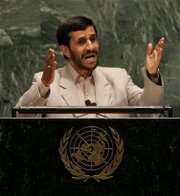
UNITED NATIONS - Iranian President Mahmoud Ahmadinejad took aim at U.S. policies in
Iraq' name=c1> SEARCHNews News Photos Images Web' name=c3> Iraq and Lebanon on Tuesday, and accused Washington of abusing its power in the
U.N. Security Council' name=c1> SEARCHNews News Photos Images Web' name=c3> U.N. Security Council to punish others while protecting its own interests and allies.

He addressed the annual U.N. General Assembly hours after
President Bush' name=c1> SEARCHNews News Photos Images Web' name=c3> President Bush spoke to the same forum. But while Ahmadinejad harshly criticized the United States, Bush directed his remarks to the Iranian people in a clear insult to the hard-line government.
In his speech, Bush pointed to the Iranian government's rejection of a Security Council demand to stop enriching uranium by Aug. 31 or face sanctions.
"The greatest obstacle to this future is that your rulers have chosen to deny you liberty and to use your nation's resources to fund terrorism and fuel extremism and pursue nuclear weapons," the U.S. leader said.
"
Iran' name=c1> SEARCHNews News Photos Images Web' name=c3> Iran must abandon its nuclear weapons ambitions," he said. "Despite what the regime tells you, we have no objection to Iran's pursuit of a truly peaceful nuclear power program."
He also said he hoped to see "the day when you can live in freedom, and America and Iran can be good friends and close partners in the cause of peace."
Ahmadinejad insisted that his nation's nuclear activities are "transparent, peaceful and under the watchful eye" of inspectors from the
International Atomic Energy Agency' name=c1> SEARCHNews News Photos Images Web' name=c3> International Atomic Energy Agency, the U.N. nuclear watchdog. He also reiterated his nation's commitment to the Nuclear Nonproliferation Treaty.
Earlier this month, Ahmadinejad proposed a debate with Bush at the General Assembly's ministerial meeting after the White House dismissed a previous TV debate proposal as a "diversion" from serious concerns over Iran's nuclear program.
But even though the two leaders were addressing the same forum, they skipped each other's speeches and managed to avoid direct contact during the ministerial meeting.
Ahmadinejad also accused the United States and Britain of using their veto power on the Security Council to further their own interests and he said it had become an "instrument of threat and coercion."
"If they have differences with a nation or state, they drag it to the Security Council," and assign themselves the roles of "prosecutor, judge and executioner," Ahmadinejad said. "Is this a just order?"
The U.S. and Britain played central roles in helping craft a U.N. Security Council resolution passed in July that gave Iran until Aug. 31 to suspend uranium enrichment and asked the IAEA to report on Tehran's compliance, dangling the threat of sanctions if Iran refused. Tehran made clear even before the deadline expired that it had no intention of suspending uranium enrichment.
The IAEA last week rejected a recent American report on Iran's nuclear capability, saying the Islamic republic has produced material only in small quantities that is far below the level that can be used in nuclear arms.
Ahmadinejad also criticized the Security Council for failing to call for an immediate cease-fire after war broke out between
Israel' name=c1> SEARCHNews News Photos Images Web' name=c3> Israel and the Islamic militant group Hezbollah in Lebanon. A truce was only reached on Aug. 14 to end the 34-day conflict.
"The Security Council sat idly by for so many days, witnessing the cruel scenes of atrocities against the Lebanese ... Why?" asked Ahmadinejad, whose government is one of Hezbollah's main backers.
He said the answer is self-evident: "When the power behind the hostilities is itself a permanent member of the Security Council, how then can this council fulfill its responsibilities."
The United States and Britain refused to call for a cease-fire during the monthlong war between Israel and Hezbollah, declaring it part of war on terror. Only after Israel's failure to defeat Hezbollah and the deaths of nearly 1,000 Lebanese civilians did Washington and London agree to push for a truce by the U.N. Security Council.
The Iranian leader had harsh words about U.S. efforts in Iraq, saying "the occupiers are incapable of establishing security in Iraq" and every day hundreds of people get killed "in cold blood."
Ahmadinejad claimed that numerous terrorists apprehended by the Iraqi government were "let loose under various pretexts by the occupiers."
Domestically, Ahmadinejad, who doesn't enjoy widespread popularity among his people, has been able to use America's uncompromising stand against Iran's nuclear program to his own benefit. Many Iranians, including those who are against the president's domestic policies, support him in his showdown with the United States on the nuclear issue.
In an interview with "NBC Nightly News," Ahmadinejad was asked about Bush's appeal to the Iranian people.
"We have the same desire ... to be together for the cause of world peace," he said through a translator.
"We think that the American people are like our people. They're good people, they support peace, equality and brotherhood," he said.
He said his issue was with the U.S. administration.
"I explicitly say that I am against the policies chosen by the U.S. government to run the world because these policies are moving the world toward war," he said.

Tuesday, September 19, 2006

Rocky's attack on Matheson: A conspiracy?

Both deny mayor's sniping is part of a secret agreement to boost their careers
By Rebecca Walsh The Salt Lake Tribune


Jim Matheson Attacked for being Bush-friendly

No one would expect Jim Matheson and Rocky Anderson to be buddies. Anderson is a royal blue Democrat; Matheson's political philosophy puts him closer to powder on the political color spectrum. Salt Lake City's mayor takes on the president. More often than not, the congressman votes with Bush on the big issues. Anderson has never been one to worry about political fallout from his liberal views. And Matheson is the ultimate political pragmatist, transforming himself in six years in office into what a reporter for The Nation called a "Bush Democrat." So it's no surprise that Anderson has started criticizing Matheson - on his radio show and in television and newspaper interviews. He's even suggesting Utahns should vote for Bob Brister, the Green Party's 2nd Congressional District candidate. "Just because somebody has a 'D' after their name doesn't make it so," said Anderson. "It doesn't seem like we have a real Democrat in this race." Anderson's shots at the congressman are unusual. It's considered bad form to take on another member of your own political party - particularly an incumbent in the middle of an election year. But the mayor is unapologetic and uncensored. He doesn't plan to stop. And Republicans are taking note. Some wish the mayor would just shut up, figuring his criticism can only help Matheson with conservative voters. But one Republican leader claims the spat between two of the state's top Democratic officeholders is a conspiracy, a secret deal between Matheson and Anderson to increase their own cachet with different constituencies. Salt Lake County Republican Party Chairman James Evans believes the mayor is "auditioning" for a job with a liberal think tank and the congressman is trying to lure more Republican voters into his camp. "I think it's coordinated with Matheson's campaign. He's helping Matheson win re-election," Evans told a University of Utah communications class this week. "It's another cynical ploy. It's vintage Rocky. He operates like [he's playing a game] in three-dimensional chess." Both Matheson and Anderson dispute the conspiracy theory. "That's crazy talk," Matheson said. And Anderson called Evans "paranoid and looney." But Evans' comments reveal the political implications of the spat. Conventional wisdom would say that anything the mayor does or says boomerangs outside of Salt Lake City. If he advises "Don't vote for Matheson," conservative Utah voters might give the congressman a second look. Rather than pushing voters toward Brister, Anderson's criticism of his fellow Democrat could pull voters away from Republican candidate LaVar Christensen and guarantee a Matheson win. Anderson knows that's a possibility. But he says he feels compelled to take on the congressman. And if liberal voters actually take his advice and jump from Matheson, leading to Christensen getting elected, so be it. There's little difference between the Democrat and Republican in this race anyway, he says. He notes that Matheson voted for the Bush tax cuts and war in Iraq, for a federal constitutional ban on same-sex marriage, to limit so-called partial birth abortion, for free trade with Central America and to keep Terri Schiavo on life support - all initiatives opposed by many Democrats. The mayor brushes off Democrats who complain he's setting up Brister to be a spoiler. He says the 2000 presidential election, when Green Party candidate Ralph Nader siphoned off some of Democrat Al Gore's voters, is not comparable. Anderson says he's angry at Nader for spoiling that race because there were significant differences between Gore and Bush. But with Matheson, "in terms of a voting record, it can't be worse [with Christensen]," said Anderson, who ran unsuccessfully for the congressional seat in 1996. Matheson has only confronted Anderson indirectly, having a staff member call after the mayor criticized the congressman at a Human Rights Campaign dinner at gay-rights leader Bruce Bastian's home earlier this summer. And Matheson spokeswoman Alyson Heyrend says the congressman is comfortable with his support among Democratic voters, which the campaign gauges at more than 90 percent. "People know Matheson. They know Matheson's approach. They know Matheson's philosophy. They judge Matheson on Matheson," she said. If an anti-Rocky backlash results, former Salt Lake City Mayor Ted Wilson says, it will be organic. The longtime Democrat and Anderson adviser says Republican conspiracy theories are "overreaching." He believes Anderson's comments are more about the mayor "feeling his oats" as he heads out of office. "It is almost more about Rocky than it is about Jim," Wilson said. "Rocky's deepest conviction is that we're all too timid in what we say. There's a tendency in Rocky to say whatever's in his mind. He's the most unfiltered political leader I've ever known." State Democratic Party Director Todd Taylor dismisses the back-and-forth as a media phenomenon. Still, party Chairman Wayne Holland called Anderson after the mayor suggested voting Green this year in a television interview on KSL. Taylor said Holland did not, and probably could not, ask Anderson to be quiet. "It's Rocky being Rocky. What's the point?" Taylor said. "We weren't happy when he endorsed [Republican] Mitt Romney for Massachusetts governor. We weren't happy when he endorsed [Republican] Keith Christensen for mayor. But he has a right to do what he wants to do." For his part, Brister will take all the help he can get. He says Matheson doesn't represent a big chunk of his constituency. He calls the congressman "anti-environment, anti-labor and anti-gay." "I'm not delusional. I don't expect to move to Washington D.C. in January," Brister said. "But people have a right to vote for people who represent them. I'm filling a vacuum on the left side of the political spectrum." walsh@sltrib.com

Push for 4th seat has its detractors


Ex-lawmaker cites constitutional issues
By Deborah Bulkeley and Suzanne StruglinskiDeseret Morning News
As Utah's governor and the state's entire congressional delegation push for a fourth seat in the House of Representatives, a former state lawmaker is pushing an online petition against the idea, citing constitutional concerns. Matt Throckmorton said his concerns surround a bill, HR5388, which would create an additional at-large seat for Utah, and create a seat for Washington, D.C. Throckmorton said the Constitution reserves congressional seats for states. So, Throckmorton recommends a constitutional amendment, similar to the 23rd Amendment, which gave the District of Columbia a presidential vote. "Anything worth doing is worth doing right," said Throckmorton, who served two terms in the Utah House and unsuccessfully challenged GOP Congressman Chris Cannon in 2002 and 2004. The bill "sets a very uncomfortable precedence. ... If we amend the Constitution without amending it, where do we stand?" The petition, online at www.amendnotbend.com, had 126 signatures as of Monday, including a couple of current and past state lawmakers, and former Salt Lake County District Attorney Neal Gunnarson. While a few of the signers had opposed the idea of the Washington seat in general, most comments echoed Throckmorton's constitutional concerns.

State Rep. Margaret Dayton, R-Orem, said she signed the petition even though she believes Utah deserves a fourth congressional seat. "We were gypped unfairly out of that fourth seat," Dayton said. "My concern, however, is we are not following exactly the constitutional direction for doing so." The constitutional issue was among those addressed at a congressional hearing Thursday, at which Utah Gov. Jon Huntsman Jr. testified in favor of the bill. And supporters say the constitutional questions have been addressed. "Gov. Jon Huntsman, who testified at yesterday's hearing on the Utah-D.C. vote bill, the three Utah House members, and I have done our due diligence on the constitutional issues and on the views of the people we represent," said Delegate Eleanor Holmes Norton, who represents the District of Columbia in Congress. "The opinion of constitutional experts is that Congress is fully authorized to give an additional seat to Utah and to the District of Columbia." David Marin, spokesman for Rep. Tom Davis, R-Va., added that "any and all public debate" is welcome, as is the attention to the issue. "In this case, however, we're pretty confident in the rigorous constitutional analysis the bill has received from our staff and outside experts like Ken Starr, Viet Dinh, and Adam Charnes, among others." The idea behind the bill is that granting a seat to Utah, which would likely go to a Republican, and another to heavily Democratic Washington, D.C., wouldn't upset the balance of power. Utah fell 857 people short of a fourth congressional seat following the 2000 Census. Utah's politicians have long said Utah was denied the seat only because the state's residents living abroad weren't counted, largely the population serving missions for The Church of Jesus Christ of Latter-day Saints. The state also unsuccessfully challenged in court a counting method by the U.S. Census Bureau that Utah contends violates the Constitution. Demographers have said Utah's growth since the 2000 Census will almost certainly result in a seat in 2010. The bill, as written, would create an at-large seat until the 2012 election, after which boundaries for four congressional districts would be drawn. Throckmorton said he's not opposed to the idea of a fourth seat, he's just opposed to the process. Throckmorton said he and a handful of Republican delegates set up a petition as a way of letting lawmakers know not all Utahns support the bill. He's not targeting any specific lawmakers and acknowledged he likely wouldn't be able to change any Utahns' minds. "The issue is not giving Utah a fourth seat or giving 600,000 people (in Washington) a seat," he said. "We'll get there." But Charles Isom, spokesman for Rep. Chris Cannon, R-Utah, said while he appreciates the petitioners' opinions, it makes sense to create Utah's fourth seat sooner rather than later. Isom said if Utah waited until 2012 to get its new seat based on the population taken after the next Census, it would miss out an having a member that would gain seniority between now and then.
E-mail: dbulkeley@desnews.com

Monday, September 18, 2006

White House offers revised CIA interrogation plan


By Vicki Allen Mon Sep 18, 6:53 PM ET
WASHINGTON (Reuters) - Seeking to quell an uprising over its legislation on the treatment of foreign terrorism suspects, the White House on Monday offered a revised plan to three Republican senators who charge that its bill would subject suspects to abusive interrogations and unfair trials.
"Our commitment to finding a resolution is real and that's why we're going to be sharing some language because we are eager to find a resolution," White House spokeswoman Dana Perino said.
Republican Sens. John Warner, John McCain and Lindsey Graham were to get the latest proposal on
President George W. Bush' name=c1> SEARCHNews News Photos Images Web' name=c3> President George W. Bush's bill, and were expected to comment on it on Tuesday, said John Ulyott, Warner's spokesman.
While the senators had several differences with Bush's plan, an administration official said the new proposal dealt only with the main sticking point of Bush's demand that Congress more narrowly define protections for prisoners under the Geneva Conventions.
Bush insists this is necessary to get information from "high-value" detainees, while the senators said it would allow interrogations that violate international standards.
Meanwhile the House of Representatives postponed to next week a vote on Bush's bill as Republicans tried to avoid a showdown that could derail Republicans' efforts to depict themselves as stronger than Democrats on fighting terrorism before November 7 congressional elections.
Bush, who has come under fire for harsh treatment of detainees at the Guantanamo prison and abuses at
Abu Ghraib' name=c1> SEARCHNews News Photos Images Web' name=c3> Abu Ghraib prison in
Iraq' name=c1> SEARCHNews News Photos Images Web' name=c3> Iraq, needs Congress to approve a system to try suspects mostly picked up in the
Afghanistan' name=c1> SEARCHNews News Photos Images Web' name=c3> Afghanistan war after the Supreme Court struck down his original plan.
HOUSE WAITS
The House put off floor action to next week on Bush' bill "only because the Judiciary Committee requested an opportunity to review the criminal code provisions and habeas corpus provisions," said Kevin Madden, spokesman for House Republican leader John Boehner of Ohio.
But other Republican House aides acknowledged the delay improved chances that the White House could reach a compromise and avoid a potentially ugly fight on the Senate floor in which a group of eight or 10 Republicans joined by Democrats could defeat Bush's bill.
"We continue to look for a way to resolve differences between the two approaches," Ulyott said.
Senate Republican leader Bill Frist of Tennessee said he expected the issue will be on the Senate floor next week as Congress struggles to complete pending business before breaking at the end of the month to campaign in elections that will determine control of Congress.
Warner of Virginia, chairman of the
Senate Armed Services Committee' name=c1> SEARCHNews News Photos Images Web' name=c3> Senate Armed Services Committee, and committee members McCain of Arizona and Graham of South Carolina contend the latest plan would deprive defendants of basic rights and would permit
CIA' name=c1> SEARCHNews News Photos Images Web' name=c3> CIA interrogations using harsh methods that violate the Geneva Conventions' requirement for humane treatment.
The committee last week passed its own bill that, unlike Bush's plan, would give defendants access to classified evidence being used to convict them. It also would set tighter limits on use of testimony obtained by coercion.
The committee's bill also offers CIA interrogators some legal protections from charges of abuse, but rejects the administration's plan to more narrowly define the Geneva Conventions' standards for humane treatment of prisoners.
The three senators along with Maine Republican Susan Collins and all of the committee's Democrats voted for it, against the remaining Republicans who supported Bush.
Since then, Republicans Sens. Chuck Hagel of Nebraska and Olympia Snowe of Maine have gone on record backing the committee's bill, and several other Republicans have not committed to backing Bush.
(Additional reporting by Tabassum Zakaria)

Iranian leader urges more papal protests


By LEE KEATH, Associated Press Writer 18 minutes ago
CAIRO, Egypt - Al-Qaida in
Iraq' name=c1> SEARCHNews News Photos Images Web' name=c3> Iraq warned
Pope Benedict XVI' name=c1> SEARCHNews News Photos Images Web' name=c3> Pope Benedict XVI on Monday that its war against Christianity and the West will go on until Islam takes over the world, and
Iran' name=c1> SEARCHNews News Photos Images Web' name=c3> Iran's supreme leader called for more protests over the pontiff's remarks on Islam.

Protests broke out in South Asia and Indonesia, with angry Muslims saying Benedict's statement of regret a day earlier did not go far enough. In southern Iraq, demonstrators carrying black flags burned an effigy of the pope.
Islamic leaders around the world issued more condemnations of the pope's comments, but some moderates in the Middle East appeared to be trying to put a damper on the outrage, fearing it could spiral into attacks on Christians in the region.
On Sunday, Benedict said he was "deeply sorry" over any hurt caused by his comments made in a speech last week, in which he quoted a medieval text characterizing some of the Prophet Muhammad's teachings as "evil and inhuman" and calling Islam a religion spread by the sword.
Benedict said the remarks came from a text that didn't reflect his own opinion, but he did not retract what he said or say he was sorry he uttered what proved to be explosive words.
The
Vatican' name=c1> SEARCHNews News Photos Images Web' name=c3> Vatican on Monday sought to defuse the anger, ordering papal representatives around the world to meet with leaders of Muslim countries to explain the pope's point of view and full context of his speech.
Roman Catholic leaders stepped forward to defend the pontiff. At an Italian bishops' conference, Cardinal Camillo Ruini underlined the bishops' "total closeness and solidarity to the pope" and said they deplored interpretations of the pope's comments "which attribute to the Holy Father ... errors that he has not committed and aim at attacking his person and his ministry."
Few in the Islamic world were satisfied by Benedict's statement of regret.
"The pope's words have caused a deep wound in the hearts of Muslims that won't heal for a long time, and then only after a clear apology to Muslims," Egypt's religious affairs minister, Mahmoud Hamdi Zaqzouq, wrote in a column in the government daily Al-Ahram on Monday.
An influential Egyptian cleric, Sheik Youssef al-Qaradawi, called for protests after weekly prayers on Friday, but maintained they should be peaceful.
Extremists said the pope's comments proved that the West was in a war against Islam.
Al-Qaida in Iraq and its allies said Muslims would be victorious and addressed the pope as "the worshipper of the cross," saying "you and the West are doomed as you can see from the defeat in Iraq,
Afghanistan' name=c1> SEARCHNews News Photos Images Web' name=c3> Afghanistan,
Chechnya' name=c1> SEARCHNews News Photos Images Web' name=c3> Chechnya and elsewhere. ... We will break up the cross, spill the liquor and impose the 'jizya' tax, then the only thing acceptable is a conversion (to Islam) or (being killed by) the sword."
Islam forbids drinking alcohol and requires non-Muslims to pay the "jizya" tax, though those who convert are exempt. The tax, sometimes called a head tax, has not been imposed in Muslim nations in about 100 years, though Islamic militant groups have tried to force non-Muslims to pay it on a local level in some countries.
"You infidels and despots, we will continue our jihad (holy war) and never stop until God avails us to chop your necks and raise the fluttering banner of monotheism, when God's rule is established governing all people and nations," said the statement by the Mujahedeen Shura Council, an umbrella organization of Sunni Arab extremist groups in Iraq.
Another Iraqi extremist group, Ansar al-Sunna, challenged "sleeping Muslims" to prove their manhood by doing something other than "issuing statements or holding demonstrations."
"If the stupid pig is prancing with his blasphemies in his house," the group said in a Web statement, referring to the pope, "then let him wait for the day coming soon when the armies of the religion of right knock on the walls of Rome."
In Iran, supreme leader Ayatollah Ali Khamenei used the comments to call for protests against the United States. He argued that while the pope may have been deceived into making his remarks, the words give the West an "excuse for suppressing Muslims" by depicting them as terrorists.
"Those who benefit from the pope's comments and drive their own arrogant policies should be targeted with attacks and protests," he said, referring to the United States.
The anger recalled the outrage earlier this year over cartoons depicting the prophet published by a Danish paper. The caricatures, which Muslims saw as insulting Muhammad, set off large, violent protests across the Islamic world.
So far, protests over the pope's comments have been smaller. However, there has been some violence: Attackers hurled firebombs at seven churches in the
West Bank' name=c1> SEARCHNews News Photos Images Web' name=c3> West Bank and
Gaza Strip' name=c1> SEARCHNews News Photos Images Web' name=c3> Gaza Strip over the weekend, and a nun was shot to death in Somalia.
Some 200 Khamenei loyalists in the Syrian capital, Damascus, held a protest Monday at an Islamic shrine, dismissing the pope's apology. "The pope's sorrow was equivocal," read one banner.
Dozens protested outside the Vatican Embassy in Jakarta, Indonesia, and schools and shops in the Indian-controlled section of
Kashmir' name=c1> SEARCHNews News Photos Images Web' name=c3> Kashmir shut their doors in protest.
"His comments really hurt Muslims all over the world," Umar Nawawi of the radical Islamic Defenders' Front said in Jakarta. "We should remind him not to say such things which can only fuel a holy war."
Islamic countries also asked the U.N. Human Rights Council to examine the question of religious tolerance. Malaysia's foreign minister, Syed Hamid Albar, said Benedict's apology was "inadequate to calm the anger."
In Egypt, the Muslim Brotherhood said the anger should not be allowed to hurt ties with the Middle East's Christian minorities. But worries among Christians in the region are high.
Guards have been posted around some churches, and the head of Egypt's Orthodox Coptic Church, Pope Shenouda III, disassociated himself from Benedict's statements.
The Dominican mission in Cairo also criticized Benedict's words, saying he chose a text for his speech that "revived the polemics of the past."
"These comments, seen by many Muslims as hurtful, risk encouraging extremists on all sides," it said in a statement, "and put in danger all the advances in dialogue made in recent decades."

Get real - vote 'political correctness off island'


By Star ParkerScripps Howard News Service

"Survivor" has played the race card. The CBS reality show now creates teams selected by race to compete with each other. White, black, Latino and Asian. Horrible and tasteless, you say. Exploitive and reaching for ratings by appealing to our worst instincts. In the name of the Almighty Dollar, CBS, critics say, sets back our lofty goals of racial harmony, divides our nation along racial lines and promotes the very racial stereotypes we've tried so hard to bury. But, really, what's all the fuss about? What's new here? We've been living this reality show for 40 years. Been to visit Congress lately? We've got the Congressional Black Caucus (the black team) to represent allegedly black interests. We've got the Hispanic Caucus (the Latino team) to represent allegedly Hispanic interests. We've got the Voting Rights Act (which you might say serves the equivalent of the "Survivor" production staff) to guarantee election of blacks and Latinos so that we have caucuses, teams, to compete for the political prizes. I read that some corporations have pulled advertising dollars from "Survivor" so that they are not associated with this tasteless outrage. But each one of these corporations, in all likelihood, has diversity officers who oversee programs to ensure that blacks and Latinos get hired by different standards than whites. The goal? No, not equality under the law. Diversity, as an ideal end in itself. Ethnic teams. The NAACP sends surveys to these corporations to find out how many are on their black teams. And we wonder why, after all these years, we still have racial divides and pronounced racial consciousness. When I go to a corporation to seek support for my organization, in all likelihood, because I am black, I wind up shunted to the diversity officer who, in all likelihood, will hate what I do. His or her job is to get the ethnic teams hired. My goal is a society in which all aspire to the ideal of one law of one nation under God. I remember getting my home loan, when the loan officer sheepishly asked if she could write down that I'm black. I understood that they need to compile the data so they can report how many Negroes they've lent to, in order to avoid hearing from the race police. It's pretty sad what has happened and how the Rev. Martin Luther King's message has been turned inside out and on its head. King's point of contention was not with the words of our founders, that "all men are endowed by their Creator ...with unalienable rights." That "We hold these truths to be self evident, that all men are created equal." His point of contention was that we weren't living up to these standards and that without them, everyone, black and white, was in jeopardy. He exhorted the nation to live up to its own unrealized ideals. But, instead of a nation, under God, with one law, where all are judged by character and not by skin color, we created a nation of teams. A reality show that makes skin color the standard and character incidental. Regarding the new racial wars on "Survivor," one black journalist frets that the stereotypes that the black team might generate will have nothing to do with her own reality. Yes, and what does the left-wing agenda of the Congressional Black Caucus have to do with me and millions of other conservative black Christians? Corporations, allegedly to help blacks, pour millions of dollars into the NAACP to promote an agenda that is anathema to these same millions of black Christians. The sad state of affairs is evident in an article in this month's Harvard Business Review called "Rethinking Political Correctness." The authors, after extolling the achievements of diversity laws over the last 40 years, share with us a groundbreaking conclusion of their research that political correctness cannot solve all problems in the workplace. "Our work suggests that high-quality relationships cannot be mandated." No kidding. Praise the Lord for the Harvard Business School. The article goes on to report behavioral guidelines the authors recommend, from their research, that individuals can use to contend with "tensions" that emerge from "diversity-related dilemmas" in the workplace. Children once learned civility at church and at home. Now it's not a matter of right and wrong, but of "constructive engagement." I think CBS has done us a favor by holding a mirror up to the country. We just need to decide if we want a reality show or a great nation. The former may be good for CBS's ratings. I'd prefer living in the latter.
Star Parker is president of CURE, Coalition on Urban Renewal and Education (http://www.urbancure.org/) and author of the new book "White Ghetto: How Middle Class America Reflects Inner City Decay."

Realigning would be fair, Huntsman says


By Suzanne StruglinskiDeseret Morning News
WASHINGTON — Gov. Jon Huntsman Jr. told a U.S. House subcommittee Thursday that Utah would take a "fair and objective" approach in drawing new congressional districts for the state, if required to do so to gain an extra seat in the House of Representatives.

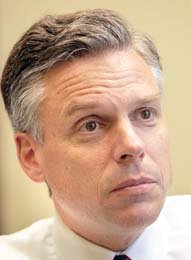
Jon Huntsman Jr. A pending bill would create an at-large seat for Utah until the 2010 Census is completed and would give the District of Columbia a House vote. But a key lawmaker wants to change the at-large element for the Utah seat and instead create four districts for the state. Huntsman told the House Constitution Subcommittee that he prefers the at-large seat as it stands in the bill now. The measure would create a fourth seat for Utah that would represent the whole state until the 2012 election. "I consider that a significant benefit, because redistricting — which is always a difficult, time-consuming and politically costly process — would be especially undesirable at this point in time, less than four years before the next decennial census," Huntsman said. House Judiciary Chairman James Sensenbrenner, R-Wis., is likely to offer an amendment taking away the at-large status and calling for four districts in Utah. His spokesman, Jeff Lungren, said the chairman wants Utahns to each have only one representative, like residents of other states, and creating the at-large seat would give each Utahn two representatives. Huntsman told the subcommittee that the bill would give Utah the additional House seat it "should have received" after the 2000 Census. The measure "rights the wrongs that were committed in the 2000 Census, benefits those who suffered most as a result of those wrongs, and does so in a way that makes sense," he said. The governor briefly outlined the state's problem with the 2000 Census, when the federal government failed to count Utah residents living abroad, most on missions from The Church of Jesus Christ of Latter-day Saints. Utah fell 857 people short to get a new congressional seat.

The census also used a counting method that the state believes violated the Constitution. The U.S. Supreme Court rejected the state's arguments in a 2002 decision. Huntsman said the court's decision diminished representation among Utah's three congressional districts, cheated the state of additional committee assignments and resulted in a loss of seniority that would have been gained had the seat been created after the 2000 Census. Del. Eleanor Holmes Norton, D-D.C., asked Huntsman whether Utah would be able to handle redistricting into four districts. Huntsman said he could not speak for the state Legislature, but some maps left over from redistricting after the 2000 Census included a possible fourth district, and could be used. Rep. Chris Cannon, R-Utah, pointed out that the state has changed since the last census, so he would hope those in charge of redistricting could use updated numbers. And if the state had to reassign districts, he added, "there is not much that can be done" to squeeze out Rep. Jim Matheson, D-Utah. "How do you draw a district in Utah that is more Republican than the one that he has?" Cannon said. House Government Reform Committee Chairman Tom Davis, R-Va., said the bill could not pass Congress without the Utah component in it. Davis and Norton gained Republican support for the bill by adding the seat for Utah, which would more than likely bring a Republican seat to balance out the District's almost certain Democratic vote. Davis said Huntsman made clear that he "doesn't want to play any games" with redistricting, if it were required. But three other witnesses at Thursday's hearing had problems with the bill. No one objected to the District getting a vote in the House, but they questioned whether creating a House seat for D.C. would violate the Constitution. "The central premise that Congress can by simple legislation create a representative for the District is wrong," said John C. Fortier of the American Enterprise Institute. "The Constitution, not Congress, has determined that the House and Senate will be made up of representatives of states and states alone. Congress can no more change the Constitution on this matter by simple legislation than it could repeal the First Amendment or allow 16-year-olds to serve as president." Fortier said the only way to truly grant voting rights to the District would be to admit it as a state, make the District part of Maryland, or amend the Constitution to allow the District to retain its current status but also grant it representation in Congress. The bill "has its heart in the right place, but it will not pass constitutional muster," Fortier said. Jonathan Turley, the Shapiro Professor of Public Interest Law at the George Washington University Law School, said the at-large element of the additional seat for Utah is also problematic, because it would bring disproportionate representation in Congress for Utahns, compared to residents of other states. "House members are expected to be advocates for this insular constituency," Turley said. "Here, residents of one state could look to two representatives to do their bidding, while other citizens would limited to one. Given racial and cultural demographic differences between Utah and other states, this could be challenged as diluting the power of minority groups in Congress." Despite criticism from the witnesses, Huntsman said he thinks it might be just a matter of weeks until the bill goes through the House and the Senate, before Congress adjourns for the year. "I sense that there seems to be an emerging coalition of the willing," Huntsman said. "By and large people are converging around this getting done."
E-mail: suzanne@desnews.com

Huntsman urges House panel to back 4th seat for Utah


Huntsman urges House panel to back additional seat for Utah
By Suzanne StruglinskiDeseret Morning News
WASHINGTON — Utah has been one voice short in Congress for the past six years, Gov. Jon Huntsman Jr. told members of a House subcommittee Thursday as he urged them to support a bill that would grant the state an additional seat in the House of Representatives. The pending bill permits a House vote for the District of Columbia and creates an at-large seat for Utah until the 2010 Census is completed. The bill's authors had wanted representation for the District and gained support for the measure from Republican lawmakers by adding the provision for an additional seat for Utah, which would more than likely add a Republican seat to balance out the District's almost certain Democratic vote. While Huntsman expressed his support for the bill, constitutional experts at the hearing had problems with the bill, saying Congress cannot just create a new voting position in the House. The majority of the witnesses' problems revolved about the District's vote. No one maintained that the District's residents should remain without a vote in Congress, but they disagreed with the means of getting the vote to them.

document.writeln(AAMB6);
document.write(''); "The central premise that Congress can, by simple legislation, create a representative for the District is wrong," said John C. Fortier of the American Enterprise Institute. "The Constitution, not Congress, has determined that the House and Senate will be made up of representatives of states and states alone. Congress can no more change the Constitution on this matter by simple legislation than it could repeal the First Amendment or allow 16-year-olds to serve as president." Fortier said the only way to truly grant voting rights to the District would be to admit it as a state, to make the District part of Maryland or to amend the Constitution to allow the District to retain its current status but also grant it representation in Congress. The bill "has its heart in the right place, but it will not pass constitutional muster," Fortier said. "It too easily glosses over the numerous textual references in the Constitution that grant representation only to the people of states." But the at-large element of the additional seat for Utah also would be problematic, according to Jonathan Turley, the Shapiro Professor of Public Interest Law at the George Washington University Law School. Turley said the at-large seat would add an additional representative of each resident of Utah, allowing them more representation than the people of the other states. "House members are expected to be advocates for this insular constituency," Turley said. "Here, residents of one state could look to two representatives to do their bidding, while other citizens would limited to one. Given racial and cultural demographic differences between Utah and other states, this could be challenged as diluting the power of minority groups in Congress." House Judiciary Chairman James Sensenbrenner, R-Wis., supports Utah getting a seat but is likely to offer an amendment to the bill that would make it a real District seat, not an at-large seat as the bill now specifies. Sensenbrenner's spokesman, Jeff Lungren, said the chairman wants Utah residents to only have one representative, in order to be equal to all the other states. It is not clear when a House committee would vote on the the bill or Sensenbrenner's amendment. Lungren said it largely depends on the House floor schedule. Despite criticism from witnesses, Huntsman said he thinks it might be just a matter of weeks before the bill would go through the House and the Senate before Congress adjourns for the year. He said before he arrived in Washington, it was about even, but after speaking with House members on Thursday it is "better than even money" that the bill will pass. He said there is a real "can-do attitude" among the members involved on the bill that "gives me a great sense of hope" it will get through. "I sense that there seems to be an emerging coalition of the willing," Huntsman said. "By and large people are converging around this getting done."
E-MAIL: suzanne@desnews.com

Thursday, July 27, 2006

Major Victory for Property Rights


Volokh has a good summary of the recent Ohio Supreme Court case Norwood v. Horney.

http://volokh.com/posts/1153959401.shtml

Excerpt:

The Ohio Supreme Court's decision in Norwood v. Horney - A Major Victory for Property Rights:
The Ohio Supreme Court's unanimous decision in Norwood v. Horney, issued today, is an important victory for property rights. It is probably the most important judicial decision on eminent domain since Kelo v. City of New London. Perhaps the most significant element of the decision is the fact that the Court went beyond banning "economic development" condemnations of the sort permitted by the U.S. Supreme Court in Kelo, and also suggested that there are state constitutional limitations on the governments' power to condemn property that is designated as "blighted." The Ohio Supreme Court has also become the 11th state supreme court to ban Kelo-style condemnations under its state constitution, a decision which largely negates the shortcomings of Ohio's woefully inadequate post-Kelo "reform" law.

Thursday, July 13, 2006

Six More Years for Orrin

Originally Posted by Scott Hinrichs
Thursday, May 05, 2005

Another Six Years For Hatch?
27 years ago I walked up the steps of the Capitol building in Washington, D.C. as part of a group of Explorer Scouts from Utah. There we met with Senators Jake Garn and Orrin Hatch. I don’t remember much of what they said, but I do remember being impressed at having the opportunity to shake hands with two very powerful politicians.Fast-forward 27 years. Jake Garn has long since retired from the Senate, but Orrin Hatch is still there. He is preparing to run for another term in that office. By the end of that term he would have served in the Senate 36 years. Is he angling to become the next Robert Byrd or Strom Thurmond? Career politicians always say the same things when they run for re-election. They need our support so that they can continue their important work, they have unfinished business, etc.Blogger Mark Towner at Utah Politics wrote, “On Saturday at the Salt Lake County convention [Senator Hatch] asked us for 6 more years to accomplish what he has not been able to accomplish in the past 30, is that likely?” He suggests that Senator Hatch’s arguments against Senator Frank Moss 30 years ago are more than applicable to Hatch today. He has served well, but he’s out of touch with the average Utahan. It’s time for him to retire and time for some new blood. Moss then. Hatch now.Towner notes that Newt Gingrich eloquently stated (in the heat of a climate that clamored for term limits) that the longer one breathes the rarified air inside the D.C. beltway, the more one becomes co-opted into the bureaucracies against which they once campaigned. They become attuned to the realities of political deals and compromises. I think it goes further than that. They begin to feel that the preservation of liberty-inhibiting institutions is actually the best way to serve their constituents.Like universities, power in the Senate derives from tenure. The more senior one becomes the more power one wields. Thanks to the kerfuffle with Arlen Spector (R-PA) becoming chairman of the Senate Judiciary Committee after the last elections, much has been said and written both pro and con about the Senate’s seniority system. Regardless of how we feel about that system, there is little chance that it will change because it provides predictability and stability, and it is the major factor upon which senators (who would have to vote to change the rules) base their careers.Since the senatorial equation seniority = power is here to stay for now, Utah is best represented by having the most senior senators possible, right? I mean, if seniority is everything in the Senate, Utah would be best served by sending Hatch back for another term, right?Towner would say that’s wrong. He says, “Senator Hatch is conflicted. Too many deals and too many years in Washington make it impossible for him to actually do what he knows to be right, but instead goes along with what will pass in the Senate.” In other words, what good does seniority do if the views of the constituency are being poorly represented? While seniority is the most important thing to a senator, it is not the primary consideration for a voter, whose first priority is how his or her concerns are being addressed.Seniority-is-everything ideologues that argue for keeping Hatch are short sighted. Towner points out a likely scenario where Senators Bennett and Hatch will retire in 2010 and 2012 respectively, leaving Utah with two freshman senators. He notes that given the average age in the Senate (and therefore the impending retirements there), Utah would be best served by sending a freshman senator now to begin gaining status for a potential leadership position instead of being left doubly low on the totem pole down the road. Towner suggests that if Orrin were more interested in Utah than in his own career he would retire next year.Is there a possibility that Utah won’t re-elect Senator Hatch? I don’t think so unless he miraculously steps aside. If you survey Hatch’s fundraising and behind the scenes preparation you can see that he’s fully prepared to mount a serious campaign. He’s not thinking at all about retiring soon.Many have argued that Hatch won 29 years ago because Senator Moss underestimated his young punk challenger, and that another young challenger could do the same to Hatch next year. I think, however, that Senator Moss failed to appreciate the change in Utah’s political landscape that took place during his tenure in the Senate. Utahans fled the Democratic Party in droves during the 60s and 70s as the party allowed itself to be taken over by secular extremists that challenged traditional morality. When Hatch argued that Moss was out of touch, it was easy for Utahans to see how Moss’ party had lost touch with their values. When Hatch offered an alternative, it was easy to dump Moss because of his party affiliation.During Hatch’s almost three decades in the Senate, Utah has become more Republican. Hatch has several factors in his favor including being Republican, incumbency (with all of its associated benefits), being active in the LDS Church, and having a weak Democratic party that is unable to offer a viable opponent. It’s not like Moss who was facing a candidate from an ascending Republican Party.Hatch is working to fend off any serious challenge from within the Republican Party. Any serious candidate needs to be doing a lot of heavy lifting now to prepare for a campaign next year. Is there anyone out there doing that? Are there any major financiers out there helping to mount a campaign against Hatch? Can anyone wrest the party’s commitments and resources from Hatch?It’s not that Utah lacks viable potential senators; it’s just that Hatch is working to clear and prepare the field so he can reap a bountiful harvest come fall 2006. I think Hatch would have to do something degrading or suffer a serious decline in health for someone to have a chance of bringing him down. Let’s face it, Utahans know and understand Orrin Hatch’s style. Many respect him and few think that he merits dumping, even if he is getting somewhat out of touch with his base. He has become a human institution of sorts.My personal preference would be to elect a new senator to replace Hatch next year. Is that likely to happen? Probably not, but I’d be happy to take a look at anyone willing to give it a serious try.

Sunday, June 25, 2006

How Congress can protect our SSN# from identity theft.


For those of us who use the internet to pay bills, order pizza, and balance our checkbooks (ok I admit it, I never balance my account, I just look to see what checks have cleared, add the outstanding amounts, and hope there is enough to clear all the checks) we all are familiar with the security code or PIN.

My suggestion for congress is to create a SSN# pin creation that will allow each social security card holder add a personal PIN to their number. Then whenever an authorized request is made for this number, you must also know the PIN. Without the PIN, the number is useless. Banks and credit cards use PIN’s all the time and folks have gotten used to the practice. College students requesting student loans must apply for a special PIN to electronically sign their applications.

I would encourage the Congress to get this solution implemented ASAP, so the millions of vets and other workers of America can feel safer about their personal, private information.

Contract OK'd for 60 new F-22A Raptors

Hatch hails vote; planes to be serviced at HAFB
By Suzanne StruglinskiDeseret Morning News
WASHINGTON — The government will be able to use a three-year contract to buy 60 new F-22A Raptors, which would be serviced at Hill Air Force Base, thanks to an amendment approved Thursday by the Senate. Entering into a multiyear contract changes the normal annual procurement the government follows, and supporters say buying the planes in bulk will help save taxpayers up to $335 million. The Senate approved the change 70-28. Utah' Sens. Orrin Hatch and Bob Bennett, both Republicans, co-sponsored and voted in favor of the amendment. Hill maintains the planes. "It's common sense that you shouldn't pay more for an acquisition than you have to," Hatch said. "Everyone agrees that the Air Force should have these 60 Raptors, and we'll save millions by buying in bulk now." Hatch said the additional planes will bring more jobs to Hill Air Force Base. "The Air Force knows that when they want a job done right, they need to come to Utah," Hatch said in a statement. "For depot maintenance, no one comes close to Hill."

Sen. Saxby Chambliss, R-Ga., offered the amendment. Lockheed Martin, the prime contractor for the plane, has a final assembly plant Georgia. The Air Force has committed to buying 122 planes. So far, 72 planes have been delivered, according to Lockheed Martin. "This is not about spending money, it's about saving money, and it's about good acquisition practices and policy," Chambliss said on the Senate floor. He said the savings could be reallocated to other programs in the Defense Department or returned to the taxpayers. He said the government knows it is going to buy the 60 planes over the next three years but the question is how it will buy the planes. He said he expects a high standard for a multiyear contract and that this contract would save the same amount of money as other multiyear contracts Congress has approved in the past. The Government Accountability Office came out with a report Tuesday saying "the Air Force has not demonstrated the need or value for making further investments in the F-22A program" and suggested delaying any further purchase of planes. It estimated the multiyear contract would cost $1.724 billion. Chambliss said the GAO report contains "frankly false factual information" and said the multiyear contract satisfies the requirements needed to be approved. Opponents, including Sen. John McCain, R-Ariz., and Senate Armed Services Committee Chairman John Warner, R-Va., said it was not the right time to enter into multiyear contracts.
E-mail: suzanne@desnews.com

Friday, June 23, 2006

A Victory for Anonymous Blogging?

Recent Events have brought this issue to the attention of Utah Bloggers. In all cases to this point that have been litigated, the person who sought the identity was a public figure. Does your right of free speech allow you to attack the credibility, or allow you to slander a non public person. Should you be able to slam your neighbor, or anyone else for that matter and call it free speech? Several test cases that may answer these questions are in the works. Below is an article by Daniel J. Solve that seems to address the issue for public elected officials.

October 08, 2005
A Victory for Anonymous Blogging
posted by Daniel J. Solove
Anonymous bloggers received a great victory this week in a case decided by the Delaware Supreme Court -- Doe v. Cahill (Oct. 5, 2005). The case involved John Doe, who anonymously posted on a blog statements about Patrick Cahill, a City Councilman of Smyrna, Delaware. Doe, in criticizing Cahill’s job performance, noted that Cahill had “obvious mental deterioration” and was “paranoid.” Cahill sued Doe for defamation.
Doe was anonymous, but his IP address could be linked to his postings, and Cahill sought to obtain Doe’s identity from Comcast, Doe’s ISP. Comcast notified Doe that Cahill was seeking his identity, and Doe immediately went to court to prevent the disclosure of his identity. The case reached the Delaware Supreme Court, which concluded that Cahill should not be permitted to obtain Doe’s identity.
The issues in this case are very important. Many of you comment here anonymously; and many comment anonymously on other blogs. Some have anonymous blogs, such as the person pretending to be Supreme Court nominee Harriet Miers on a blog or the pseudonymous “Article III groupie,” who maintains the famous blog, Underneath Their Robes. EFF has produced a manual about how to blog anonymously.
What if your identity – and those of the Miers impersonator and Article III groupie -- could readily be unmasked?
The First Amendment provides for a right to speak anonymously. It does so because without anonymity, people might be chilled in saying certain things. But what happens when anonymous speakers defame people or invade their privacy? Those injured people should be able to sue. This issue has been a difficult one for courts, which have tried to balance a person’s free speech rights to speak anonymously with the injured plaintiff’s rights to proceed with a lawsuit.
Many courts have adopted a heightened pleading standard before a plaintiff can learn the identity of an anonymous speaker. The prevailing standard is that the plaintiff must be able to present a strong enough case to survive a motion to dismiss, but that standard is relatively easy to satisfy. Only really frivolous cases will fail.
The Delaware Supreme Court adopted a different balance, one that I applaud. It requires that a plaintiff, suing for defamation, must satisfy a summary judgment standard in order to unmask the identity of the anonymous speaker. In this case, Cahill was a public figure, and to prevail in a defamation lawsuit, he had to prove that (1) Doe made a defamatory statement (damaging to Cahill’s reputation); (2) the statement was concerning Cahill; (3) the statement was published (disseminated to others); (4) others would understand the statement to be defamatory; (5) the statement was false; and (6) Doe made the statement with actual malice (he either knew it was false or acted in reckless disregard of the truth).
The Court concluded that Cahill must satisfy the summary judgment standard relating to most of these elements. That means that Cahill must show that there’s a genuine issue of material fact about these issues. In other words, he must show enough evidence to justify why he should proceed to a jury on these issues.
The Court made an exception to this rule for the sixth element – actual malice. With the other elements, they can readily be proven without knowing the identity of who said the statement. But the actual malice element depends upon the motivation of the speaker – and it is here where knowing the speaker’s identity is essential in order to determine whether the speaker had actual malice or not.
This approach strikes me as a very sensible way to balance protecting anonymous speech and allowing plaintiffs to pursue defamation lawsuits.
Posted by Daniel J. Solove at October 8, 2005 12:30 AM