Wednesday, March 22, 2006

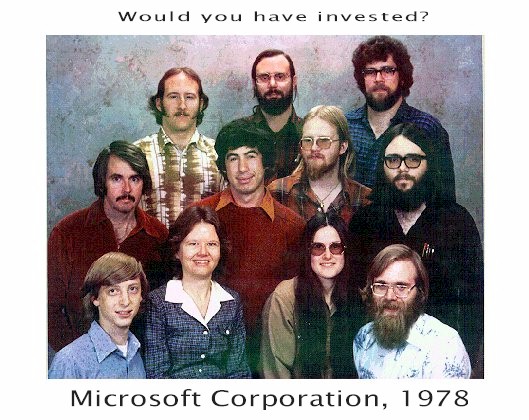
Would You Have Invested Your Money?


Check the guy in the lower left......... that's Bill Gates.
Paul Allen, the owner of the Seattle Seahawks with a net worth around $20 billion is on the far right, lower corner!!

I grew up in Seattle and started my own software company in 1980. Our Offices were on 116th in Bellevue. At that time Microsoft had some leased office space down the road. We were looking for Office space to rent and actually looked at space in the same building. I had met Bill Gates on several occasions at computer shows, and was never impressed. If I could only go back in time and had based my software on Microsoft, not CPM/MPM and Novell. Who would have guessed?

Sunday, March 19, 2006

Gay Unions open can of worms: Polygamy


Best article on the subject yet. This is my official position on the subject.

By Charles Krauthammer


WASHINGTON — And now, polygamy. With the sweetly titled HBO series "Big Love," polygamy comes out of the closet. Under the headline "Polygamists, Unite!" Newsweek informs us of "polygamy activists emerging in the wake of the gay-marriage movement." Says one evangelical Christian big lover: "Polygamy rights is the next civil-rights battle." Polygamy used to be stereotyped as the province of secretive Mormons, primitive Africans and profligate Arabs. With "Big Love" it moves to suburbia as a mere alternative lifestyle. As Newsweek notes, these stirrings for the mainstreaming of polygamy (or, more accurately, polyamory) have their roots in the increasing legitimization of gay marriage. In an essay 10 years ago, I pointed out that it is utterly logical for polygamy rights to follow gay rights. After all, if traditional marriage is defined as the union of (1) two people of (2) opposite gender, and if, as gay marriage advocates insist, the gender requirement is nothing but prejudice, exclusion and an arbitrary denial of one's autonomous choices in love, then the first requirement — the number restriction (two and only two) — is a similarly arbitrary, discriminatory and indefensible denial of individual choice. This line of argument makes gay activists furious. I can understand why they do not want to be in the same room as polygamists. But I'm not the one who put them there. Their argument does. Blogger and author Andrew Sullivan, who had the courage to advocate gay marriage at a time when it was considered pretty crazy, has called this the "polygamy diversion," arguing that homosexuality and polygamy are categorically different because polygamy is a mere "activity" while homosexuality is an intrinsic state that "occupies a deeper level of human consciousness." But this distinction between higher and lower orders of love is precisely what gay rights activists so vigorously protest when the general culture "privileges" (as they say in the English departments) heterosexual unions over homosexual ones. Was "Jules et Jim" (and Jeanne Moreau), the classic Truffaut film involving two dear friends in love with the same woman, about an "activity" or about the most intrinsic of human emotions? To simplify the logic, take out the complicating factor of gender mixing. Posit a union of, say, three gay women all deeply devoted to each other. On what grounds would gay activists dismiss their union as mere activity rather than authentic love and self-expression? On what grounds do they insist upon the traditional, arbitrary and exclusionary number of two? What is historically odd is that as gay marriage is gaining acceptance, the resistance to polygamy is much more powerful. Yet until this generation, gay marriage had been sanctioned by no society that we know of, anywhere at any time in history. On the other hand, polygamy had been sanctioned, indeed common, in large parts of the world through large swaths of history, most notably the biblical Middle East and through much of the Islamic world. I'm not one of those who see gay marriage or polygamy as a threat to or assault on traditional marriage. The assault came from within. Marriage has needed no help in managing its own long slow suicide, thank you. Astronomical rates of divorce and of single parenthood (the deliberate creation of fatherless families) existed before there was a single gay marriage or any talk of sanctioning polygamy. The minting of these new forms of marriage is a symptom of our culture's contemporary radical individualism — as is the decline of traditional marriage — and not its cause. As for gay marriage, I've come to a studied ambivalence. I think it a mistake for society to make this ultimate declaration of indifference between gay and straight life, if only for reasons of pedagogy. On the other hand, I have enough gay friends and feel the pain of their inability to have the same level of social approbation and confirmation of their relationship with a loved one that I'm not about to go to anyone's barricade to deny them that. It is critical, however, that any such fundamental change in the very definition of marriage be enacted democratically and not (as in the disastrous case of abortion) by judicial fiat. Call me agnostic. But don't tell me that we can make one radical change in the one-man, one-woman rule and not be open to the claim of others that their reformation be given equal respect.
Charles Krauthammer's e-mail address is letters@charleskrauthammer.com. Washington Post Writers Group

Wednesday, February 22, 2006

A typical day at Utah Policy Daily


Many have asked how things happen at Utah Policy. So I thought I would share with the blog world a daily routine that has been nearly perfected in two years and 400 plus editions.

The production day for UPD actually starts the night before. Publisher LaVarr Webb after putting in a normal business day for the Exoro Group (10 hours), around 10pm starts writing the Daily Buzz column. Around 11 pm, LaVarr takes a break and grabs some sleep (about six hours). Golden Webb (LaVarr’s son) who is a web serfing guru starts reading national and local newspaper headlines as these papers publish electronically. Additionally he reads over 100+ blogs and creates the National, Local, and Blog report which must be finished by 4:30am. This is then transmitted to LaVarr for his final edits and the creation of the Messages section. LaVarr get’s up at 5am to put on his finishing touches, and then transmits to the editor Paul Hollingshead. Luci Hollingshead, Paul’s wife and Lavarr’s daughter must update the UPD calendar and candidate tracking, while Paul formats the entire newsletter and publishes to the Website by 6am. Then he must create a HTML and PDA version of the newsletter which is then transmitted to our nearly 10,000 subscribers by 7am. The website is hosted and maintained by Dave Webb, LaVarr’s Brother and programming assistance from another brother Gaylen. To say this is a “web” of Webb’s is an understatement. I’m the only non family member to be included in this Swiss watch operation.

The professionalism and integrity of this family project is most refreshing. I’m honored to be a small part in the success of Utah’s best source of political and policy reporting.

Cheers,

Mark E. Towner,
Business Development Director
Utah Policy Daily

Thursday, February 09, 2006

Utah’s Second Congressional District may decide US House Majority.


The latest breakdown of the 2006 Congressional race has the Democrats pickup 14 seats!

Fifteen seats give them the majority. How does this sound: Speaker Nancy Pelosi, Chairman Barney Frank of Finance, Chairman John Conyers of the Judiciary, Chairman Skelton of Armed Services (there goes Hill AFB), and Chairman Charlie Rangel of Ways and Means.

Is it time to send Jim Matheson back to the private sector so he can spend more time with his wife and new baby?

Calculating the GOP's Troubles By Charlie Cook© National Journal .com This column was originally featured in National Journal on February 4, 2006

A year ago, with Republican victories in the 2004 elections still fresh and with President Bush's job-approval ratings still above 50 percent, Democrats' chances of capturing the House looked fairly slim. Today, however, with Bush's approval ratings hovering around 42 percent, the possibility of a Democratic takeover -- although less than 50-50 -- is very real.
Even though House Democrats need a net gain of only 15 seats this November, that task is fairly daunting because the playing field is so small: Few House Republicans are retiring, and few of the Republican incumbents who ought to be vulnerable are in districts that actually are competitive.
Nevertheless, the Democrats do have a real shot at ending the GOP's control of the House. A simple statistical model that Cook Political Report Senior Editor Amy Walter and I developed several years ago suggests that the 2006 House election will be very close.
On an Excel spreadsheet, we gave each of the 435 House districts a numerical score based on our assessment of the chances of its going Republican this November. The score is computed by taking into account a number of factors, including the historical voting patterns of that district, the caliber of this year's candidates, the strength of the campaigns, and the political atmosphere in the district. If a district looks solidly Republican, we give it a score of 1.0. If a district is rock-solid Democratic, we assign it a score of 0.0. If the parties have an equal chance of winning in a given district, we give the district a .5 score. Very few districts are in the toss-up territory; the vast majority fall close to the partisan extremes -- 1.0 or 0.0.
Adding up the probabilities of those districts ending up in Republican hands yields an overall estimate of the number of seats that the GOP will hold after the election. We then factor in a margin of error of a few seats to come up with the range of seats likely to be gained or lost by the two parties.
This method is apt to underestimate the turnover in seats if a national "wave" election materializes. But that is a danger that we can keep in mind when analyzing the data.
The current model predicts a net Democratic gain of 10 seats. When we factor in a four-seat margin of error, the model projects that as of today, under current conditions, and without speculating about what the national political environment may do between now and November, Democrats will make a net gain of six to 14 seats. With a bit of luck -- or a wave of any size -- Democrats might even grasp their gold ring: 15 seats.
To be prepared to make the most of a wave, if one occurs, Democrats need to recruit strong challengers in states where filing deadlines have not yet passed. They also need, of course, to raise plenty of money.
Republicans must continue to hold down their retirements in competitive districts, raise money, and pound Democratic challengers in those GOP-held districts where Democrats have a chance of taking over.
The not-so-secret weapon of the National Republican Congressional Committee in recent elections has been its use of money to rip into Democratic challengers and Democratic open-seat candidates early and often. Early attacks have thus enabled the NRCC to create negative impressions of those contenders before they could define themselves positively.
In the past few campaign cycles, the NRCC had enough money to go on the attack very early and very effectively. The danger for Republicans this time is that while the committee has much more money than the Democratic Congressional Campaign Committee -- $19 million at the end of 2005, compared with $15.7 million for the Democrats -- the GOP's resources might not be sufficient to douse all the anti-Republican fires that could erupt around the nation.

Will the GOP have enough money to prevail? That's the question keeping Republican strategists awake at night.

• Check out the latest changes to the House At-A-Glance chart and the Competitive Race Chart.
• Check out the latest Senate and Governors polls.

Tuesday, January 31, 2006

A Foreign Legion to Protect Our Borders?


Identification — I have been pondering recently about the Immigration proposal presented by President Bush, and how this does little to protect our southern boarders. Additionally we need the creation of a National ID / Work Card / Drivers License for all non US citizens. This would eliminate the practice of illegal aliens getting Driver’s Licenses in Utah, then moving to another state and getting a drivers License there using the Utah License as ID. Any non US citizen when pulled over for a traffic citation would present their ID card and this would alert the police that this person is not a US citizen, and they should do a little more checking before just writing a citation and letting them go. As for driving, when they can demonstrate in the state of their jurisdiction the ability to pass both a written and practical test, their ID cards would be embossed with driving privileges from that state. This must be accomplished in 90 days upon arrival to the US. This would allow tourists visiting the US to be able to rent cars while here in the US without this restriction. (Since my original post in 2004, some of these ideas have been implemented)

Border Security — I would propose the creation of a "USA Foreign Legion" run and administered by the US Marine Corps. This force would recruit foreign nationals to enlist for 4 years. After successfully completing the normal Marine Corps Training program (failure of this training program would return them to the country of origin) they would be trained for a new Horse Calvary unit that would be stationed all along the southern border. Although fully armed for any situation, these forces would be specially trained to intercept, and control border incursions using high tech non lethal measures. Those illegal aliens intercepted would be photographed and fingerprinted, then after processing they would be immediately flown by Chinook helicopter back over the border to a deportation base in Mexico. Utilizing the old US Army training manuals for the upkeep of the animals, feeding, grooming, etc will keep these troops fairly busy. After successfully serving a 4 year stint in the legion, they would be given fast track status for US citizenship. They could choose to re-enlist into the regular Army, or continue with this force. This force also could be deployed anywhere in the world for peacekeeping proposes, reserving our shock fighting forces for quick deployment. Coordinated ops with military helicopter units along the boarder directing the cavalry forces to the locations of incursion, these forces by utilizing infrared and other Military technology would finally secure our southern boarder. The benefits to the US would be a bilingual force that is familiar with the region, creates an avenue to US citizenship, and they are trained soldiers who are proud to be part of the US military. Upon honorary discharge they could enter the US civilian status with the education and tools to be successful in life.

How to Secure Air Travel — To travel by air in the United States, you should have a passport. The new generation passports should have RF ID chips and holographic pictures that can be read automatically when you go through security. Arm the pilots, X-ray all cargo and baggage and create special transponder beacon codes that airline flights are assigned that they must squawk at a designated time during the trip.

Originally Posted by on January 16, 2004 03:37 AM

Mark E. Towner, Business Development DirectorUtah Policy Dailyhttp://www.utahpolicy.com/801.502.9134

Thursday, January 26, 2006

Finally an Elected Official Gets It Right for Healthcare


Small Business Health Coverage Affordability Act
HB 122 (Rep. Mascaro)

Summary

HB 122 is designed to stimulate economic development and cover many of Utah’s working uninsured by allowing small businesses (2-50 employees) to buy-into the Public Employee Health Plan, a private not-for-profit health care trust fund. Premium costs for participating businesses will be significantly lower by virtue of the administrative efficiency, economies of scale, and community rating (pooling or spreading of risk) that are the hallmarks of PEHP.

Background

Double digit increases in health insurance premiums are threatening the competitiveness of Utah businesses and forcing many employers to drop coverage entirely. Some are shifting costs to workers, while others are thinning out the benefit package. Small business owners and their employees are particularly impacted by these challenges. Utah’s entrepreneurs should not be forced to choose between covering their workers and competing in an increasingly globalized economy.

Over the last decade premiums for employer-provided family health insurance in Utah grew 50% faster than in the US (Medical Expenditure Panel Survey). In August of 2003 employer concern about insurance costs reached a 3-year high of 42% (Kaiser Family Foundation). PEHP is able to offer affordable premiums because it has 3.8% administrative overhead costs, compared to the insurance industry average of 15%. HB 122 makes coverage more affordable for small businesses, by taking advantage of the robust purchasing power, significantly lower administrative costs, and efficient risk pooling of PEHP.
The Target Population

% of Employees in Businesses that offer health insurance by firm size in Utah, 2000-03

Source:: http://www.meps.ahcpr.gov/.

Private Sector Employees by Firm Size
Source: www.meps.ahcpr.gov/MEPSDATA/ic/2003/Tables_II/TIIB1A.pdf
…The target population is roughly 45% of 254,872. or 114,692 Utah workers. The target population would be less if there was a look-back period, (a period of time during which workers would need to be uninsured before they are eligible).

Frequently Asked Questions

How will HB 122 stimulate economic development and possibly create jobs?
Small businesses have enough to worry about meeting their bottom line. It is the intent of the legislation to encourage new business development, relocation, and expansion by making health coverage more affordable for small businesses.

Does this Initiative Create Unfair Competition for Other Insurers?
No. Since participation in the PEHP buy-in would be entirely voluntary, the program does not confer any competitive advantage to PEHP over other players in the market. Health insurance companies are always free to compete by offering more affordable or higher quality products. If anything, HB122 will promote competition based on quality and price in a vastly underserved market.

How much will HB 122 cost?
The cost should be minimal because outreach to small businesses will happen through the Governor’s new Office of Economic Development which has access to small businesses statewide. This initiative is heartily endorsed by the Vest Pocket Business Coalition, several regional Chambers of Commerce, Downtown Merchants Association, and other high-profile business associations. PEHP might need to add a few more claims processors, but otherwise they can build the buy-in into its current administrative apparatus.

Why not try a purchasing cooperative?
Utah tried to implement two purchasing coops over the last 11 years, and both failed because of low enrollment due, in turn, due to excessive cost.

Is there a precedent for groups buying into PEHP?
Yes, there are several. For over 25 years PEHP has been providing benefits for employees of the State of Utah. In addition, Salt Lake County, Salt Lake City, and dozens of other public entities and school districts within our state also offer benefits through PEHP. Today PEHP has 177,854 covered lives. In 1998, state statute was modified to permit PEHP to administer the Children’s Health Insurance Program. HB122 further modifies the statute to allow small businesses to buy into PEHP.
Small Business Health Coverage Survey Preliminary Results (n=174)

Preliminary results from a survey designed and conducted by the Utah Alliance for Health Policy Solutions and sponsored by the Governor’s Office of Economic Development show very strong support for initiatives like HB122. Key findings include:

· The average age of respondents’ (n=171) workforce was 37.2, lower than the average age for PEHP. This suggests that concerns about adverse selection are exaggerated. A younger group will be healthier and thus more likely to reduce the actuarial risk—and cost—for the rest of the pool.

· 90% of respondents (n=168) indicated that the cost of coverage impacts their businesses’ profitability, and 88% saw an impact on employee retention.
· 74% of employer respondents (n=168) said they were having trouble affording health coverage for their employees.
· 80% of respondents said that 76-100% of employees would be interested in having a health insurance benefit.

· If the employer were expected to cover 50% of a full premium cost ($300 per member, per month) for standard PEHP-like coverage, 84% of respondents indicated they would buy. 53% of respondents said they would cover 75-100% of the full premium cost. Another 39% said they would cover 50% of the premium.
· Given this level of support, 53.5% of respondents thought that 76-100% of their employees would take up the coverage. Another 24.2% said 51-75% would enroll.

Good for business, Good for Workers

Utah Premiums Paid by Workers Rising 5x Faster than Wages (2000-2004)

Change in average insurance premium
Change in Average Earnings

Utah
66.3%
13.2%

U.S.
35.9%
12.4%

Source: The Lewin Group for Families USA, 2004
Distribution of Nonelderly Uninsured by Employment data, 2002-2003.

1 Full-time Worker Part-time Worker Non-Workers
in household in household

Source: http://www.statehealthfacts.org
For further information contact Judi Hilman, Research Director, The Alliance for Health (801) 870-3887 judi@healthsolutionsalliance.org . Thanks to Nick Racker and Scott Spendlove for assisting w/data collection.

Tuesday, January 24, 2006

New Service: Roadmaps for Illegal Aliens


by Bobby Eberle , First Posted: January 24, 2006 at 7:47 am

There’s something quite mind-boggling about the ongoing debate over illegal immigration. Countless examples point to illegal aliens receiving tax-payer-funded health care, education, and other services. In some states, illegal aliens are receiving tuition discounts for colleges. In all their efforts to aid and abet these people, many left-wing groups apparently forget the “illegal” part of the equation. Now, an Arizona group is taking the illegal service industry one step further by providing roadmaps to illegals so that their travels will be easier.
According to Activists to provide migrants Ariz. maps in the Arizona Republic, a human rights agency in Mexico plans to “give out detailed maps of the Arizona desert, including rescue beacons and water stations” in order to guide “migrants” from Mexico through Arizona.

The maps were designed by a Tucson-based group, Humane Borders, which plans to hold a joint press conference today with the National Human Rights Commission in Mexico City to announce its strategy.
The maps are the latest effort by activists to aid undocumented immigrants as they trek across the border, helping to fuel a raging debate over illegal immigration in Arizona and other parts of the United States.
The problem with this plan, outside of the fact that it clearly aids in illegal activity, is that it also encourages illegal activity. It should be harder to get into the U.S. illegally, not easier. The Arizona Republic quoted Rep. J.D. Hayworth (R-AZ) as saying that “maps and water jugs do nothing but give illegal crossers false hope.”
“Either we convince potential crossers not to make the journey or, failing that, we stop them from crossing the border,” Hayworth added.
If America is serious about security, then we must be serious about putting a stop to illegal immigration. We must enforce our existing laws; we must increase the number of border patrol agents; we must invest in new surveillance technology; and clearly, we must not encourage illegal activity with complementary roadmaps to go along with defacto promises of amnesty.

Everyone Should File a Return to Enroll Their Kids


I think the following amendment should be attached to any tax reform legislation. When enrolling students each year, the parent must show proof that they have filed a state income tax for the previous year, and that ALL the kids they are registering for school must be on the return. If they have not lived in Utah for 1 year and not filed a return, then they must show proof that they filed either in another state that has income tax, or at least their Federal Income Tax return that shows the names of dependent children. Parents now must prove that their kids have had their immunizations to be enrolled, why shouldn't parents show they at least file their tax returns. I believe that everyone that works legally in Utah should file a tax return regardless of income. Many people who do not owe any taxes receive refunds or work credits. Since the funding mechanism for public education is state income tax, plus property tax, the least any parent should be required is to provide proof they actually filed a tax return. I do not think this is asking too much of anyone... I did some research on this matter today and I really think my proposal has merit. Let me state my case before you just click to the next message OK?
1. I never said any child or children would be restricted from getting an education.
2. This is how the proposal would work. When you file a tax return,(everyone who works in this state must file, it's the law folks) would be in the system as a taxpayer. The Tax Commission would simply include a certificate of compliance with the yearly tax notification. All somebody would have to do is go to the Tax Office and fill out a form to get into the system. If they don't work for a legal company that is withholding income tax, then they should be required to send in quarterly estimated tax. If they just do this much, I would have a lot less heartburn about their kids receiving a subsidized education by other taxpayers.
3. This actually could be attached to the tax reform proposal H3,which will change how we all file our taxes anyway to a small 1/2page form. They would not have to hire anyone to do their taxes, so no additional costs.
4. The parents would simply bring a copy of their Tax Compliance, along with everything else they need to register their kids. So what's the big deal? If you are reading any of this Senator Bramble, how about attaching an amendment that accomplishes this. There would be no fiscal note needed, as this would be handled by computer in the Tax Commission.
5. What’s the worst that can happen? A parent goes down to the Tax Office, fills out a form, gets a certificate and enrolls their kids. Or they say to themselves, maybe some other State would be better to call home.

Mark E. Towner

Monday, January 23, 2006

Removal of Sales Tax on Food is Dead!


January 23, 2006

Salt Lake City-Capital Hill

After speaking today with several prominent State Senators, the consensus is that sales tax on food will stay. One State Senator said “this legislation is dead in the Senate, period” I also spoke with several prominent County Commissioners and County Council Members who oppose the removal. One Commissioner I spoke with was Dannie R. McConkie, Commissioner for Davis County. He said “I’m opposed to removing sales tax on food. Most people do not understand the incredible web of intra-connections to this revenue stream. Small communities in Utah that rely on this revenue to pay bonds and provide public services would have their credit ratings lowered, costing their citizens more to borrow money for fire trucks and other community needs”.

I also spoke for some time with former Senator Garn Biography of Jake Garn. He had just addressed an education committee about the need for Utah to Invest in Science and Technology. Senator Garn is very supportive of the USTAR: Utah's Economic Development Initiative and along with ATK - ATK Thiokol ‘s Doug White said that it is critical that both primary education and teachers must receive investment of dollars to achieve the future scientists and engineers for Utah’s technology needs. ATK Doug White said they will need 122 positions filled to accomplish their task of putting men back on the moon, and on to mars. ATK recently was awarded the contract for NASA’s new manned rocket program that will replace the Space Shuttle.

Insure All Americans by 2010


We should have the goal of 100% access to insurance for all Utahans. The Bush Administration's proposed budget includes programs and financial support to advance us towards this goal. We can achieve 100% coverage through market-based solutions, private/corporate efforts, tax incentives, direct public subsidies, strong community support, and faith-based outreach programs. Personal responsibility, individual ownership, portability, and healthcare consumerism are the hallmarks of such a system.

In order for the system to work, the individual consumer must have accurate information, timely knowledge of health needs; access to the best information about how to maintain personal health; knowledge of whom to see and where to go for health services, and confidence that health providers are practicing medicine using the best practices based on the most up-to-date understanding of outcomes-based medicine. We are fortunate here is Utah because of Senate Bill 132 Sponsored by Sen. Allen M. Christensen which passed in the 2005 Legislative session. The Bill located at www.le.state.ut.us/~2005/bills/sbillint/sb0132.htm provides for a state website where healthcare consumers can see information on Health Care Issues, Patient Safety, Locate a Doctor and see what training and certifications they possess, verify a license or see if they have been disciplined, and also if needed file a complaint.

In a White Paper written for The Center for Health Transformation by Ronald E. Bachman he states the following.

"The test for a new system is to provide affordable access to quality care and financial security for all. It must work for the poorest and sickest among us. It must include preventive care, provide for early intervention, and support the maintenance of healthy lifestyles. It must encourage and reward good health and healthcare purchasing behaviours. If a movement to healthcare consumerism is to be successful, it must be for all Americans. It must provide improved products and services at lower prices. Most importantly, the 21st Century Intelligent Health System must provide access to affordable insurance coverage for those currently uninsured. No one can be left behind.

To put it simply, insuring all Americans is a moral imperative. 18,000 people die every year because they are uninsured. According to the Institute of Medicine (IOM), uninsured adults have a 25% greater rate of dying than adults with insurance. Uninsured trauma victims are less likely to be admitted to the hospital or receive the full range of needed services. They are 37% more likely to die of their injuries. A recent Health Affairs report projected that by 2013 the number of uninsured will rise from the current 45 million to 56 million lives. This means that without change, excess deaths for those without insurance will increase to over 24,000 lives per year.

Uninsured children are 70% more likely to go without care for common childhood conditions such as asthma, ear infections, and sore throats. Uninsured children are five times more likely to have an unmet need for medical care each year. The uninsured are 33% less likely to get a routine physical examination and 25% less likely to visit a doctor for an illness. Uninsured women are 36% less likely to get a pap smear, and 60% less likely to get a mammogram. Uninsured men are 40% less likely to get a prostate examination.

The ripple effects of being uninsured and having poor health are felt throughout society. Uninsured children have impaired development and poor school performance. Uninsured adults have more absences from work, more unscheduled sick days, and greater rates of disability. The 2004 Kaiser Family Foundation study found the societal costs of the uninsured to be $125 billion. Regardless of how one views the issue, the cost to society is high. Without insurance - the health, lives, and financial security of families are at extreme risk.

Eight out of 10 people who are uninsured are in working families. Almost 29 million of the uninsured in 2002 had household incomes of $25,000 or more. The great job creation machine in this country is small business. Yet, 45% of companies with 3 to 9 employees and 24% of companies with 10-24 employees do not provide health insurance. Even if you are working for an employer that offers health insurance, you may be only a pink slip away from being uninsured. With employer-based health insurance, over 38% are worried or very worried about losing their insurance.

What is new? What has happened or is about to happen that provides an historic opportunity to make affordable healthcare available to 100% of the country? Well, new laws and regulations over the past 3 years have created the foundation for transformation to a 21st Century Intelligent Health System. In 2002, the U.S. Treasury Department recognized in regulation Health Reimbursement Arrangements (HRAs) that sparked the consumerism movement. In 2003, Congress passed Health Savings Accounts (HSAs). Employers who have and are adopting these new consumerism structures have demonstrated lower costs and better outcomes.

With these advances, carriers are now developing new healthcare consumerism products at lower costs with more choices. In 2004, Aetna consumerism plans showed cost increases of only 1.5% versus increases of more than 10% for traditional health plans. Employers that offered only consumerism plans had an average decrease in premiums of 2.9%. Similarly, United Health Care showed average cost increases of less than 1% for consumerism plans. Humana, Blue Cross Blue Shield, and other health insurers are finding similar results from their new consumerism products.

Insurers and large employers have shown the way to healthcare consumerism. Now small employers and individuals are beginning to experience the benefits of consumerism. Assurant Health reports that 43% of HSA applicants were previously uninsured. Affordability is the key. 71 percent of people who bought HSAs from Assurant Health paid premiums of $100 per month or less. Golden Rule, another company offering HSAs, stated the majority of enrollees (52.83 percent) paid between $51 and $100 a month. On average, Golden Rule’s customers saved 45-55 percent on annual insurance premiums. Forrester Research predicts 24% of Americans will be covered under consumerism plans by 2010.

The Center for Health Transformation supports pushing this movement to the next level - providing affordable insurance coverage for all Americans. What is needed to achieve this long sought after goal? To reach the uninsured, government subsidies are needed that encourage personal responsibility and empower individuals to purchase private insurance. Letting everyone buy into the same free-market products will expand choices, lower costs, and improve quality. In addition, a more vibrant free-market is needed to encourage more competition, increase technological innovation, and provide creative plan designs. Insurance markets have for too long been over-regulated with stifling bureaucracies.

History has proven that laws and regulations matter. Insurers can only operate and create affordable products within the legal and regulatory boundaries allowed. The Congress and state legislatures must act swiftly to expand on the successes of healthcare consumerism.

The following Congressional actions are needed now:

Pass the Bush proposal to establish a national health insurance market that gives individuals the freedom to shop for insurance plans across state lines (through the internet or by personal agent).
Pass the Bush proposal to extend HSAs to low income Americans by providing eligible families up to $1,000 in direct contributions to their HSA, along with a $2,000 advanced tax credit to purchase an HSA-eligible High Deductible Health Plan (HDHP). Individuals would receive up to $300 in their HSA and receive up to $700 in an advanced tax credit to purchase an HDHP.
Pass the Bush proposal to make the HDHP insurance premiums for HSAs tax deductible.
Pass the Bush proposal to provide tax rebates to small businesses that contribute to their employee’s rebates (up to $500 per family or $200 for a single employee).
Pass legislation that allows 100% roll over of funds in flexible spending accounts.
Pass legislation that ensures there is no difference in coverage between mental health and other benefits in health plans that include mental health care benefits.
The Joint Committee on Taxation 10-year (2006-2015) estimates the cost for the Administration's health care proposals as follows:

Refundable tax credit for purchase of health insurance…………… $64.1 billion
Above-the-line deduction for HDHP premiums…………………... $32.8 billion
Refundable tax credit for contributions to employee HSAs…….… $20.3 billion
Total Proposed Budget Amount ………………………………………..... $117.2 billion

The following State actions are needed now:

Pass high risk insurance pool legislation, to provide subsidized protection for the uninsurable.
Eliminate any existing state premium taxes on health insurance.
Prepare for cross-state selling of health insurance plans by removing unnecessary mandates, outdated pricing restrictions, and bureaucratic costs.
Remove any existing state law and regulatory conflicts to offering flexible HSAs.
Provide for state HSA tax subsidies supplemental to the proposed federal subsidies.
Approve state tax deductibility of HDHP premiums as proposed at the Federal level.
Clearly, addressing the uninsured is about savings lives and saving money. To reach the goal of 100% coverage by 2010, the Center for Health Transformation has a long list of recommendations for hospitals, doctors, other medical professionals, employers, and insurers. While all parties must move in a coordinated simultaneous manner, new laws are needed now. The Center for Health Transformation applauds the President’s proposals and encourages Congress to immediately take action and pass the above items. States must act in concert with the federal proposals to create a vibrant and viable market place for new products. Insuring every American will save thousands of lives and billions of dollars – but we must act now if we are to succeed."

For more information about your healthcare here in Utah go to http://health.utah.gov/hda/Reports/dataplanupdate2004.PDF
For More Information about The Center For Health Transformation http://www.healthtransformation.net/home/