Wednesday, November 14, 2007

Thompson urges million-member ground force for military


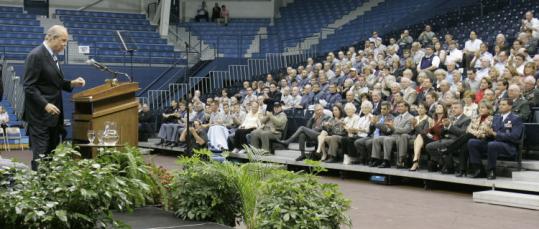
Republican presidential candidate Fred Thompson spoke yesterday at The Citadel, a military college in Charleston, S.C. Republican presidential candidate Fred Thompson spoke yesterday at The Citadel, a military college in Charleston, S.C. (Mary Ann Chastain/Associated Press)
Email|Print| Text size – + November 14, 2007

CHARLESTON, S.C. - Republican presidential candidate Fred Thompson called yesterday for a million-member military ground force and more funding to equip and care for service members and veterans.

Thompson said he wants a military ground force of 775,000 in the Army and 225,000 Marines, 23,000 more Marines than the Pentagon is seeking.

"Some would say this plan is too much and too big," Thompson said at The Citadel, a military college. "I don't believe that's the case, not at all."

Thompson didn't say how he would pay for the increase, but added that military spending should be set at 4.5 percent of the value of the goods and services the nation creates. His campaign said that would be the equivalent of increasing military spending by as much as $150 billion a year, but that those increases would be phased in and depend on economic growth.

Rudy's got the numbers


Nobody is playing the expectations game more aggressively these days than Rudy Giuliani. Usually it's the underdog who plays this game, not the big dog. In so many ways, the 2008 cycle is different.Never has a national front-runner's campaign team argued publicly that their candidate could lose the first three contests in the nomination battle and still emerge as the winner. That, however, is what Mike DuHaime, Giuliani's campaign manager, did in a conference call with reporters on Monday."Are you guys confident that you guys could perhaps go 0 in 3 out the gates and still be strong in Florida in February?" a reporter on the call asked DuHaime.
He replied, "Yes, I am confident of that."
For some time now DuHaime and other Giuliani strategists have been telling people they were pursuing a strategy unlike that used by any other candidate in recent nomination battles. This is a strategy that starts with Feb. 5, when 20 or more states will hold contests, and works backwards to the front of the calendar, rather than starting with Iowa and New Hampshire and works forward. It is also a strategy that seems on its face to prize the accumulation of delegates over momentum. For Giuliani's team, the real battle for the nomination appears to begin on Jan. 29, when Florida holds its primary, rather than on Jan. 3, when Iowa holds its caucus. DuHaime argues that Florida is the first big delegate prize of the GOP race, with 57 awarded to the winner of the state."We believe that whoever wins Florida will have a delegate count lead going into" Feb. 5, he said.DuHaime long has seen Feb. 5 as a day tailor-made for Giuliani -- a day when a number of the nation's largest states will hold primaries, including several in the former New York mayor's home region. All together, 1,038 delegates will be distributed on Feb. 5 alone. Giuliani's advisers see him as the regional favorite to rack up victories in New York, New Jersey, Connecticut and Delaware, which together will award more than 200 delegates on a winner-take-all basis. Add that to Florida and Giuliani would be a fifth of the way to the nomination.But there are more big prizes available that day as well, with allocation of delegates by the winner of a state's congressional districts. Those states include California, Illinois and Missouri, where Giuliani's team believes he is well positioned. There are other states with primaries that day -- Georgia, for example, where a southern candidate like Fred Thompson or Mike Huckabee, if they're viable at that point, would be favored. And some states like Utah where Mitt Romney has a clear edge. But on the whole, the Giuliani team likes the way the calendar sets up for them."[As] you start to do this as a delegate game and start to look at places where the mayor is very strong and look at where the other candidates are strong, this very much lines up very favorably right now for us," DuHaime said.But what about the early states? Veterans of past and present presidential campaigns doubt the Giuliani assertion that he can lose Iowa, lose New Hampshire and lose Michigan and win the nomination. What they know is that winning -- or losing -- early can have a profound effect on the shape of a nomination race.In 2000, George Bush saw what looked like an insurmountable lead in South Carolina evaporate overnight after McCain beat him soundly in New Hampshire. Bush won that primary but only after a monumental fight. Howard Dean, who was considered the presumptive nominee before Iowa in 2004 never recovered from his loss to John Kerry in that state."I am very skeptical they can lose two or three in a row and still be a front-runner," one strategist said in an email. "I think they are delusional. Yes this year is different with no logical conservative being embraced by both sides of the movement, but this is where a real campaign strategy and a little luck will pick the winner."Terry Nelson, who was political director for the Bush reelection campaign and for a time John McCain's campaign manager, said in an email Tuesday, "I do think the calendar has changed things, but that doesn't mean that the fundamental physics have been changed. Winning provides momentum. Momentum means money. And you just can't play on Feb. 5 if you don't have cash."
When I asked John Weaver, who was McCain's chief strategist, whether Giuliani's advisers were right about winning the nomination while losing the early states, he emailed back this reply: "They don't know. They hope so, I suppose. If one candidate won those three, I would say no. If it became a pile up with Romney winning one, McCain one, for example, then maybe it would be such a jumble the momentum rules wouldn't apply. But I wouldn't count on it."It's doubtful Giuliani's advisers are counting on it either. What their conference call did was attempt to build expectations for Giuliani's rivals in the early states while putting them as low as possible for the former mayor. What has been clear for some time, however, is that their strategy also aims to spring a surprise early to blunt the momentum of Giuliani's main rivals and establish him early as the one to beat.Given the fluidity of the races in Iowa and New Hampshire, that may be a shrewd strategy. Romney leads the polls in both those states. But in Iowa, Huckabee is coming on strong. Thompson has been unimpressive so far but on Tuesday got the National Right to Life Committee endorsement and has started TV ads in Iowa. In New Hampshire, McCain and Giuliani have clear strength and could cause Romney problems there.Giuliani has spent far less time in Iowa and New Hampshire than Romney and has done no television advertising. But he presumably has plenty of money to run a late blitz in those states and he has been sending direct mail pieces for some time to voters in both states. He may be less visible but he is playing seriously -- and his advisers believe he can actually win New Hampshire.What they're hoping is that, though they tout him as the national front-runner, any early victory will be treated as exceeding expectations, rather than merely meeting them. If they're clever enough to pull that off, Giuliani's Feb. 5 strategy will look brilliant. But if one of his rivals -- and Romney is right now best positioned for this -- wins the first three, the Republican race won't look like it does today. That's when DuHaime's theory will be put to the test.
--Dan Balz

Tuesday, November 13, 2007

Shanker likes peer review

4) This Week's Message from Beyond. Shanker likes peer review.

5) Nano-News. This week's infinitesimal information:

* Aunt Polly's Revenge – The executive committee of the Mansfield School Employees Association (Ohio) impeached union president Tom Sawyer in a 39-2 vote last week.

* Bad News for Kentucky Boyfriends - It's illegal in the state to encourage a teenage girl to disobey her parents.

* Royal Flush - A Las Vegas union isn't all that crazy about card check.

* Appomattox Now – Southwestern College's attempt to secede from the California Teachers Association is crushed.

* Shocker – There are provisions in Ohio teacher contracts that contradict state law.

United Federation of Non-Teachers

3) United Federation of Non-Teachers. The United Federation of Teachers in New York City celebrated surpassing the 200,000 member mark, with the induction of 28,000 home day care workers in a recent union authorization election. This makes UFT the largest union local in the nation.

The breakdown of the 201,486 members is interesting, though. Others have already noted the effect on policy of UFT's 54,000 retired members, but it's more eye-opening to see that only 118,000 (58.6%) are "in-service educators."

With enrollment falling steadily in New York City, it's conceivable we could see a future where working K-12 teachers are a minority in their own organization.

Lid Tight on AFT Disaffiliation Battle in Colorado

2) Lid Tight on AFT Disaffiliation Battle in Colorado. Last Tuesday, EIA broke a story on Intercepts about a disaffiliation attempt in Colorado that resembled a previous battle in Puerto Rico. As I wrote:

"Accounts vary, as they say in the news biz, but what isn't in dispute is that the executive council of the Colorado Federation of Public Employees (CFPE) - 1,000 members strong at last check - voted on October 20 to disaffiliate from AFT. CFPE President Jo Romero notified AFT the same day.

"An October 24 letter from AFT President Ed McElroy in response claimed the council's vote was without legal effect, since it violated CFPE's constitutional requirement to place affiliations to a rank-and-file vote, requiring a two-thirds majority.

"Additionally, McElroy accused CFPE of being at least four months behind in dues payments. He placed AFT Colorado President Dave Sanger in charge of CFPE's relations with the AFL-CIO, central labor councils, and state government.

"For its part, AFT Colorado stated, 'Most troubling are indications that an agent of an outside union may have been involved improperly in orchestrating this failed hijack attempt. The facts of the matter are being explored and will be shared as they come to light.'

"CFPE is standing fast. 'It is disappointing to learn that the AFT may be contacting CFPE members to make assertions about CFPE, its officers and council members that are simply inaccurate,' the council wrote to members."

Later in the week, CFPE issued a further denial that its decision was prompted by a relationship with any other union. "Be aware that CFPE and its members are not part of any coalition, merger or joint effort with SEIU-CAPE, AFSCME or AFT," it said.

The backdrop is an executive order signed by Colorado Gov. Bill Ritter to allow "partnerships" in which state employee organizations would negotiate with the government. It looks, acts, and quacks like collective bargaining, but all parties deny it is collective bargaining.

Two Million New Teachers Needed in the Next 10 Years! Or Is It the Last 10 Years?


Communiqué for the Week of November 12, 2007:
To subscribe to the e-mail version, simply send a request to EducationIntel@aol.com. It's all handled by human beings, not
e-mail autobots, so plain English works fine!

1) Two Million New Teachers Needed in the Next 10 Years! Or Is It the Last 10 Years? NEA Executive Director John Wilson visited South Dakota last week, prompting a local newspaper story with the lede, "The head of the National Education Association says the nation is facing an unprecedented teacher shortage, with as many as two million new teachers needed within the next decade."

Wilson, naturally, believes it is time for Americans to "step up to the plate and invest in education." But it's hard to take Wilson seriously if he really believes the situation is unprecedented, since NEA has been making the "two million new teachers in 10 years" claim for, well, almost 10 years.

Exhibit A is this September 20, 1998 op-ed from NEA President Bob Chase, who foresees a calamity as "a tidal wave of teacher retirements creates a need for two million new teachers over the next decade."

As you might expect, what constitutes a "new teacher" does not lend itself so neatly to such sound-bites, since a teacher who transfers from District A to District B is a "new teacher" for District B. Nevertheless, researchers recognize the importance of properly defining terms, and reports such as this one, excerpted in Education Statistics Quarterly, examine all the angles.

I deliberately chose it because it was written by William J. Hussar in 1999, and it is titled "Predicting the Need for Newly Hired Teachers in the United States to 2008-09." Accounting for a number of variables, Hussar concluded that America would need between 1.7 million and 2.7 million new teachers by 2008-09. He expected about 75,000 teachers per year to retire.

Now if the National Center for Education Statistics will provide me with a substantial grant, I'll be more than happy to compare Hussar's 1999 predictions of newly hired teachers with the actual numbers. However, I don't think it's necessary. Because one of two things must have happened: a) the projections were off, and so Wilson's for the next 10 years are probably also off; or b) they were correct, and somehow the United States managed to hire the required number of teachers. Indeed, it appears we did better than that, since by NEA's own accounting we have 500,000 more K-12 teachers than we had 10 years ago.

Stop Taxpayer Bailout, another S&L fiasco

I came across this website and found some of the points quite interesting.

http://stoptaxpayerbailout.typepad.com/

Is this a problem in Utah?

Around the Country?

What should be done?

Monday, November 12, 2007

Unions 2, Children 1

Unions 2, Children 1
School choice goes down to defeat in Utah.

BY PETE DU PONT
Monday, November 12, 2007 12:01 a.m. EST

One hundred eleven years ago, in 1896, the state of Utah joined the Union. Today its Legislature is focused on enacting sound policies that will help improve its education system. Its citizens, though, have a different view, for in Tuesday's referendum they voted down a very strong parental school choice bill.

Last February the Utah Legislature enacted the Parent Choice in Education Act, giving parents the option of a $500 to $3,000 scholarship, depending upon their household income, to send their child to the private school of their choice instead of the public school they are attending. Since there are 120 private schools in Utah, with an average tuition of about $4,000, the scholarships would help low-income families get the best education for their children and give Utah parents substantial educational choice.

School choice is not a new idea--there are voucher programs operating in about a dozen states--but the Utah program reflected some fresh thinking. The average cost of the scholarships would be about $2,000 a student, so lawmakers decided to increase support of the state's public schools by allowing them to keep the difference between the cost of educating each of their students--about $7,500 per child--and the scholarships when a child left their school. For each student who chose to move to a private school, his former public school would get the $5,500 difference for five years, after which it would go back to the state's education budget. Utah State University estimated this would give the public schools about $1 billion in additional funding over 13 years.

The cost of the scholarships would be paid from the state's general funds, not from state school funds or local property taxes, costing the Utah government about $5.5 million in the first year and $8.5 million in the second as more children took advantage of the opportunity to go to the private school of their choice, and up to $71 million in the 13th year.

This scholarship program would make public schools better because class sizes would be smaller and more money would be available per pupil. Education would improve, and the scholarships would help level the playing field by giving educational opportunities to families with lower incomes.

School choice and charter schools have proved very effective in improving the quality of education. Milwaukee has had a school choice program since 1990, and a 2004 study showed that vouchers students the previous year had a 64% graduation rate, vs. just 36% for the public schools. A Texas study showed that students at charter schools had a significantly higher increase in performance than their peers in traditional public schools.

And Utah has been on the leading edge of school choice for many years. An initial charter bill was enacted in 1998, challenged and then upheld by the Utah Supreme Court. In 2001 school districts were given the right to approve charter schools. In 2004, lawmakers considered a bill providing a refundable income tax credit for a family's private school expenses. It didn't pass, but the Legislature approved a study of the bill which concluded it could save the state $1.3 billion over 13 years. In 2005, a law was enacted to provide vouchers for special education students, and a school-choice bill nearly passed. When it fell short, House Speaker Greg Curtis lamented, "We do not reward excellence in education. We don't fund it, we don't demand it, and don't encourage it."

That improved with the enactment of the Parent Choice in Education statute last February, but on Tuesday it all fell apart. Utah citizens voted down the voucher plan by 62% to 38%. That is too bad--educational choices by parents for their children is an important concept--but not surprising. While there are successful school choice programs operating in Milwaukee, Cleveland and Washington, 10 state referenda on various voucher proposals have been defeated since 1972, including two defeats each in California, Michigan and Colorado.

One reason for these defeats has been the work of the teachers unions, which oppose school choice of any kind because it limits their power. Passage of the Utah school choice statute earlier this year prompted a union call to arms. The national teachers unions went to war in Utah and won.

When the choice bill was passed by the Utah Legislature last winter, Nancy Pomeroy of Parents Choice in Education enthusiastically recited the score: "Parents and Children 1. Unions and Educrats 0." Unfortunately the score flipped on Tuesday. Patrick Byrne, CEO of Overstock.com and a major backer of the measure, was bitter, saying of Utahns: "They don't care enough about their kids. They care an awful lot about this system, this bureaucracy, but they don't care enough about their kids to think outside the box."

Mr. du Pont, a former governor of Delaware, is chairman of the Dallas-based National Center for Policy Analysis. His column appears once a month.

Sphere: Related Content

Get the Raptors deployed to Elmendorf Air Force Base

Washington Watch

Hatch: Boost Raptor Fleet
Sen. Orrin Hatch leads a coalition of senators in urging the DOD "to boost the fleet of F-22A Raptors in light of the public reports on the increasingly advanced aircraft in development by foreign powers like Russia, India, and China" (see press release).

Check out This New Video

Sunday, November 11, 2007

Thank God the Teamsters Haven't Tried This


The Student Labor Action Project, known for similar stunts, held a nude march in support of living wages at the University of Vermont yesterday.

Even here, commitment to the union cause was half-hearted. Only a few of the two dozen protesters went the full monty, and then for only 10 minutes. That's not going to get the job done against those corporate university evil-doers.
|

Utah Influence Index this Week


Utah's Most Influential Political blogs

RankBlogPrev
1THE UTAH AMICUS1
2KVNU's For The People2
3JM Bell3
4Mark Towner's Political Spyglass4
5The World, According To Me6
6The Senate Site14
7Pursuit of Liberty5
8SLCSpin9
9Jeremy's Jeremiad -
10Voice of Utah -
11Utah State Democratic Party -
12The SideTrack8
13Wasatch Watcher10
14A Liberal Mormon -
15Weber County Forum16
16Davis County Watch18
17Simple Utah Mormon Politics -
18The Third Avenue7
19GenRolly Speaking11
20Utah Stories -

Put your BNN blog rank on your blog.
File 'c:\mysql\share\charsets\?.conf' not found (Errcode: 2) Character set '#33' is not a compiled character set and is not specified in the 'c:\mysql\share\charsets\Index' file

BlogNetNews' Blogosphere Influence Rating combines a variety of data sets to determine which blogs are most powerfully influencing the direction of the Utah political blogosphere. The exact method BNN uses to calculate influence scores must remain proprietary in order to prevent attempts to game the system. BNN's methodology takes into account the fact that all Internet data is profoundly limited in its reliability by using multiple data sets that, when combined, reveal a fair picture of activity in the blogosphere.

Saturday, November 10, 2007

So's Your MotherMcCain v. Giuliani gets personal


John McCain and Rudy Giuliani have had a cozy little truce for much of the presidential race. On background, the candidates and their aides tell supporters and the press why the other man can't get elected. In public, though, they've been sweet to each other. Giuliani even said McCain would be the man he'd vote for if he weren't running.

The era of good feeling was bound to disappear, since McCain's aides will tell you that much of his support drifted over to Rudy once the mayor got into the race. And now it's getting very personal very fast.

For the last week McCain and Giuliani have been engaged in a quasi-policy dispute over waterboarding. Giuliani suggested that he was sympathetic to the complexity of whether the tactic is torture, as a former prosecutor who sometimes had to use harsh interrogation techniques. McCain responded that such a careless comment about torture suggested Giuliani wasn't ready to lead the country.

http://www.slate.com/id/2177793/

GIULIANI'S 'SURPRISE' OVER MCCAIN COMMENTS

From NBC/NJ’s Matthew E. Berger
HENDERSON, NV. -- On the day of Bernard Kerik’s indictment, Giuliani faced the media and received four questions about Kerik. While the indictment’s timing had been known for days, Friday brought new attacks from Democrats and John McCain, questioning Giuliani’s judgment and leadership because of his association with his former police commissioner, now accused of tax fraud.

But when asked about McCain’s remarks, Giuliani feigned disbelief that his longtime friend -- and someone Giuliani has been careful not to criticize on the campaign trail -- had attacked his leadership.

“I'd be very surprised if John did that,” he said. “John is a very good friend. I probably have about 20 quotes from John since all of this became public ... [describing] me as a hero.”

He went on to say he believed McCain saw him as a hero, and would be surprised if he said anything on the contrary. “John prides himself on being a straight shooter and nothing has changed, and John has made all these comments since these things have come out,” he said. “I really doubt that he's changed his mind about that. I'd be really surprised if he did.”

Giuliani couldn’t have been that surprised, though. His campaign had already responded with a snarky quote from Communications Director Katie Levinson, mocking McCain for his campaign’s poor financial standing. And that was followed up by an e-mail with 12 quotes from McCain praising Giuliani. It seemed unrealistic that no one had told the candidate what McCain had said.

After eating a chicken pita sandwich and spending a long period of time chatting with the restaurant owner’s family, Giuliani seemed relaxed in relaying both his mistake in not vetting Kerik more thoroughly and his view that it was just one mistake in a long record.

“This was a mistake,” he said. “I've made mistakes. This is not the only one I've made. But if you look at the full context of the decisions I've made, and look at the amount of correct decisions, I really doubt there is anyone running for president that has the concrete results that I've had.”

He also said he did not believe the Kerik trial would be a distraction throughout the race. “No, not at all,” he said. “I think that I have a very, very long and complete public record with numerous decisions that I've made. And people evaluate you in the context of all of the decisions that you've made.”

Giuliani was careful not to comment on the trial directly, including whether or not he would be called to testify.

It did not go unnoticed that the retail stop at Crazy Pita, about 15 minutes off the Las Vegas Strip, occurred at 3:15 p.m. Pacific time, or 15 minutes before the start of network evening news on the East Coast. It allowed for Giuliani to not look like he was avoiding the media, but also to not get his reactions on the news all day Friday.

Fred Thompson's stunning error


November 8, 2007

Fred Thompson was well into a prolonged dialogue about abortion with interviewer Tim Russert on NBC's ''Meet the Press'' on Sunday when he said something stunning for social conservatives: ''I do not think it is a wise thing to criminalize young girls and perhaps their parents as aiders and abettors.'' He went further: ''You can't have a [federal] law'' that ''would take young, young girls . . . and say, basically, we're going to put them in jail.''

Those comments sent e-mails flying across the country reflecting astonishment and rage by pro-life Republicans. No anti-abortion legislation ever has proposed criminal penalties against women having abortions, much less their parents. Jailing women is a spurious issue raised by abortion rights activists.

Thompson's comments revealed astounding lack of sensitivity about the abortion issue. Whether the candidate blurted out what he said or planned it, it reflects failure to realize how much his chances for the presidential nomination depend on social conservatives.

Thompson was a former senator working as television actor when on ''Fox News Sunday'' on March 11 he made himself available for president. I started to take him seriously a month later when a religious conservative activist (call her Miss Jones because she works for a nonpartisan organization) surprised me by telling me she favored Thompson to fill a void among announced presidential hopefuls. She complained that no first-tier candidate -- Rudy Giuliani, Mitt Romney or John McCain -- fit her model and that overt social conservatives -- Mike Huckabee and Sam Brownback -- could not be nominated.

After Thompson's unannounced candidacy got off to a shaky start, I checked again with Miss Jones shortly after Labor Day. She still supported Thompson, though she seemed less enthusiastic. But Sunday's ''Meet the Press'' changed everything. ''It was the last straw,'' Miss Jones told me.

In his first question on abortion, Russert asked Thompson whether, as a candidate, he could run on the 2004 Republican platform that endorsed a ''human life'' constitutional amendment banning all abortions. ''No,'' Thompson replied, suddenly monosyllabic. ''You would not?'' ''No,'' said Thompson, adding ''that's been my position the entire time I've been in politics.'' In fact, every Republican platform starting in 1980 has endorsed such an amendment and every Republican candidate has been able to run on it.

Thompson thought better of this position after the program. His campaign manager Bill Lacy told me Tuesday that Thompson ''does not want to change the platform'' in 2008. But there was no apology for raising the criminalization chimera. Neither Thompson nor Lacy seemed to understand that what he said had antagonized the social right.

Miss Jones told me she switched off ''Meet the Press'' after Thompson's talk about jailing women. If she had continued, she would have heard him reiterate positions that previously had disturbed social conservatives: opposition to a constitutional amendment banning gay marriage and to congressional intervention to save the life of Terri Schiavo.

Thompson's performance coincided with Republican perception of weakness in Sen. Hillary Clinton as the Democratic candidate. But where will Miss Jones go? Giuliani still defends a woman's right to choose. Romney has made the switch from pro-choice, ending previous opposition to a human life amendment. Huckabee is described by one national conservative leader as a member of the ''Christian left.'' That leaves McCain as the major candidate with the clearest position against abortion.

Clinton and Giuliani: Each is What the Other Is Not

By David M. ShribmanFri Nov 9, 7:57 PM ET

Can you win your party's presidential nomination by running against someone in the other party as if she already were in the White House? Can you be nominated on your leadership qualities even if major chunks of your party's political base find your views on the issues repugnant?

These are questions that can only be asked this year and next, that can apply only to the Republican presidential race, that can be directed only at Rudolph W. Giuliani. No matter how many alternative universes there are, there very likely is no one quite like the former mayor of New York. Who else could remotely qualify as the person whom rivals consider the most dangerous man in America and whom supporters think is best suited to keep America safe?

The Rudy phenomenon -- the spectacle of a man being praised for strength in a party that disavows many of his strongest positions -- illuminates some important features of next year's election. They can be summarized in two contradictory sentences that, together, explain the political scene a year from Election Day:

(1) The entire 2008 election is about leadership qualities; and (2) the entire 2008 election is a referendum on Hillary Clinton, who isn't even president.

Ordinarily, with an economy in confusion if not upheaval and with an unpopular war being prosecuted by an unpopular president, you might think that the election would be about the sitting president. But, apart from anti-Bush barbs tossed to the Democratic masses like pieces of raw meat, President Bush is the missing man from the 2008 contest. That is in part because his vice president, Dick Cheney, isn't running for office, but it is also in part because the Bush presidency has ended before Mr. Bush's term has come to a close.

We've seen this before in modern times. Ronald Reagan was president for at least a year before he defeated Jimmy Carter, and if you doubt that for a moment, take a look at the last budget Carter proposed. The election of 1980 simply made the Reagan ascendancy legal.

Now, a few months into the post-Bush era, the two parties' nomination fights are dancing to the same tune. The soundtrack is leadership and Hillaryship.

The former New York mayor is leading the Republican pack (though by less than any GOP front-runner has led his nearest competitor since 1979) by emphasizing his leadership qualities and emphasizing that he is not Mrs. Clinton. The New York senator is leading the Democratic pack by emphasizing her own leadership qualities and is profiting from the unusual phenomenon of being the most incendiary influence in both parties' nomination battles.

The most recent poll by the Pew Research Center for the People and the Press shows that many Giuliani supporters cite their opposition to Mrs. Clinton as the main reason for backing him -- almost as many as those who cite their affinity for him.

That underlines this notion, apparent since the aborted first confrontation between the two in the 2000 Senate race in New York: They are matter and anti-matter. Love one and you hate the other. Or, more precisely: Love one because you hate the other.

Another matter of matter and anti-matter: The two candidates have reverse profiles.

Mrs. Clinton's supporters cite her stand on the issues as the biggest reason for their views. Mr. Giuliani's supporters cite his leadership abilities, not his stand on the issues. Indeed, Giuliani's views are less important to his political base than they have been for any presidential candidate in 16 years.

These two candidates need each other like the flowers need the rain. They define each other. Mr. Giuliani is intuitive; Mrs. Clinton is cerebral. Giuliani is deeply emotional; Clinton is deeply rational. Giuliani has a habit of demonizing his opponents; Clinton is accustomed to being demonized. Giuliani says he is a Red Sox fan even though he's not; Clinton says she is a Yankees fan but can't even believe that herself. She's everything he isn't. He's everything she isn't. Look for spontaneous combustion if they ever occupy the same debate stage.

They do have one thing in common: Only about half of the voters, according to the Pew survey, see the two as trustworthy.

One thing more. Both candidates have strong opponents waiting in the background if they stumble. Giuliani's is former Gov. Mitt Romney of Massachusetts, who has a credible chance of winning both Iowa and New Hampshire, which ordinarily is a formula for success. Clinton's is Sen. Barack Obama of Illinois, who lags in the polls and in the money race but not in optimism or eloquence.

Meanwhile, let's not let the rich color of the personalities involved in the 2008 race blind us to some larger events happening within both parties and within the political system.

Once again, we are faced with opposites: a Republican Party that seems to be pulling apart, a Democratic Party that seems to be pulling together. That occurs as the sitting president seems to be a bigger asset to his rivals than to his allies. And it occurs as the two parties have front-runners who are polarizing figures.

All that is a reminder that this will be an election unlike any other -- not only because of the presence of a former mayor at the front of one party (so far) and of the presence of a woman at the front of another (so far). Either of these would be important departures. But let's not lose sight of the fact that in the next year we are going to witness the shifting of all sorts of assumptions, changing not only our politics but also our country.

Copyright © 2007 Yahoo! Inc. All rights reserved.
Questions or Comments
Privacy Policy -Terms of Service - Copyright/IP Policy - Ad Feedback

Play of the Day: McCain's Mom on Mormons

Sometimes the Truth about peoples real bias comes out through their parents. I think there is more here than meets the eye, and this could spell a real problem for McCain.


MEREDITH, N.H. (AP) — John McCain's 95-year-old mother, in a swipe at her son's rival Mitt Romney, said Friday that Mormons were to blame for the scandal that rocked the 2002 Salt Lake City Olympics.

During an appearance on MSNBC, Roberta McCain laid out why her son, John, deserves to win the Republican presidential nomination. But in evaluating McCain's primary rivals, she criticized Romney's Mormon faith and his time in Salt Lake City.

"As far as the Salt Lake City thing, he's a Mormon and the Mormons of Salt Lake City had caused that scandal. And to clean that up, again, it's not a subject," Roberta McCain said.

John McCain quickly stepped in: "The views of my mothers are not necessarily the views of mine."

"Well, that's my view and you asked me," Roberta answered.

The Salt Lake Organizing Committee had enticed International Olympics officials with lavish gifts and accusations of bribery mired the Games in scandal while resignations sullied the region's reputation.

Utah officials tapped Romney to lead the effort and as president and CEO of the organizing committee he pared the budget, boosted revenues and worked to repair the committee's reputation.

A Romney campaign spokesman said the McCains made a mistake.

"I would disagree with any candidate or any campaign surrogate that chooses to disparage someone based on the faith that they hold, and instead implore other candidates and their campaigns to make a case to voters based on the important issues facing the nation," said Kevin Madden.

Roberta McCain immediately apologized to her son.

"I didn't mean to say it," she said as they stepped away from the cameras.

McCain told The Associated Press after the interview that his mother misspoke.

"Mormons are great people and the fact that Mitt Romney is a Mormon should play no role whatsoever in people's decision," McCain said.

"What she meant was the Olympics were screwed up by the people in Salt Lake when Romney came in and fixed the problems there. But I know my 95-year-old mother is certainly in favor of Mormons."

Compiled by Philip Elliott.

Friday, November 09, 2007

Battle Won. Pillaging Begins.


Having handily defeated the voucher referendum, the Utah Education Association and its allies want to get their hands on the money the state legislature had budgeted for the program.


The money resides in the general fund - put there purposely so that opponents couldn't claim vouchers would reduce funding to public schools (they did anyway). Now the debate is on whether to spend the general funds for general purposes or to drop the spoils into the K-12 bucket.

The Daily Herald quotes Kirk Jowers, director of the Hinckley Institute of Politics at the University of Utah, as saying failure to deliver the tribute "would really be seen as sour grapes."
|

Coming Up on 'FOX News Sunday': Bill Richardson and John McCain

FOXNews.com

Friday , November 09, 2007

By Chris Wallace

FC1

Our guests this week include:

• Gov. Bill Richardson, D-N.M., presidential candidate
• Sen. John McCain, R-Ariz.

We’re just under two months away from the first in the nation caucuses in Iowa and beginning the process of determining the nation’s next president. As the race heats up, "FOX News Sunday" continues its ongoing series “Choosing the President.”

This week, we start with one hopeful that a columnist named the Democratic candidate with the most appealing resume. He’s a former congressman, ambassador and secretary of Energy. And now he’s the sitting governor of New Mexico. Democratic presidential hopeful, Bill Richardson, is live only on "FOX News Sunday."

Then we bring you someone from the other side of the aisle with another storied career: Vietnam War hero, prisoner of war, former congressman and now sitting senator for Arizona. How can the comeback kid put himself back on top? We’ll ask Sen. John McCain, live, only on "FOX News Sunday."

Clinton and Giuliani took a few hits this week — our panel will discuss how the two frontrunners weathered the storm. They will also go into the increasing turmoil in Pakistan. Joining us will be Juan Williams and Mara Liason of National Public Radio, Bill Kristol of the Weekly Standard and Brit Hume, Washington managing editor of FOX News.

Plus, our Power Player of the week: White House Social Secretary Amy Zantzinger takes us behind the scenes of the White House Dinner with French President Nicolas Sarkozy.

So check your local listings and we'll see you on the next "FOX News Sunday."

McCain Gets Outside Help As Polls Rise


WASHINGTON (AP) — Republican John McCain, climbing in polls but lagging in money, is negotiating a $3 million loan while some of his backers launch an independent advertising effort seemingly at odds with his years of fighting outside influence in campaigns.

The steps under way inside and outside the campaign indicate a degree of urgency as the first nominating contests draw near and as McCain shows signs of resurgence after a dismal spring and summer.

Campaign aides said they hoped to finalize arrangements within days for a line of credit of about $3 million to help pay for expenses as well as for ads, mailings and other means of voter contact. The campaign also is considering taking public matching funds, but some aides fear the attached spending limits could hinder McCain if he does secure the nomination.

Separately, a newly created group was airing an ad Friday in South Carolina that portrays the Arizona senator and two of his congressional allies as "leaders who share our priorities" of supporting funds for U.S. troops and opposing pork-barrel spending.

Financed mainly by McCain backers, the Foundation for a Secure and Prosperous America was created with the help of Republican admaker Rick Reed. He called himself a volunteer with McCain's presidential effort earlier this year, and he is close to McCain's campaign manager.

McCain wrote a strict 2002 campaign finance law and has criticized independent advertising in the past. His aides said they had no knowledge of or involvement in any outside efforts.

Reed is not new to independent advertising efforts during presidential campaigns. He was the media strategist who co-produced a series of ads in 2004 by the Swift Boat Veterans for Truth, who questioned Democratic nominee John Kerry's service in Vietnam. McCain, at the time, condemned those ads.

The new group, a 501(c)4 nonprofit corporation under IRS regulations, is not required to disclose its donors, unlike political campaign and political action committees the Federal Election Commission covers.

Reed would not disclose how much has been raised or the identity of donors. Asked if they were McCain supporters, he said, "Some are, maybe even all at this point."

He said the group is designed to promote a strong national security, limits in spending and vigorous anti-terrorism efforts while identifying leaders who best reflect the group's positions.

"Right now Senator McCain seems to be the closest to the group's views," Reed said. Others, he said, include South Carolina Sen. Lindsey Graham and Arizona Rep. John Shadegg; both appear in the first ad and both have endorsed McCain.

A disclaimer at the bottom of the group's Web site states: "As a qualified nonprofit organization, Foundation for a Secure and Prosperous America may on occasion use some of its funds for political purposes such as supporting or opposing persons who happen to be candidates."

Said McCain spokeswoman Jill Hazelbaker: "The McCain campaign does not coordinate with any outside groups that are making or planning to make independent expenditures in the presidential election."

The campaign paid Reed's firm $1,690 in May for what aides said was archival McCain footage from the 2000 campaign that was in the firm's possession. Aides said the firm has provided no services for McCain's 2008 bid.

Reed's effort could be the first of several independent ventures that could help McCain. Other supporters and donors have been discussing how to expand his advertising reach in key early nominating states. Backers of other presidential hopefuls also are contemplating independent efforts to boost their candidates.

Such steps allow major fundraisers and donors of candidates who have already given the maximum allowed by law to individual campaigns to assist their candidates by putting money into other entities.

By organizing itself as a nonprofit 501(c)4 organization, the Foundation for a Secure and Prosperous America can raise unlimited amounts of money for its ads without disclosing its donors or details of its spending. Under Internal Revenue Service regulations it can engage in political activity provided that is not the sole purpose of its existence.

The ad does not mention McCain's candidacy, but it does show pictures of him and flash his name. Broadly, the ad focuses on promoting military funding legislation in Congress and calling on viewers to urge Congress to approve.

Any independent ad campaign has to be unaffiliated to the McCain campaign and organizers would be prohibited by law from discussing their plans with McCain or his staff.

Reed said the group is abiding by the law, and that he had not spoken with the campaign since his firm ended an affiliation with it early this year.

Still, such a separate organization could undermine McCain's image as a campaign finance reformer by creating the appearance that McCain backers are exploiting loopholes in the law.

McCain was one of the authors of a 2002 campaign finance law that ended the ability of national parties to collect unlimited contributions known as soft money. McCain also has criticized the emergence of other nonprofit groups, known as "527" organizations, that have skirted campaign finance laws and raised millions in unlimited money from wealthy donors.

"On the one hand, he's obviously always been a strong proponent of campaign finance reform," said Dan Schnur, a Republican strategist who worked on McCain's 2000 campaign but who is unaffiliated now. "On the other hand, I know he doesn't believe in unilateral disarmament either."

McCain is considering accepting public matching funds for his campaign. At this point, he would be eligible for $5 million, but aides said McCain has made no decision on whether to seek the money. McCain is the only Republican at the top of the presidential field who has taken steps to obtain the public funds. By accepting the money, McCain would have to restrict his spending in primary states, placing him at a potential disadvantage against better-financed rivals.

Once considered the GOP front-runner, McCain found himself all but broke and languishing in polls at summer's end. As fall began, his fortunes improved, and he now senses opportunity, particularly in New Hampshire and South Carolina.

The compressed primary calendar has increased pressure on his campaign to capitalize on his improved standing — and spend heavily on television ads. The Iowa caucuses are scheduled for Jan. 5 and could be followed promptly by the New Hampshire primary. Michigan is considering holding a primary Jan. 15, followed by South Carolina on Jan. 19.

McCain ended the third quarter of the year with $3.5 million, $1.7 million of which was available for the primaries. He also reported a debt of $1.7 million.

He's been running ads in New Hampshire, recently expanding to the expensive Boston market, but he has been unable to afford to go on the air in South Carolina, though advisers say he will soon. The campaign is also conducting direct mail campaigns in Iowa and New Hampshire.

Aides and fundraisers for McCain said donors are beginning to open up their wallets again and the campaign is raising money faster than it is spending it.

Aides said the line of credit would be secured by campaign assets and would give the campaign more flexibility. As opposed to an outright loan, a line of credit would permit the campaign to use part of the amount, depending on its needs.

"We don't have to do it. We think it would improve our competitiveness if we do it," said Rick Davis, McCain's campaign manager. "This helps us manage the cash flow."