Friday, October 27, 2006

Yikes, GOP on the Ropes? Repeat of 1994?


Poll: Middle class voters abandoning GOP
By LIZ SIDOTI and TREVOR TOMPSON, Associated Press Writers 1 hour, 30 minutes ago
WASHINGTON - The 2006 election is shaping up to be a repeat of 1994. This time, Democrats are favored to sweep Republicans from power in the House after a dozen years of GOP rule.

Less than two weeks before the Nov. 7 election, the latest Associated Press-AOL News poll found that likely voters overwhelmingly prefer Democrats over Republicans. They are angry at
President Bush' name=c1> SEARCHNews News Photos Images Web' name=c3> President Bush and the Republican-controlled Congress, and say
Iraq' name=c1> SEARCHNews News Photos Images Web' name=c3> Iraq and the economy are their top issues.
At the same time, fickle middle-class voters are embracing the Democratic Party and fleeing the GOP — just as they abandoned Democrats a dozen years ago and ushered in an era of Republican control.
"I don't think the Republican Party represents what I stand for. The guys I golf with, we're in the middle class, we're getting hurt," says Joseph Altland, 73, a retired teacher in York, Pa. He is a registered Republican but says he is considering becoming an independent.
The AP-AOL News telephone poll of 2,000 adults, 970 of whom are likely voters, was conducted by Ipsos from Oct. 20-25.
In it, 56 percent of likely voters said they would vote to send a Democrat to the House and 37 percent said they would vote Republican — a 19-point difference. Democrats had a 10-point edge in early October.
"I don't care if I vote for Happy the Clown, just so it's not who's there now," said Mary Nyilas, 51, an independent voter from Cologne, N.J. She said she would do everything she could to "vote against the powers that put us in this situation" in Iraq.
In the minority, Democrats need to gain 15 seats in the House and six in the Senate to win control of Congress. They are arguing for a change in leadership and trying to tap into intense public anxiety about the Iraq war as well as discontent with Bush and the Republicans in charge of the House and Senate.
The 2006 election has been likened to 1994, when backlash against the controlling party — then the Democrats — triggered the election of new rulers — in that case, the Republicans.
On Thursday, House Speaker
Dennis Hastert' name=c1> SEARCHNews News Photos Images Web' name=c3> Dennis Hastert, R-Ill., dismissed talk of a sour outlook for the GOP and cited signs of a strong economy. "Things are looking pretty good, and I don't think anybody would really want to change that at this time," he said in Aurora, Ill.
One of Hastert's lieutenants, Rep. Philip English (news, bio, voting record), R-Pa., said that while he senses "a strong anti-Washington blowback ... the conclusion that, therefore, this is going to be an election like '94 or that control of Congress is likely to shift, I don't think is warranted yet. I think this is gong to come down to the wire."
Unlike in 1994 when the GOP offered a policy platform, English said, Democrats "seem unable to unite behind a common theme."
Democrats say history is on their side.
"Every decade, the American people at some point get angry at Washington for the course they've chosen and the results of that course," said Rep. Rahm Emanuel (news, bio, voting record), the head of the House Democrats' campaign effort, rattling off various election years and circumstances that infuriated voters in each.
This year, he said: "it's a failed strategy in Iraq and a failed economic agenda here at home, and that's what this election is about."
Overall, the picture looks bleak for Republicans.
Likely voters have low opinions of both Bush's job performance and that of the GOP-controlled Congress. The president's approval rating is at a dismal 38 percent while Congress' is even lower — 23 percent. Two-thirds of adults say America is on the wrong track.
"The country's in a big, big mess," said Cynthia Leininger, 44, a homemaker in Wilson, N.Y., who says she leans toward Democrats. "I'm looking for change."
Voters have grown increasingly angry at the Bush administration and Republican leadership in Congress throughout October.
Only 12 percent of likely voters say they are enthusiastic about the administration. The percentage of those who say they are angry with it has grown to 40 percent from 32 percent in early October. As for the GOP-controlled Congress, 32 percent of likely voters call themselves angry, up from 28 percent.
Groups of voters who grew more angry throughout the month include: women, minorities, liberals, moderates, Democrats and people who voted for Sen.
John Kerry' name=c1> SEARCHNews News Photos Images Web' name=c3> John Kerry, D-Mass., for president in 2004.
In 1994, exit polls found that a majority of voters were dissatisfied with the federal government, with two in 10 reporting they were angry. Voters now are twice as likely to be angry at the current administration.
The AP-AOL News poll shows Democrats remain tied with Republicans on who would best protect the country, but Democrats have a 15 percentage point advantage on which party would best handle the situation in Iraq.
On that front, nine in 10 likely voters call Iraq a very or extremely important issue to them personally, pushing it to the top of a list of topics voters care deeply about.
"I'm just not seeing a lot of progress," frets Kimberly Froeschner, 34, a GOP-leaning independent in Raleigh, N.C. She said she has grown frustrated with Iraq in the past year and feels "it's more about oil."
Aside from the level of voter anger, the other dynamic that invites comparisons to 1994 is the attitude of middle-class voters — those earning less than $75,000 a year and who have graduated high school or have some college education.
In 1994, these voters deserted the Democrats in droves, helping Republicans capture dozens of Democratic-held House seats to seize control for the first time in decades.
Democrats recovered some of that lost ground in the following years, but they never fully regained their grasp on the middle class. In the intervening midterm elections, Democrats and Republicans split the House vote among middle-income and middle-education groups.
This fall, however, the AP-AOL News poll shows that Democrats have an advantage — in some cases in the double digits — among middle-class voters.
A majority of middle-class voters now favor Democrats to control the House and say that Democrats best represent their most closely held beliefs. They trust Democrats more than Republicans to handle the situation in Iraq, which most of them view as a mistake. The war is this voting group's most important issue. The economy and health care are close behind.
Like voters of all stripes, the middle class is angry with Bush and GOP leaders on Capitol Hill — and these voters could take out their fury out on the controlling party at the ballot box as they did in 1994.
The poll has a margin of error of plus or minus 2 percentage points for all adults and 3 percentage points for likely voters.
___
Associated Press writers Will Lester and Kasie Hunt, and news survey specialist Dennis Junius contributed to this report.
___
On the Net:
Ipsos: http://us.rd.yahoo.com/dailynews/ap/ap_on_el_ge/storytext/election_ap_poll/20737691/SIG=1104qgugc/*http://www.ap-ipsosresults.com

Thursday, October 26, 2006

Lohra Miller broke no law, prosecutors decide


By Leigh DethmanDeseret Morning News
The Republican candidate for Salt Lake County district attorney didn't break any laws by accepting third-hand campaign contributions from a property management company, a team of government prosecutors found.

Lohra Miller The prosecutors from the district attorney's and attorney general's offices ruled Wednesday that Lohra Miller did nothing illegal by accepting money from Wasatch Property Management employees even though there were accusations that the donations were forced. Former employee Shauna Hardy said she was one of 12 employees who allegedly received $2,000 bonuses and then were ordered to sign the cash over to Miller's campaign fund. Miller, who has claimed she was always open about contributions and did nothing illegal, said the ruling is vindication. "I hope that this is the end of the dirty campaigning, so now we can go back to focusing on the important issues of this race," Miller said. "I hope the voters can see this for what it is — it's just dirty campaigning just before the election." The investigation started after former University of Utah law professor John Flynn filed a complaint asking the district attorney to determine if the proxy contributions violated the law. County law says donors cannot make a contribution with someone else's funds. If elected officials knowingly accept the money from a contractor who works for the county, they could be charged with a class-B misdemeanor. After Flynn's complaint, the question of who should investigate seemed difficult. The problem was Attorney General Mark Shurtleff backs Miller, while District Attorney David Yocom is endorsing her Democratic opponent, Sim Gill. Both Shurtleff and Yocom declined to investigate, because of the obvious conflicts of interest, said Paul Murphy, spokesman for the Attorney General's Office. Instead, their respective staffs did the work.

The team of prosecutors said that since Miller is not an elected official and Wasatch Property Management does not have a contract with the county, no crime was committed. "Since the action complained of is not a crime, and further action would unnecessarily expend public funds investigating a matter that has no basis for prosecution, this concludes the matter for both prosecutors' offices," the attorneys wrote in a joint statement. Even so, Flynn said he still believes Miller and Wasatch Property Management violated the spirit of the law. "I think any voter would like to know who is paying for the campaign of the various candidates on the ballot," Flynn said. "If people hide contributions by playing games like this, I think that's inappropriate." To avoid problems like this in the future, Flynn said Utah campaigns should be publicly financed. Wednesday's ruling also clears Wasatch Property Management of any criminal liability, since the company does not have a contract with the county. Wasatch Property Management officials, including chief executive officer Dell Loy Hansen, did not return phone calls seeking comment. Matt Burbank, a political science professor at the University of Utah, said the incident illustrates why the district attorney's office should be nonpartisan. Both Miller and Gill agree. They said they believe a system needs to be set up to avoid the slightest appearance of political bias in cases requiring an investigation of elected officials or candidates. The two candidates, however, have different ideas on how to achieve that. Miller wants the Legislature to set a statutory procedure that district attorneys must follow in cases where political bias might come into play. She said the law should clearly spell out when a district attorney should be removed from a case, as well as what a conflict of interest is for the county's top prosecutor. Sen. Mark Madsen, R-Lehi, sponsored a bill in the 2006 legislative session that would have done just that but withdrew the bill and instead sent it to an interim study committee. "We can make a change beforehand, before the issue comes up," Miller said. "We've got to remove politics out of the office entirely." Gill said he wouldn't wait for the Legislature to take action. He said that within 90 days of taking office, he would set up a bipartisan advisory board made up of former judges and lawyers "that I hope I will never have to call upon." The board would review evidence and recommend whether the district attorney should file charges against an elected official. "It would establish integrity and trust for that office," Gill said of the board. "Politics absolutely has no place at the district attorney's office — period."

What if Democrats Win? Spotlight on Telecommunications

By David Hatch, CongressDaily© National Journal Group Inc.Tuesday, Oct. 24, 2006
This is the seventh in a series of articles exploring the impact on key committees and issues if Democrats win control of the House and Senate in November’s elections.
For some insight into Congress’ approach to telecommunications policy under a Democratic House and Senate, look no further than FCC Chairman Kevin Martin’s schedule. The nation’s top communications regulator, a Republican, is rarely summoned to Capitol Hill by the GOP, and when he is, the circumstances are never hostile.
The FCC's Kevin Martin should start bracing for regular trips to Congress -- and for Dingellgrams.

But that would change with Democratic control, congressional and industry sources said. The Senate Commerce Committee, under Sen. Daniel Inouye, D-Hawaii, and the House Energy and Commerce Committee, under Rep. John Dingell, D-Mich., would closely scrutinize the agency’s actions, they said. That means Martin should start bracing for regular trips to Congress and for Dingellgrams, the Michigan lawmaker’s legendary queries. There would also be major changes in pending telecom overhaul legislation, assuming it is not approved during the lame duck session, when Sen. Ron Wyden of Oregon and other Democrats will try to block it.
Whether Inouye and Dingell would pursue comprehensive telecom overhaul legislation or a series of smaller measures is unclear. Most sources think they would retain portions of the pending bills sponsored by Senate Commerce Chairman Stevens and House Energy and Commerce Chairman Barton. But it is uncertain whether nationwide video franchise relief for the Bells -- the central tenet of the GOP bills -- would survive. If it does, Democrats would seek to couple it with consumer protections. Nationwide agreements would make it easier for AT&T and Verizon to enter the video programming business and compete with cable. Complicating the picture is whether the Bell companies, the major driver behind the GOP legislation, will be at the table next year. They are hinting they won’t be because they have secured several statewide video franchises.
But some suggest the Bells will not be satisfied with a hodgepodge of state regulations and are bluffing to win passage of the pending legislation in the lame-duck session. One Democratic staffer said Dingell would keep close tabs on the FCC’s court-ordered review of its media ownership rules, promote broadband deployment and revamp the massive universal service fund, which lowers telecommunications costs for rural residents and those with lower incomes. Inouye’s office declined comment.
Democrats also are expected to ratchet up their demands for network neutrality safeguards designed to prevent telecom and cable giants from potentially dominating the flow of content on the Internet. Stevens has blamed a controversy over the issue for stalling his bill. But killing legislation lacking net neutrality might prove easier than passing a bill containing it. To that end, Democrats in both chambers must seek common ground with the opposition and industry to get anything done, observers say. That is particularly true in the Senate, where Democrats would face the same hurdle that Stevens faces: corralling 60 votes to fend off filibusters.
While Dingell historically has had strong ties with the Bells, he has been critical of Barton’s bill, which is considered favorable to the companies. The Michigan lawmaker is close friends with Stevens, but a Democratic aide said that would not affect his positions if the GOP holds the upper chamber and Stevens remains in charge of the Senate panel.

What if Democrats Win? Spotlight on the Judiciary

CONGRESSDAILY SPECIAL REPORT: WHAT IF DEMOCRATS WIN? Spotlight On The Judiciary
By Bill Swindell, CongressDaily© National Journal Group Inc.Monday, Oct. 23, 2006
This is the sixth in a series of articles exploring the impact on key committees and issues if Democrats win control of the House and Senate in November’s elections.
A decade-long push to overhaul the tort system to make it harder for consumers to sue businesses will likely come to an end if Democrats take control of the House or the Senate. Led by the U.S. Chamber of Commerce, business lobbyists have successfully pushed through an overhaul of class-action suits, changes in the bankruptcy system to make it harder for borrowers to escape paying debts, and limits on shareholder lawsuits. As a critical ally to the Democratic Party, the trial-lawyer lobby wants the “tort reform” campaign curbed. If the trial lawyers have their way, that campaign would be replaced by a greater focus on efforts to protect the rights of Americans to have their day in court, especially against mandatory arbitration clauses that restrict a consumer’s ability to sue such entities as a creditor, insurance company or loan provider.
The Chamber of Commerce would not view a Democratic takeover of Congress as an end to its effort to limit abusive lawsuits, a Chamber official says.

“Consumer groups, not just lawyers, are concerned about [this]. It is a fairly standard practice now to get consumers to sign away their legal rights through a mandated system of arbitration,” said Travis Plunkett, legislative director for the Consumer Federation of America.
Consumer groups and trial lawyers also are asking that Congress explore removing the antirust exemption for the insurance industry, which was established under the 1945 McCarran-Ferguson Act. Senate Judiciary ranking member Patrick Leahy, D-Vt., who would become Senate Judiciary chairman if his party rules the Senate, has previously sponsored legislation that would repeal the exemption for medical malpractice insurance. Leahy argued that under the antitrust exemption, insurers can collude to set rates and prevent free-market competition.
“Why not apply the competition statutes to the business of insurance,” said Linda Lipsen, senior vice president for public affairs at the Association of Trial Lawyers of America. “We saw the mess that emerged following Katrina. It is the only consumer product that when you need it, it might not be there.”
But the Chamber would not view a Democratic takeover of Congress as an end to its effort to limit abusive lawsuits that it says harm the U.S. business climate. Lisa Rickard, president of the Chamber’s Institute for Legal Reform, noted that Judiciary Committee Democrats including Sens. Dianne Feinstein of California, Herb Kohl of Wisconsin, and Rep. Rick Boucher of Virginia, have backed previous efforts to curb plaintiff lawsuits. Rickard contends those lawmakers could work with moderate Republicans to craft measures that would have enough support to pass in a Democratic-controlled chamber.
In addition, Leahy has shown some flexibility for bipartisan compromise, working with Senate Judiciary Chairman Specter on legislation that would provide compensation to those who suffered health problems as a result of asbestos exposure. That measure died in the Senate earlier this year amid disputes between insurers, trial lawyers and labor unions. “[House Minority Leader] Pelosi’s been pretty vocal how she hopes to have an inclusive bipartisan approach to their agenda. We’re hopeful that we can take that at face value and that would include the areas in the litigation arena that need to be examined,” Rickard said.
She added that bipartisan support is emerging to nullify a recent Justice Department policy to seek waivers of attorney-client privilege from corporate executives in boardroom criminal investigations.
On another subject matter, Democrats are likely to push for an overhaul of the nation’s patent system to make it easier for high-tech and financial services firms to protect and obtain patents, though pharmaceutical companies are resisting such widespread changes. Leahy has sponsored legislation with Sen. Orrin Hatch, R-Utah, that would streamline patent litigation by limiting the defense of a willful infringement or “inequitable conduct” cases, in which a patent is challenged because the holder did not operate in good faith in its application to the Patent and Trademark Office.
In the House, Rep. Howard Berman, D-Calif., would take over the chairmanship of the Judiciary Courts, the Internet and Intellectual Property Subcommittee. He would look to protect his nearby Hollywood interests by cracking down on piracy and protecting against copyright infringement of TV, music and movie productions.

What if Democrats Win? Spotlight on Finance

By Bill Swindell, CongressDaily© National Journal Group Inc.Friday, Oct. 20, 2006
This is the fifth in a series of articles exploring the impact on key committees and issues if Democrats win control of the House and Senate in November’s elections.
If the Democrats win a Senate majority next month, Sen. Christopher Dodd of Connecticut will take the helm of the Banking Committee as Banking ranking member Paul Sarbanes of Maryland retires. The change will be noticeable: Sarbanes takes a cautious, almost scholarly approach to crafting bills and is not known as press friendly. By contrast, Dodd is one of the more quotable members of Congress, with a keen eye to looking out for his home state’s interest while willing, at times, to buck his party.
Dodd has sided against his party at times in favor of business interests -- but also has a populist streak in protecting consumers and investors.

A Dodd chairmanship would be a boon to the insurance industry as Connecticut is home to such companies as Aetna, The Hartford Financial Services Group and W.R. Berkley Corp. Dodd has been a leading proponent for the federal government’s terrorism risk insurance program, which expires at the end of 2007, and is expected to be an advocate for continuing the federal backstop despite opposition from the White House that favors a free-market approach.
Dodd also has sided against his party at times in favor of business interests. For example, he backed a 1995 law that restricted shareholder lawsuits against public companies, which cleared despite a veto from President Clinton. The U.S. Chamber of Commerce contends trial lawyers are attempting to skirt the law and that further changes are needed. Dodd has said the Banking panel should hold a hearing on the issue. But he also has a populist streak in protecting consumers and investors, such as introducing legislation prohibiting deceptive lending and credit card marketing practices.
“It would do away with a lot of most abusive practices that consumer groups have seen. He’s been clear that he’s been very concerned about credit card industry practices,” said Travis Plunkett, legislative director for the Consumer Federation of America.
In the House, Rep. Barney Frank of Massachusetts would become chairman of the Financial Services Committee. While Frank has burnished a reputation of a liberal who is eager to battle conservatives in debate on the House floor, on the panel he has worked in a mostly bipartisan fashion with Financial Services Chairman Oxley. Frank wants to continue such tradition, though with a focus on some issues that have not received as much attention under GOP control, specifically housing issues. Frank said he would work with Rep. Charles Rangel, D-N.Y., who would take over the chairmanship of Ways and Means, to expand low-income tax credits and better coordinate federal programs to boost affordable housing units.
“Right now, if you want to do affordable housing, there is some production through the affordable housing tax credit and there are some other programs, but you really have to twist yourself into knots to make them work together,” Frank said. He also said Democrats would fight to preserve the number of federal housing vouchers, complaining that federal rules are often too punitive.
Frank also has expressed interest in bringing more oversight to the trillion-dollar hedge fund industry. He has sponsored legislation that would authorize the registration and monitoring of hedge funds, reversing a recent federal court decision that barred SEC efforts to regulate the industry through its own rulemaking. He also has been a leading proponent of reining in industrial loan companies, which are state-chartered banks that offer limited financial services but are not subject to Federal Reserve supervision. Critics complain that the growth of the industry, especially bids by Wal-Mart and Home Depot to acquire their own ILCs, poses a safety and soundness risk to the nation’s banking system.
On insurance matters, many lobbyists believe Frank will allow Rep. Paul Kanjorski, D-Pa., to take the lead on the issue as he would assume chairmanship of the Capital Markets Subcommittee. Kanjorski has expressed some skepticism of legislative efforts to allow insurance companies to be regulated under a new federal agency rather than the current state-based system.

What if Democrats Win? Spotlight on Congressional Reform

CONGRESSDAILY SPECIAL REPORT: WHAT IF DEMOCRATS WIN? Spotlight On Congressional Reform
By Greta Wodele and Christian Bourge, CongressDaily© National Journal Group Inc.Thursday, Oct. 19, 2006
This is the fourth in a series of articles exploring the impact on key committees and issues if Democrats win control of the House and Senate in November’s elections.
House and Senate Democrats say they plan to stick to a pledge made earlier this year to change ethics and lobbying policies if their party controls one or both chambers next year. "It's an issue that Democrats have clearly articulated this election cycle," said one Senate Democratic aide, acknowledging the party would feel political pressure to follow through with promises to change House and Senate rules. In January, House and Senate Democrats gathered the media in the ornate Library of Congress and publicly pledged to "restore honest leadership and open government" in Congress. One by one, the lawmakers signed the oath, conjuring up images of Republicans' "Contract with America" in 1994.
After choosing the next House speaker, “the first vote ... will be on the rules package and that will be first on integrity, upholding the highest ethical standards," says House Minority Leader Pelosi.

Democrats unveiled a proposal at the signing ceremony that is likely to serve as an outline for reforms next year. It called for requiring lawmakers and lobbyists to disclose more information about their activities and relationships and set criminal penalties for failure to comply. Democrats said they would ban congressional travel funded by lobbyists as well as gifts and meals. They also proposed increasing the ban on lobbying by former members of Congress from one to two years after they leave office and prohibiting former lawmakers from lobbying on the House and Senate floor.
They would also extend the post-employment ban to senior congressional and executive branch staff. Democrats said they would require lawmakers and senior congressional and executive staff to disclose negotiations for private-sector jobs. Other transparency provisions include a 24-hour review period after a conference committee agrees on legislation; disclosure of government contracts and a ban on no-bid contracting. On changing rules for committee assignments and chairmanship slots, Senate Democrats said they would wait to make those decisions after taking the temperature of rank-and-file next year.
"There are no proposals for term limits," said Senate Minority Whip Durbin, adding that Democrats "have not been in power for so long, we haven't even thought about" rules for a potential majority party.
House Democrats have found much to fuel their “culture of corruption” platform -- with House GOP leaders currently embroiled in the scandal surrounding former Rep. Mark Foley of Florida, Rep. Bob Ney of Ohio refusing to step down from office despite pleading guilty to corruption and bribe-taking charges last week, and former Rep. Randy (Duke) Cunningham of California resigning after pleading to corruption charges. But with federal corruption charges possibly coming at any time against one of their own -- Louisiana Rep. William Jefferson -- House Democrats have problems that raise the bar even higher than the level set by their good government rhetoric, something evident in the ambitious ethical reform agenda they have set for themselves if they win back control of the House.
Minority Leader Pelosi, Minority Whip Hoyer and other Democrats have promised reforms from nearly the very moment that Pelosi ascends to the speakership and Hoyer becomes majority leader. “We have put our [ethics reform] proposal in writing,” Pelosi said last month in reference to the "Honest Leadership and Open Government Act" that she and Senate Minority Leader Reid have proposed. “The first vote that the members will take, after they vote for speaker of the House, will be on the rules package and that will be first on integrity, upholding the highest ethical standards.” Pelosi reiterated the Democrats' wish to bring “civility” back to the House after years of Republicans shutting out the minority party by reaching across the aisle on issues sides can agree upon.
In an interview, Hoyer said the centerpiece of Democrats’ reform agenda is the joint House-Senate proposal to “severely” restrict member travel and expenses that can be paid for by outside interests and to double the waiting period before departing members can lobby the House. House Democratic leaders are also promising to bring more transparency to the lawmaking process and the Byzantine rules that cover how a bill becomes law and allow for easy addition of earmarks to projects.
Hoyer said members will be given at least 24 hours notice on the content of legislation, including conference report language coming up for vote on the floor. Still up in the air is a proposal to limit how long a Democrat could serve as chairman of a single committee. That issue has divided the House Democratic Caucus.

What if Democrats Win? Spotlight on Taxes


By Martin Vaughan, CongressDaily© National Journal Group Inc.Wednesday, Oct. 18, 2006
This is the third in a series of articles exploring the impact on key committees and issues if Democrats win control of the House and Senate in November’s elections.
Democrats are stressing that, if given control of the House or Senate, they will seek to work with Republicans to improve the tax code in areas where there is bipartisan support for change -- for instance, on making the research and development tax credit permanent or in reining in the alternative minimum tax. “We need to pick some issues initially where we can come together and build trust,” said a senior House Democratic tax aide. In doing so, they hope to deflect attention away from GOP charges that Democrats would make wholesale changes like reversing some of the tax cuts passed in Bush’s first term. This is in part tactical -- Republicans in the run-up to Nov. 7 have been getting lots of mileage out of the bogeyman of coming Democratic tax increases.
Over the past several years, House Republican leaders have turned back a host of proposals passed by the Senate that would have raised taxes on specific industries by closing what Democrats say are loopholes in the code.

But it also reflects a recognition that if Democrats manage to take control of one or both chambers, they will be dealing with slim majorities and an unsympathetic White House. That means larger priorities like tax simplification and reform will be impossible without bipartisan cooperation, and makes the more partisan goal of rolling back tax cuts that expire in 2010 less likely.
“Let’s tackle tax cuts that people are in danger of losing right now,” said an aide to Senate Finance ranking member Max Baucus, D-Mont., noting that the one-year cost of extending taxpayer protections from the alternative minimum tax rises to $45 billion in 2007. House Ways and Means ranking member Charles Rangel, D-N.Y., has repeatedly stressed a desire to deal with the AMT problem on a permanent basis. And R&D tax credit permanency -- rather than the current practice of extending the research credit on a year-by-year basis -- remains a major goal for Baucus. Democrats will have other tax priorities they will want to pursue. In an Oct. 5 speech at Georgetown University, House Minority Leader Pelosi pledged to make the child tax credit more generous for lower-income families and “dramatically increase the tax deductibility of college tuition.”
But Democrats are pledging to return to pay-as-you-go budgeting rules, meaning all those initiatives will have to be offset by spending cuts or tax increases -- and therein lies the rub for the business community and anti-tax advocates. “All of us are going to be hanging onto our checkbooks and alerting our members to be very careful, because there will be an effort to find new sources of revenue,” said Jade West, senior vice president for government relations at the National Association of Wholesaler-Distributors.
Democratic aides said a Democratic majority would seek to offset some of that cost by tightening the “tax gap,” taxes that are owed but go uncollected each year, a figure estimated by the IRS to reach as high as $345 billion per year. But some Democratic sources would not rule out reversing the benefits of the Bush tax cuts for the wealthiest taxpayers before those tax cuts expire in 2010. House Democratic alternatives to GOP tax bills in recent years have proposed raising taxes on households with annual income over $500,000 per person.
“I can see that in the picture, because we’ve proposed that several times to pay for these things,” said one House Democratic tax aide. The aide also noted that the sooner such a change is enacted, the more revenue will be generated for goals like AMT relief, as the 2010 expiration of those tax cuts approaches.
But more fearsome for downtown lobbyists is the prospect of targeted tax increases affecting the oil and gas, financial services and other industry sectors. Over the past several years, Ways and Means Chairman Thomas and House Republican leaders have turned back a host of proposals passed by the Senate that would have raised taxes on specific industries by closing what Democrats say are loopholes in the code. A recent example is the one-time, $5 billion tax on oil inventories, known as the “last-in first-out,” or LIFO accounting change, some Democrats will likely seek to revive. Pelosi vowed to “repeal current tax incentives that serve to export American jobs overseas,” in the Georgetown speech.
“House Republicans under Thomas have been a thumb in the dike” with regard to such proposals, said West. “With the House in Democratic hands, one could expect a very different dynamic where offsets are concerned.”

What if Democrats Win? Spotlight on Trade

By Martin Vaughan, CongressDaily© National Journal Group Inc.Tuesday, Oct. 17, 2006
This is the second in a series of articles exploring the impact on key committees and issues if Democrats win control of the House and Senate in November’s elections.
With presidential trade negotiating authority set to expire next June, the biggest trade question looming over the next Congress is whether it will be renewed and on what terms. Democrats insist that if they controlled Congress, they would not reject out of hand granting President Bush that authority for the remaining 18 months of his term. But they will not agree to such an extension without changes to negotiating objectives that reflect long-held Democratic positions.
"Congress has been a secondary partner," says Rep. Sander Levin, D-Mich.

“I wouldn’t exclude it, but we would be emphatic about how it was shaped,” said Rep. Sander Levin, D-Mich. Democrats have criticized the “enforce your own labor laws” standard that is a part of the 2002 trade negotiating authority bill, and would seek an enforceable commitment that countries will improve their laws and practices to meet international core labor standards.
But Democrats say just as important as labor changes are efforts to strengthen requirements for the administration to consult with Congress as it negotiates trade agreements. Senate Democrats were stung last June when Bush administration trade officials ignored language approved unanimously by Senate Finance panel members that would have prohibited goods made with forced labor from benefiting from the U.S.-Oman trade agreement. U.S. trade officials said the language was not “necessary and appropriate” to implementing the agreement.
Democrats might pursue changes to seek earlier input on negotiating proposals in trade agreements, and scrap the Congressional Oversight Group, which has been criticized as superficial and ineffective. “Congress has been a secondary partner. COG meetings are perfunctory,” said Levin.
However, unless prospects brighten for restarting global negotiations in the Doha round, trade negotiating authority might be allowed to lapse, regardless of which party is in control of Congress. “If there isn’t any hope of [a Doha deal] by March, I think a lot of members from both parties will come in and say, what’s the point?” said William Reinsch, president of the National Foreign Trade Council.
The business community has already started talking about a short-term extension of current authority to give time for Doha talks to conclude, pointing toward 1993 when former President Clinton got a straight extension of fast-track as the Uruguay Round talks were wrapping up. But a straight extension of trade negotiating authority seems unlikely if Democrats retake the House or Senate. “The circumstances were very different in ’93,” said Viji Rangaswami, an associate at the Carnegie Endowment for International Peace.
She noted that Congress in 1993 voted to extend a bill that had won broad, bipartisan support, while the 2002 trade negotiating authority squeaked through the House with the support of 25 Democrats. “The essential ingredient that allowed for a straight extension in 1993 is not present today,” she said.
A Democratic victory in the House or Senate would complicate the path for the U.S.-Peru free trade agreement, and a host of other Bush administration bilateral trade initiatives, but not necessarily forestall them. Democrats would likely insist on strengthened labor provisions in the Peru deal -- at least through an addendum to the agreement, if not through re-opening language that has already been negotiated. House Ways and Means ranking member Charles Rangel, D-N.Y., and Senate Finance ranking member Max Baucus, D-Mont., both have praised the administration’s launch of bilateral trade talks with South Korea, which are still in the early stages.
Cracking down on unfair trade practices would likely be a key area of Democratic focus, and Democrats would reach for stronger medicine than has been resorted to by the Republican Congress. A trade enforcement bill introduced by Ways and Means Democrats this year would allow U.S. industries to seek countervailing duties against imports from non-market economies such as China. That provision enjoys bipartisan support in the Senate, though not from Baucus and Senate Finance Chairman Grassley. The House Democratic bill also laid the legal basis for attacking Chinese currency manipulation through countervailing duties and limited the administration’s leeway in rejecting industry petitions for safeguard quotas against Chinese imports.

What if Democrats Win? Spotlight on the Budget

By Peter Cohn, CongressDaily© National Journal Group Inc.Monday, Oct. 16, 2006
This is the first in a series of articles exploring the impact on key committees and issues if Democrats win control of the House and Senate in November’s elections.
If Democrats take over one or both chambers next year, they say they would seek a return to balanced budgets within the next decade. They say that goal can be achieved even with higher domestic spending -- if combined with more modest tax-cut policies and a return to the "pay as you go" budget enforcement rules from the 1990s. Reinstatement of lapsed pay/go rules would require tax-cut extensions to be deficit neutral, posing a hurdle for some of President Bush's signature policies and likely pushing him to use his veto pen more often.
"There may be some tax cuts that go to the wealthiest among us that are going to have to get trimmed [when they expire], because you know we have to pay our bills," says Senate Budget ranking member Kent Conrad, D-N.D. Democrats would continue middle-income tax cuts expiring in 2010, as well as preventing the alternative minimum tax from ensnaring more middle-class taxpayers and extending some business-friendly provisions such as the research and development credit. This year, for example, House Budget ranking member John Spratt, D-S.C., proposed $150 billion in tax cuts in his budget blueprint, paid for by closing the "tax gap" between what is owed and what is paid -- which the IRS estimates to be around $350 billion. Less certain is the fate of tax cuts geared to wealthier taxpayers, such as lower rates on capital gains and dividends, also expiring in 2010. "There may be some tax cuts that go to the wealthiest among us that are going to have to get trimmed [when they expire], because you know we have to pay our bills," Senate Budget ranking member Kent Conrad, D-N.D., said last month.
Democrats also would increase domestic spending across the board to keep pace with inflation, while continuing robust military budgets. Army readiness would be a key theme. House Appropriations ranking member David Obey, D-Wis., and Defense Appropriations ranking member John Murtha, D-Pa., argue that not since the end of the Vietnam War has the service been as ill-prepared for war. Added emphasis would be also be put on homeland security, with funds likely increased for security at the nation's 361 seaports, a top priority of Senate Appropriations ranking member Robert Byrd, D-W.Va. While overall spending would get a boost, Democrats say they will subject federal agencies to more scrutiny. When Obey was Appropriations chairman in 1994, he eliminated or cut 123 programs, his staff notes. There would be more oversight and hearings -- and fewer local earmarks.
There also would be a return to 10-year budget projections in the annual budget resolution, to show longer-term impacts of spending and tax policies. In the House, Democrats might end the practice of avoiding a separate vote to hike the statutory debt ceiling upon adoption of the budget resolution. They would ensure that the end result of the "reconciliation" process -- the creation of filibuster-proof tax and mandatory spending bills -- is a net reduction in the deficit. By contrast, Republicans used reconciliation in 2005-06 to pass a $70 billion tax-cut bill and a $40 billion spending-cut bill -- adding $30 billion to the deficit.
With Democrats in control, Bush would be hard-pressed to push his proposals for Social Security and Medicare spending. Social Security overhaul is a nonstarter with most Democrats. While both parties acknowledge future Medicare obligations outstrip the government's ability to pay, the Bush administration mostly wants to trim payments to hospitals, home health providers, skilled nursing facilities and other beneficiaries. Democrats want to find savings through cuts to insurer subsidies and to allow HHS to negotiate lower drug prices, for example.

Tuesday, October 24, 2006

KSL Radio/Television: Vote Yes for Prop. 3


KSL Radio/Television join a lengthy list of business, government, education, environmental, medical, news media and other organizations in endorsing Proposition 3 in Salt Lake County. Some excerpts from KSL’s editorial:

“Salt Lake County voters should not let the absence of a specific listing of priority projects scuttle a rare opportunity to do something truly significant for the future of transportation along the Wasatch Front.

“… while specifics may be lacking, there’s much more promise than apprehension that the money will be used as intended for adding critical TRAX lines, building Commuter Rail through the valley, and acquiring land for highway projects.

“The bottom line is this: each of the projects is integral to preventing gridlock and increasing mobility as the population grows, and ultimately, each will be built. Better to pass Proposition 3 now in order to accelerate the construction process, than to reject the measure and pay much more later on for what inevitably will be.”

Sunday, October 22, 2006

Does the GOP need a Time Out?

Conservative Commentary on why the GOP should lose in 2006.

With Republicans controlling Congress and the White House, conservatives these days ought to be happy, but most aren’t. They see expanding government, runaway spending, Middle East entanglements, and government corruption, and they wonder why, exactly, the country should be grateful for Republican dominance. Some accuse Bush and the Republicans today of not being true conservatives. Others see a grab bag of stated policies and wonder how they cohere. Everyone thinks something’s got to change.


Now seven prominent conservatives dare to speak the unspeakable: They hope the Republicans lose in 2006. Well, let’s be diplomatic and say they’d prefer divided government—soon. (Perhaps that formulation will fool Dennis Hastert.) Of course, all of them wish for the long-term health of conservatism, and most are loyal to the GOP. What they also believe, however, is that even if a Speaker Pelosi looms in the wings, sometimes the best remedy for a party gone astray is to give it a session in the time-out chair.

Let's quit while we're behindBy Christopher Buckley

Bring on PelosiBy Bruce Bartlett


Give divided government a chanceBy William A. Niskanen


The show must not go onBy Richard A. Viguerie

Friday, October 20, 2006

The Rest of the Story


GenRolly Speaking:Political insights by columnist Paul Rolly.

Friday, October 20, 2006

The Rest of the Story
I wrote on this blog Wednesday about the lawsuit filed by Republican activists Jim Decker, Ella Duke-Baxter and Maxine Barney, claiming their constitutional rights were violated because another person, not the plaintiffs, was allegedly barred from participating in Republican events.The lawsuit stemmed from the fact that 3rd District Judge Sandra Peuler issued an injunction against Republican activist Mike Ridgway, barring him from having any contact with Republican rival Mark Towner and his family.
It also alleged Republican leaders had stopped Ridgway from participating in certain Republican events.But Ridgway was not a plaintiff in the suit and the plaintiffs showed no damage to themselves as a result of the actions regarding Ridgway.
Federal Judge Ted Stewart dismissed the lawsuit as frivolous. No kidding? Stewart must have drawn the short stick. Before he reviewed the case and issued his order, federal judges Dee Benson, J. Thomas Greene, Bruce Jenkins and David Sam all recused themselves from the case, asking the court clerk to find someone else to hear it.Meanwhile, it appears the defendants Towner, Peuler and a group the lawsuit describes as "Utah State Republican Boss Hogs" were not even notified of the suit that was filed several months ago, nor were they served with any documents, as defendants in a case usually are.It seems Towner and Peuler would have been pretty easy to find for notification, although it is conceded that Republican Party "Boss Hogs" might have been a little difficult to track down.
On another matter: I erred in my blog earlier this week when I said State Reps. Jim Dunnigan of Taylorsville and Wayne Harper of West Jordan were running against each other for House Majority Whip. Dunnigan is running for assistant whip. So he will be vying against current Assistant Whip Ben Ferry of Corinne and Brad Dee of Washington Terrace.Harper is running for majority whip against Becky Lockhart of Provo and Gordon Snow of Roosevelt.I had made the point that if Harper and Dunnigan were running against each other, they would cancel each other out among the Salt Lake County vote and ensure the election of a non-Salt Lake County representative. But they are not running against each other so that argument is moot.I had compared them to Democrats in Salt Lake City who keep running against each other for mayor and cancelling each other out. So, apparently, Salt Lake County Republicans are not as foolish as Salt Lake City Democrats after all.Cheers,Paul Rolly
2:33 PM 0 comments

Panelists clash on the right to health care


By Angie WellingDeseret Morning News
A state senator believes that every Utah resident has a right to basic, affordable health care and would like to see such a right reflected in the Utah Constitution. Sen. Scott McCoy, D-Salt Lake City, has written a constitutional amendment making it the "responsibility of the state to ensure that no resident of the state lacks access to basic, affordable health care." "This sets a framework," McCoy said of the proposed amendment, which he plans to introduce in the upcoming legislative session. "This does not define what the system looks like, this just sets out the fundamental principle." The amendment would have to pass both houses of the Legislature by a two-thirds majority and then be approved by voters in November 2008. The measure would force state lawmakers and the governor to work toward a solution to the rising number of uninsured and underinsured Utahns, McCoy said. "What the amendment says is, 'This is something that is so fundamentally important that you have to do it,"' he said. "Right now, we're doing nothing, and we do have a crisis."

Numbers vary by source, but estimates place Utah's uninsured between 300,000 and 400,000 people, with some 300,000 more underinsured. The proposed amendment was met with mixed reviews at a Thursday evening health-care panel discussion at the University of Utah's S.J. Quinney College of Law. "This is laudable to the extreme," moderator Ted Wilson said of the "brave" proposal. "The question is, how do you do it?" That question, for some panelists, was the problem. Roberta Herzberg, head of Utah State University's political-science department, said it would be "irresponsible" to mandate health care for all without specifying how to fulfill the requirement. "Health care is one of these issues where we have a great deal of consensus at this general level and virtually no consensus when it gets down to the details," said Herzberg, who has done extensive research on health-care policy. "I'm happy to put an amendment into the Constitution if we are able to work out how we intend to achieve that goal as a state." Joe Jarvis, McCoy's Republican challenger in next month's election, also opposes the proposed amendment. It would be, at best, a symbolic gesture, said Jarvis, a physician and chairman of the board of trustees for the Utah Health Policy Project, a health-policy think tank. "The lack of a constitutional right to health care is not the reason Americans are uninsured," Jarvis said. Rather, he said, the problem is a health-care system with high overhead, high administrative costs and bureaucratic waste. In 2006, Americans will spend $2 trillion on health care, with 60 percent of that paid through tax dollars, Jarvis said. This summer, a national working group tasked with suggesting changes to America's health-care system recommended a universal health-care system that makes at least basic medical, mental-health and dental care available to all Americans. One of the recommendations from the Citizens' Health Care Working Group was a public policy that all Americans have affordable health care. Several panelists Thursday night said the problems have become a national crisis. "When one in four people can't afford the health care they need, you have a health-care crisis," said Bill Tibbetts, executive director of the Crossroads Urban Center, which supports McCoy's amendment.
E-mail: awelling@desnews.com

Wednesday, October 18, 2006

Class Action? Cival Rights? What the Heck!


GenRolly Speaking:Political insights by columnist Paul Rolly.

Wednesday, October 18, 2006

Class Action?
The Utah Republican Party has long had its problems with the "fringe" element and those constant complainers who want to spend hours in party caucuses and conventions debating the finer points of GOP rules and regulations.But when that intra-party sniping began to clog up the courts with frivolous lawsuits, at least one federal judge, a long-time Republican operative himself, was not amused.U.S. District Judge for Utah Ted Stewart recently dismissed a lawsuit filed by Republican activists Jim Decker, Ella Duke-Baxter and Maxine Barney, who claimed their civil rights were violated because the Republican Party "interfered" with one person's participation in its convention and a state district judge issued a restraining order against another Republican, even though none of the plaintiffs were the affected people in those alleged wrongs.The defendants in the case were "Utah State Republican Boss Hogs, Mark Towner and Honorable Sandra Peuler."Peuler granted a restraining order against Republican U.S. Senate candidate Mike Ridgway, banning him from getting close to Towner, a Republican rival.After pointing out the ambiguity of the plaintiffs' claims ("In response to the question: Was the defendant acting under the authority or color of state law at the time these claims occurred? Plaintiffs responded: Possibly.") Stewart concluded the plaintiffs made "no allegations that these defendants took any actions and list no causes of action." He also noted the plaintiffs have no standing to demand that federal law enforcement officers be compelled to accompany a person, someone other than the plaintiffs, to a political convention."It appears that plaintiffs seek to challenge an injunction issued by a state court against a non-party," the judge wrote. "This does not state a claim for a violation of the plaintiffs' constitutional rights."No wonder it takes so long for litigation to wind its way through the federal courts.Cheers,Paul Rolly
12:46 PM 0 comments

Foley Timeline and events

http://www.nytimes.com/ref/washington/FOLEYTIMELINE_GRAPHIC.html?currentcasetype=crucial

Click on the above link. This is incredible

A new Ogden plant and the A-700 jet Adam Aircraft


A new Ogden plant and the A-700 jet propel Adam Aircraft
By Steven Oberbeck The Salt Lake Tribune
Article Last Updated:10/17/2006 11:34:10 PM MDT


High above the crowd gathered on the outskirts of Ogden's Hinckley Airport, the Adam Aircraft A-700 jet soared into the clear morning sky. Its passage above the crowd of dignitaries gathered late last week at the Kemp Ogden Gateway to mark the groundbreaking for Adam Aircraft's manufacturing facility was noticeably quieter than the small prop-driven planes taking off from a distant runway. The dignitaries, who included Gov. Jon Huntsman Jr., Sen. Orrin Hatch and Rep. Rob Bishop, hailed the beginning of construction on the company's assembly plant as a major step forward for the state's aviation/aerospace indus- try. "We're seeing it right before our eyes, the creation of an aerospace [industry] cluster [of companies]," Huntsman said, noting that those businesses include composite fabrication, jet engine makers and enterprises that provide support for Hill Air Force Base. Adam Aircraft expects that the 96,000-square-foot facility, which is scheduled to be completed in May, eventually will be the company's primary assembly point for the A-700 light jet, which is in flight testing and expected to receive Federal Aviation Administration certification by late 2007. "Once this new plant is fully operational [in 2008] we're expecting it to be assembling 10 [A-700 jet] planes per month," said Craig Johnson, chief operating officer of the Colorado-based
Adam Aircraft. Adam Aircraft already has a smaller parallel plant at the Kemp Ogden Gateway Center that is assembling its A-500 twin-engine piston aircraft. The first A-500 produced in Utah is expected to roll off the assembly line in December. "Ramping up our operations here in Ogden is a top priority for us," Johnson said, noting the company expects to employ about 50 to 75 workers by year's end and quickly increase that number until it reaches approximately 300 workers by late 2008. steve@sltrib.com

WE ARE GOVERNED BY IDIOTS...


October 17, 2006
WE ARE GOVERNED BY IDIOTS....Jeff Stein has an op-ed in the New York Times today in which he recounts his adventures asking various mucky mucks if they know the difference between Shiite and Sunni. It was amusing, but I was going to skip blogging about it because it's the kind of gotcha game that probably tells us less than we think. But then Attaturk pointed to a passage I had skimmed over. This is Rep. Terry Everett (R–Ala) after admitting he didn't know the difference:
To his credit, he asked me to explain the differences. I told him briefly about the schism that developed after the death of the Prophet Muhammad, and how Iraq and Iran are majority Shiite nations while the rest of the Muslim world is mostly Sunni. “Now that you’ve explained it to me,” he replied, “what occurs to me is that it makes what we’re doing over there extremely difficult, not only in Iraq but that whole area.”
If you don't know the whole Ali/Hasan story from the 7th century, that's one thing. But if you literally don't know that there are different sects of Islam that form majorities in different regions, and that conflict between these sects is as defining as the conflict between Catholics and Protestants in Northern Ireland — and you're the vice chairman of the House Intelligence committee — then we're doomed. As Attaturk says, we are governed by idiots.—Kevin Drum 11:37 PM Permalink Trackbacks Comments (55)

Monday, October 16, 2006

More on Democrats and Redistricting


October 16, 2006
MORE ON DEMOCRATS AND REDISTRICTING....In a recent column, Paul Krugman suggested that the structure of House districts is fundamentally rigged in favor of Republicans:
The key point is that African-Americans, who overwhelmingly vote Democratic, are highly concentrated in a few districts. This means that in close elections many Democratic votes are, as political analysts say, wasted — they simply add to huge majorities in a small number of districts, while the more widely spread Republican vote allows the G.O.P. to win by narrower margins in a larger number of districts.
My back-of-the-envelope calculations suggest that because of this ''geographic gerrymander,'' even a substantial turnaround in total Congressional votes — say, from the three-percentage-point Republican lead in 2004 to a five-point Democratic lead this year — would leave the House narrowly in Republican hands. It looks as if the Democrats need as much as a seven-point lead in the overall vote to take control.
Is this true? Krugman is referring to "majority-minority" House districts, in which minority voters are packed heavily into single districts in order to encourage the election of minority candidates. These districts were originally created as a result of the Voting Rights Act of 1965, and their numbers were later enlarged thanks to the charmingly named "Project Ratfuck," a Republican program designed to help groups like the NAACP create greater numbers of majority-minority districts after the 1990 census. (See Rachel Morris's "The Race to Gerrymander" for the details.)
Did it work? The number of majority-minority districts increased from 27 to 56 after the 1990 round of redistricting, and in 1994 Republicans won a landslide victory in the midterm election. Case closed?
Not really. It's true that Republicans won 53% of House seats in the 1994 election, but they also won 53% of the two-party vote that year. And it's not just 1994. Delia Grigg and Jonathan Katz of Caltech, using data from congressional elections in every state from 1972-2000, have concluded that majority-minority redistricting has had at most a tiny effect in favor of Republicans — and most likely no effect at all. Project Ratfuck may have been meant to help the Republican cause, but in practice it had very little impact. (Although it did help a lot more minority candidates get elected.)
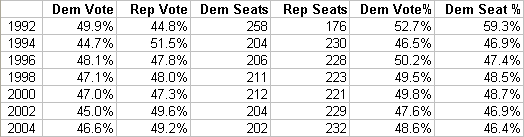
The table above lays out more evidence. It shows the percentage of the two-party vote and the percentage of congressional seats won by Democrats in every election since 1992. In 1992 they won more seats than they should have, and in every election since then (with a modest exception in 1996) they've won nearly as many seats as the popular vote suggests they should. Dems do seem to have a structural disadvantage, but it's closer to 1% than 7%.
This doesn't prove anything conclusively — in fact, the 1996 exception is a data point in favor Krugman's thesis — but the overall evidence, combined with the Grigg/Katz results, suggests that majority-minority redistricting hasn't seriously affected the ability of Democrats to win congressional seats. If Dems win 53% of the two-party vote this November, I'll bet they win close to 53% of the seats too.
NOTE: I'm mostly posting this in hopes that someone who knows a lot about this stuff will see it and chime in. I'd be interested to hear some expert opinion about whether there's more to this than meets the eye.
Kevin Drum 6:43 PM Permalink Trackbacks Comments (68)


Sunday, October 15, 2006

Tribune Supports Jarvis over McCoy in SD2


Jarvis in Senate 2
Doctor could lead health-care reform fight
Article Last Updated:10/13/2006 10:13:38 AM MDT

The voters of Senate District 2 in Salt Lake City are fortunate indeed. Regardless of which major party candidate they elect to represent them, they will have an articulate advocate in the Utah Legislature. The Democrat, Scott McCoy, is a lawyer who was appointed early last year to fill the seat when Paula Julander retired. The Republican, Joe Jarvis, is a medical doctor, former State Health Officer of Nevada and chairman of the Utah Health Policy Project. The Tribune's Editorial Board recommends Jarvis because of his moderate Republican views and his expertise in health policy. The failure of the last Legislature to provide dental and vision benefits to the most vulnerable Medicaid recipients during an unprecedented budget surplus highlighted the need for a strong voice there for health-care reform. Jarvis would provide that voice within the caucus that controls Capitol Hill. There is not a physician in the Legislature now, and Jarvis would fill that void. The only drawback we see to our recommendation is that if voters elect Jarvis, McCoy will no longer be in the Legislature. It's a shame that voters cannot send both men into the next Utah Senate, but that's not an option. McCoy has carried Sen. Julander's long battle to force health insurers to cover contraceptives. He proposes a state constitutional amendment recognizing all people's right to health care. He would outlaw smoking in cars when children are passengers, and he would create a task force to study safe disposal of toxic materials in consumer electronics. At 36, McCoy is the youngest member of the current Senate and an openly gay man. He helped to lead the fight against the Utah constitutional amendment that outlawed gay marriage. Because both young people and gays are under-represented in the Legislature, McCoy's departure would be unfortunate. However, there is another openly gay member of the Legislature, but no doctor, and specifically, no doctor with Jarvis' expertise in health-care reform. He led the effort to allow small business owners to buy into the Public Employees Health Plan, a way to reduce the number of uninsured Utahns. We want him to carry on that fight in the Senate.

Legislature flawed but doesn't deserve contempt

By Frank Pignanelli & LaVarr Webb

Webb: It's quite remarkable how perfectly normal, upright, intelligent Utah citizens, respected in their communities, are magically transformed into stupid, insolent, partisan hacks and right-wing ideologues when they are elected to the Legislature. Or so it would seem reading some of the harsh criticism leveled at the Legislature, mostly from people who could never get elected to anything themselves and who are mostly out-of-touch with reality. The latest anti-Legislature diatribe came from Morning News columnist Don Gale on Oct. 7. His way-over-the-top harangue accused legislators of "neglect, stupidity and greed." He charged that they operate with secret deals, that lobbyists run the place and that they are biased and absolutists. He said they are cruel and heartless with a majority consisting of "ultraconservative, reactionary, head-in-the-sand quasi-Republican ideologues." And there was a lot more. I talked to good, honest, hard-working Utahns, who also happen to be legislators, who were genuinely hurt by Gale's sweeping rant. These are typical Utahns, chosen in free and open elections by their neighbors and community peers, who sacrifice enormously to serve. They are business people, educators, retirees, farmers, attorneys, homemakers, engineers, etc., who spend most of their time like the rest of us, working and supporting their families. Then they go do their legislative duties and somehow become monsters. The truth is that the vast majority of lawmakers serve with honor and distinction. Most of Gale's criticisms are both unfair and unfounded. Worse, he adds to the incivility, disrespect and harsh rhetoric that poison our political process and breed cynicism and apathy. The Legislature is certainly not a perfect institution. Sometimes mistakes are made. To people who don't understand the process, it appears chaotic and undisciplined. At any given time a silly bill might be introduced or a silly speech might be delivered. But you judge a Legislature by its final product, what is passed by both houses and signed by the governor, not by any single occurrence along the way. And no one should be surprised that the Legislature is political. That's the system created by the founders of our country and state. The reality is that the political process works very well in Utah, far better than at the national level. Utah's 104 citizen lawmakers deal forthrightly with the big issues facing the state. They prioritize carefully and spend wisely. They balance the budget. They reflect the opinions and desires of a majority of Utah citizens. They deserve praise and support, not derision and scorn.

Pignanelli: The Legislature invokes the same emotions as your in-laws. You whine and moan about their boorish and crude behavior. Their exhibition of entitlement and/or superiority is infuriating. You harbor hope that a family member gets smart and dumps an obnoxious spouse. However, you enjoy many of them on an individual basis and are thankful for the process that produced them. I entertain audiences with the antics of Capitol Hill (no shortage of laughs), but respect the institution. Intermixed with my jokes is strong encouragement to improve the process through participation in elections and citizen lobbying. To underscore my objectives, I provide some observations:
• In public relations, legislators are incompetent. They make boneheaded moves (i.e. denying $2 million for Medicaid but funding $12 million for a garage). Further, caucus dynamics prevent leaders from securing too much exposure. Lawmakers hire good PR assistants, but they do not use them. (Which explains why, when I was Minority Leader, capturing good media was akin to "shooting fish in a barrel.") Utah Governors since 1993 have excelled in this arena, thereby exacerbating the problem for legislators.
• Most lawmakers sacrifice professional careers and monetary gain to serve. (Insiders know the limited few who are benefiting in a proprietary manner.) Unlike sports or entertainment figures, they receive all the criticism free.
• Because of LaVarr's beloved precinct caucus system, extremists in both parties wield extraordinary influence early in the election process. Good politicians have to throw red meat at the hungry activists, thus all the right-wing rhetoric.
• The part-time Legislature is structured to react, not lead. The governor is imbued with responsibility to provide vision. (So do not expect monumental changes in government from lawmakers.)
• The ridiculous "message bills" (which also infuriate me) garner most of the publicity during the session — but rarely pass.
• The majority caucus closes too many meetings from public scrutiny — breeding conspiratorial conclusions. (From what I gather, these assemblies rarely produce results. Insiders and the media learn of the juicy bits anyway.)
• More than 2,000 lobbyists swarm Capitol Hill every winter (signs of a healthy democracy) to push and pull 104 lawmakers in various directions. But the most influential lobbyists are the neighbors, co-workers and outspoken constituents of a legislator.
The Legislature is not imposed upon us from above. The public, by selection or omission, determines its composition. I encourage those who are angry and frustrated to participate in the elections and make a difference.
Republican LaVarr Webb was policy deputy to Gov. Mike Leavitt and Deseret News managing editor. He now is a political consultant and lobbyist. E-mail: lwebb@exoro.com. Democrat Frank Pignanelli is Salt Lake attorney, lobbyist and political adviser. A former candidate for Salt Lake mayor, he served 10 years in the Utah House of Representatives, six years as House minority leader. Pignanelli's spouse, D'Arcy Dixon Pignanelli, is a Utah state tax commissioner. E-mail: frankp@xmission.com.

Thursday, October 12, 2006

Keep Utah Moving


Keep Utah Moving!
Vote FOR Proposition 3 on the Salt Lake County ballot and the Opinion Question on commuter rail and roads in Utah County. Help Utah avert a transportation crisis, build FrontRunner commuter rail across Utah's four most populous counties, expand the TRAX light rail system, preserve highway corridor, and construct other top-priority highway projects.
Imagine having most of the Wasatch Front’s major shopping, business, entertainment and educational centers connected by a fast, efficient and dependable public rail transit network. From most anywhere on the Wasatch Front, hop on a TRAX or FrontRunner train and commute to work or school, take in a concert at the E Center, a family outing at Lagoon, a shopping spree at Cabelas, dinner at Thanksgiving Point, a football game at the U., or a Jazz game downtown. And avoid congestion, travel more safely, and at less cost, than driving a car.
The campaign needs endorsements and volunteers willing to put up lawn signs. To help, go to http://www.votefor3.com/ and fill out a simple form. See Morning News story about the campaign kickoff event.

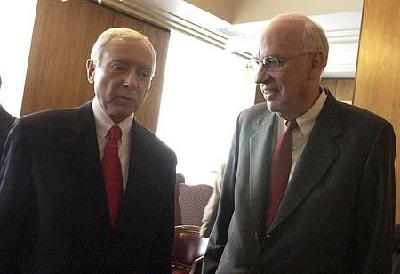
Hatch says House feared anti-gay label


Hastert's busy schedule also may have delayed action on Foley, he adds
By Matt Canham The Salt Lake Tribune

U.S. House leaders may have delayed taking action against former Florida Republican Rep. Mark Foley because they were afraid of appearing anti-gay, according to Sen. Orrin Hatch. Utah's senator called Foley's sexually explicit e-mails and instant messages to congressional pages "abysmal" and inexcusable, but he also defended House Speaker Dennis Hastert, who has drawn repeated criticism for not acting on concerns brought to his office earlier. Hatch's defense, presented to the Tribune editorial board earlier this week, centered on how busy Hastert is as the Republican leader in the House. But he also said: "I don't know anybody today in the Congress who wants to act or be homophobic, so that may be part of the problem here." Hatch's campaign opponent, Democrat Pete Ashdown, bristled at Hatch's remarks. "I think it is ridiculous," he said. "Protecting children has nothing to do with homosexuality." Equality Utah, a gay rights organization, also doesn't buy Hatch's explanation. "It's interesting that Senator Hatch and other members of Congress would express a concern about being homophobic when they have supported a constitutional amendment to define marriage. Do they not consider that be homophobic?" asked Mike Thompson, Equality Utah's executive director. Foley resigned in September after sexually
Advertisement
document.writeln(AAMB6);

explicit instant messages he sent to a male page were made public. Since then, House Republicans have been embroiled in a scandal that may cripple their bid to hold the majority. Hastert has been at the center of the controversy, since some lawmakers have said they relayed concerns over Foley's messages with pages and former pages years ago. While Hatch may defend Hastert, most Utahns want to see him punished, according to a recent poll conducted by Survey USA on behalf of KSL TV. The poll of 500 people said that 68 percent don't believe House leaders did enough when they learned of allegations against Foley, with 28 percent believing Hastert should resign his leadership posts and another 34 percent saying he should leave Congress. The FBI and a House ethics investigation are looking into Foley's actions and the response of House leaders. "There were mistakes made in my opinion that were human mistakes, but I think they are now approaching it in an intelligent way," Hatch said. Ashdown said if those investigations find that Hastert didn't act quickly enough, then "he should be removed." But until the investigations are done, Ashdown doesn't want to make a judgment. "I'm not gong to be judge and jury on Hastert," he said. Earlier this year, Hatch teamed with Foley to pass a child sex offender bill, requiring a nationwide database. Convicted sex offenders who fail to register could be charged with a felony. The irony hasn't escaped Hatch. "Here is a man who has co-sponsored the sex offender bill. He may very well be the first person prosecuted under that bill." mcanham@sltrib.com

REDISTRICTING: FACT AND FICTION.....


October 12, 2006
Is gerrymandering responsible for the fact that it's virtually impossible nowadays to defeat an incumbent in the House of Representatives? Reporters and pundits seem to accept this without question, but academic research suggests otherwise. For example, Alan Abramowitz, an Emory political science professor who's studied the decline in competitive seats, recently published a paper concluding that redistricting has had "little to do with the recent decline in competition in House elections. Other developments, such as the growing financial advantage of incumbents and increasing partisanship in the electorate, appear to be more responsible." He figures that only 12% of the decline in marginal districts has been a result of redistricting.
Still, 12% is 12%, and when the House is split as evenly as it is now that can make the difference between being in the majority and being in the minority — something that Republicans seem to understand better than Democrats. In "The Race to Gerrymander," in our November issue, Rachel Morris provides a fascinating 20-year history of Republican efforts to gain control of state legislatures in 1990 and again in 2000 so that they'd be the ones in control of redistricting:
Republicans prepared earlier and poured money into the 2000 legislative elections in critical states like Pennsylvania. Some Democrats, particularly [Martin] Frost, advocated a similarly ambitious approach, but the 1994 wipeout had thrown the party into something of a tailspin, and for the next few years presidential contests consumed much of its energy and money. Eventually Democrats did devote considerable attention to state elections and preparing for the census, but they had already lost valuable time.
After 2000, Democrats found themselves entirely locked out of redistricting in four large swing states where Republicans had won all three branches of government: Michigan, Ohio, Pennsylvania, and Florida. “In those states we got hammered,” one Democratic redistricting operative said.
It may be that Republican gerrymandering has produced a net gain of no more than 20 seats for the GOP over the past couple of decades. Still, that's enough, and it's one of the reasons I think Howard Dean's focus on rebuilding state party infrastructure is so pivotal. When 2010 rolls around Democrats need to be in a position to compete in every state, either to gain control of the redistricting process outright or to at least win enough control to prevent Republicans from dominating the process the way they have for the past two cycles. 2004 was none too soon to start working on that.—Kevin Drum 1:43 AM Permalink Trackbacks Comments (12)

Wednesday, October 11, 2006

Blogging and the Law


October 10th, 2006 @ 8:48pm
Some people view blogging as the democratization of the media. But if that's the case, bloggers should probably be prepared to play by the rules of media law. Nightside's Chelsea Hedquist has more.

Nightside's Chelsea Hedquist Reporting
A San Francisco firm that tracks blogs estimates there are now 53 million of them out there. The same firm says there are 1.6 million daily postings. And, contrary to popular belief, you can get into trouble if you post the wrong thing about the wrong person.
Most people think of the blogosphere as a free wheeling, no holds barred world where people can say whatever they want, and get away with it. Not so says attorney Jeff Hunt.

"Bloggers have to play by the same legal rules that the traditional media has to play by."
And that means bloggers are just as vulnerable to libel lawsuits as any member of the press. In fact, there have been more than fifty lawsuits this year resulting from postings on blogs and message boards.

"You're seeing a more aggressive response by some of the individuals who have been defamed on blogs to strike back."

In one case, a former U.S. Senate aid sued Jessica Cutler after she posted a blog about their sexual escapades. In another, a criminal defense lawyer in Pittsburgh filed a libel suit against a website called dontdatehimgirl.com after a posting on the site accused him of having a sexually transmitted disease.

Utah blogger Sarah Nielson has even had a close call.
"I write about dating and at one point I had someone that had written me an email that I reposted on my blog. And he had threatened to sue. So I do worry about things like that a little bit."
Nielson, who blogs on sarahbellum.org, doesn't think most bloggers realize they are bound by media law.
Neilson says, "Luckily, you know, bloggers are pretty savvy with the internet and there's always a way to find out the information they need."

One place bloggers can go to learn about their rights is the electronic frontier foundation. The site lays out the legal issues that bloggers might run into and how to handle them. Chillingeffects.Org is another good resource for bloggers. Hunt says it's a good idea for bloggers to brush up on media law.

"There's just no substitute for accuracy and bloggers need to understand that the way traditional media reporters understand that."
In all reality, libel lawsuits against bloggers are still quite rare. And Brigham Young University Professor Kevin Stoker thinks that bloggers won't pay much attention to threat of lawsuits until they become more common.

"Until we start seeing a lot of cases coming through the system - at least publicized cases coming through the system - I think you're going to see a lot of bloggers continuing to say what they will."

But after all, that's kind of the cool part about blogging. People say things they would never print on the front page of the New York Times. Law student and blogger David Billings doesn't want to see lawsuits against bloggers ruin that environment.

David: "It's a first amendment issue and, you know, no matter how many mean things they say about somebody it's just speech."
And as Stoker stresses, bloggers who are just expressing their opinion should be safe from lawsuits.

"If it's opinion it should be protected because it's hard to determine whether it's true or false, essentially.:

Nielson and other bloggers reluctantly admit there may come a day when libel lawsuits infringe on the blogosphere.
"I'm sure it will at some point but until then keep blogging."

And with as many as 150,000 blogs being created every day, we'll probably keep seeing some pretty interesting posts.

Tuesday, October 10, 2006

County to reprint "pubic" ballots at a cost to taxpayers of $40 thousand

GRAND HAVEN, Mich. - Ottawa County will pay about $40,000 to correct an embarrassing typo on its Nov. 7 election ballot: The "L" was left out of "public."

A total of 170,000 ballots will have to be reprinted.
The mistake appeared in the text of a proposed amendment to the state constitution that would ban some types of affirmative action.
The word "public" was misspelled one of the six times it appears, county Clerk Daniel C. Krueger said Tuesday. Five or six people in his office had proofread the ballot, but it was an election clerk who found the mistake early last week.
"It's just one of those words," Krueger said. "Even after we told people it was in there, they still read over it."

WHAT NORTH KOREA WANTS....


October 10, 2006
WHAT NORTH KOREA WANTS....Selig Harrison, who has spent a fair amount of time talking with North Korean officials, argues that their nuclear test on Monday was basically just a dramatic way of getting our attention:
Paradoxical as it may seem, Pyongyang staged the test as a last-ditch effort to jump-start a bilateral dialogue on the normalization of relations that the United States has so far spurned. Over and over, I was told that Pyongyang wants bilateral negotiations to set the stage for implementation of the denuclearization agreement it concluded in Beijing on Sept. 19, 2005, with the United States, China, Russia, Japan and South Korea.
Washington focuses on Article One of the accord, in which North Korea agreed to "abandon all nuclear weapons and existing nuclear programs." But what made the agreement acceptable to Pyongyang was the pledge in Article Two that the United States and North Korea would "respect each other's sovereignty, exist peacefully together and take steps to normalize relations."
In North Korean eyes, it was a flagrant violation when, four days after the agreement was signed, the United States in effect declared economic war on the Kim Jong Il regime. The Treasury Department imposed financial sanctions designed to cut off North Korean access to the international banking system, branding it a "criminal state" guilty of counterfeiting and money laundering.
Well, if we were in their position, we'd feel double-crossed too, wouldn't we? Far from being the hare-brained response of a bunch of "madmen," their feeling of betrayal was actually a pretty unsurprising reaction. Kim Jong-Il may be a weird guy, and the whole DPRK leadership is paranoid as hell, but within the constraints of how police states usually act, they actually seem to behave fairly predictably.
Of course, the part I've never really understood is our reluctance to give them the one thing they've consistently asked for over many decades: diplomatic recognition and some kind of security guarantee. After all, what's the downside? Treaty or not, if North Korea provoked a war we'd declare them in default of their obligations and then squash them. Recognition and security guarantees literally cost us nothing.
But ten consecutive presidents of both parties have declined to offer this, so there must be more to it. But what?—Kevin Drum 1:57 AM Permalink Trackbacks Comments (62)

Sunday, October 08, 2006

McGee gets the Boot at the U of U


Can you remember the last time someone asked you a very simple question, and your brain just freezed up.

I can only assume that is what happened to Utah Representative Roz McGee up at the University of Utah this past spring. Roz elected to participate in a political bee where each participant was asked a political question. The first questions were very simple so as not to eliminate everyone right off the bat.

So the crowd was stunned when Roz was asked what the 2nd ammendmant protects. She honestly did not know, and guessed several possible answers which were mostly 1st ammendment protections. I think this goes to the heart of the question. When it comes to free speech and the other protections the 1st ammendment provides for, most Democrat's know the answer. However when it comes to protection of one-self or family, most democrats charge that the 2nd ammendment really does'nt protect individual freedom, but instead allows for a military to protect the population.

Roz got the boot on the first question, and this is an Utah elected official yikes?

Mark Towner, The Spyglass

Saturday, October 07, 2006

Cannon adds fuel to fire


Utahn tries to clarify comments about possible 'precocious' pages
By Jeremy TwitchellDeseret Morning News
OREM — Comments made by Rep. Chris Cannon, R-Utah, have provided additional fuel for the fire heating up the cybersex scandal that led to the resignation of U.S. Rep. Mark Foley, R-Fla.

Rep. Chris Cannon said he did not mean to place the blame on the page involved. In a radio interview that aired Thursday on KSL Radio's Nightside Project, Cannon said "precocious" pages may have been "egging this guy on." Foley is accused of sending sexually charged instant messages to a teenage male congressional page. Cannon attempted Friday to clarify his remarks. "I used the word precocious on purpose ... by that, I meant a kid who is smarter than other kids his age," Cannon told the Deseret Morning News. "He's also not naive. I used it in the context that they know more than I did at that age." Leaders of Utah's Democratic Party expressed disdain for Cannon's statements. Alyson Heyrend, spokeswoman for 2nd District Rep. Jim Matheson, D-Utah, said she had "no idea where (Cannon) was coming from" with those statements and that they speak for themselves. Christian Burridge, Cannon's Democratic opponent in the November election for Utah's 3rd Congressional District seat, said he was "disappointed" by Cannon's comments. "This is an issue where we need to get to the truth of the matter," Burridge said, adding that Cannon's implication that the page may have induced Foley to send the messages was "irresponsible and outrageous." "These kids are sent away from their parents, and the leaders of the Congress become their stewards and become responsible for them," Burridge said. The suggestion that the page may have pulled Foley into the exchange as a prank has been floated in some circles this week, but has not been substantiated. Cannon said he did not mean to place the blame on the young man involved.

"It's not wrong of the kids, it's wrong of the man who was in a position of power," he said. "There is nothing here that isn't Foley's fault; the entire matter is his fault." Cannon said he was trying to send the message that young people, given their intelligence and technological savvy, need to exercise great care online. He called for parents to place greater emphasis on teaching their children how to be safe in the electronic world. "The problem here is not that we have kids who are precocious, but that they're precocious in an environment of predators," Cannon said. Cannon said he felt he had explained what he meant in the context of the interview in which he initially made the comments. "I'd like to hear the whole tape," he said. "I think I said what I'm saying here, but taken in pieces, it sounds harsh. But on the bright side, it allows us to draw attention to this issue." Cannon's comments also stirred debate at the national level. He appeared on CNN's Situation Room Friday, interviewed by Wolf Blitzer. Much of the controversy in the wake of Foley's resignation last Friday has focused on House Speaker Dennis Hastert, R-Ill., who has been accused of knowing Foley had made inappropriate contact with pages prior to this incident becoming public. Cannon said calls for Hastert's resignation are "premature," and that an investigation into the matter needs to run its course.


Burridge said any investigation into Foley's actions needs to focus on the involvement of the Republican Party leadership. "We need to find out who knew, and when they knew it," he said.

Contributing: Suzanne Struglinski
E-mail: jtwitchell@desnews.com