Sunday, December 03, 2006

State GOP Leadership abandoning Ship?


Next Week the Republican Party State Central Committee will be meeting up at capital hill for its quarterly meeting. After the recent resignation of State Chairman Joe Cannon, it is now reported that State Party Secretary Candace Daly will also be resigning her position. This now places acting Chair Enid Greene in the position of holding the party leadership together with two of the four members of the leadership gone.

We have not held an executive committee meeting since Joe and Enid were re-elected over a year ago, and the party has serious financial problems to resolve.

In my opinion, to wait until February or March to resolve these issues would be irresponsible. I feel interim leadership should formally be put into place by the central committee. Our governing documents do not address succession of the vice chair to become the acting chair if the chair resigns. This should be clearly defined in our documents and be addressed.

In the race for Governor for 2004, there were many including myself that felt Enid should have resigned as the vice chair once she was placed on the ballot against Huntsman/Herbert in the primary. The leave of absence by Enid tactic I felt smelled to high heaven, and that loop-hole should forever be closed.

I would hope the State Central Committee takes these issues up next Saturday, and we as a party get our rudder pointed in the right direction for 2007?, and 2008.

Mark E. Towner
Member, State Republican Central Committee, Salt Lake County

Just Say NO Elected Officials!


As a member of the Salt Lake County Republican Party central committee, I attended Saturday’s quarterly meeting. The fireworks started early by an embarrassing motion submitted by Utah GOP National Committeewoman Nancy Lord calling for the resignations of Chair James Evans and Vice Chair Dana Dickson. With a quorum of over 250 members present, we overwhelmingly rejected even placing this motion on the agenda.

The real news of the meeting was a resolution submitted to the central committee that requests that GOP elected officials reject plans in Washington DC to provide DC a voting seat in congress, even if Utah were to receive an additional 4th seat in the bargain.

The following is the “Resolved” text of the resolution. I think tomorrow’s special session may end very quickly in the Senate and House when Senator Stephenson, and Representative Hughes announce from the floor the sentiments of the elected GOP central committee representatives, from the largest County in the state.


Resolved, the Salt Lake County Republican Party does not support current efforts to immediately secure a Fourth Congressional Seat for the State of Utah;

Resolved, That the Salt Lake County Republican Party admonishes Governor Jon M. Huntsman, Jr. and the state legislature to be prudent and patient by waiting until after the 2010 census to change congressional boundaries;

Resolved, That the Salt Lake County Republican Party admonishes Senator Orrin Hatch and Senator Robert Bennett, Congressman Chris Cannon and Congressman Rob Bishop to be prudent and patient by waiting until after the 2010 census to secure a Fourth and possible Fifth seat for Utah; and,

Resolved, that a copy of this resolution be mailed to each member of our Republican state and federal delegation.

Could be interesting in the morning….

Mark Towner,
The Spyglass

Friday, December 01, 2006

Republican "brand" needs repair, governors told


By Jane Sutton 2 hours, 1 minute ago
MIAMI (Reuters) - The Republican "brand" has been tarnished by corruption and poor performance and governors from the party who have presidential ambitions must return to its traditions of tight spending and smaller government.

So concluded Republican governors and their advisers gathered in Miami for a conference that ended on Friday.
The "Grand Old Party" lost control of both houses of Congress and six governorships in the November election. Republican
President George W. Bush' name=c1> SEARCHNews News Photos Images Web' name=c3> President George W. Bush has seen his job approval rating drop 3 more points to 31 percent since then, according to a Harris Poll.
Outgoing
Republican National Committee' name=c1> SEARCHNews News Photos Images Web' name=c3> Republican National Committee Chairman Ken Mehlman, who helped steer Bush's 2004 re-election, blamed the electoral drubbing partly on discontent with the
Iraq' name=c1> SEARCHNews News Photos Images Web' name=c3> Iraq war and on some candidates' scandals and ethics problems.
But pollsters said voters told them the election was more about competence than war, scandal or any shift in ideology.
They said voters now viewed Democrats as more likely to rein in government spending, cut taxes for the middle class and trim the budget deficit -- things Republicans promised when they took control of Congress in 1994.
"The image and brand of the GOP and conservatives has taken a hit and needs repair," pollster Neil Newhouse of Public Opinion Strategies told the Republican Governors Association.
"The next president has to be a fiscal hawk," said pollster Wes Anderson of OnMessage Inc., a Republican campaign consulting firm.
"They (voters) didn't fire us because they don't believe what we believe. They fired us because we didn't do what we said we were going to do," he said.
That may hurt Republican presidential hopefuls in Congress more than those in governors' mansions.
It has become common political wisdom that it is very difficult for someone in Congress to win the presidency because congressional voting records provide so much ammunition for opponents, including votes larding the federal budget with pet projects for home districts.
FROM STATEHOUSE TO WHITE HOUSE
By contrast, state governors, who function largely as chief executives and are prohibited in many states from running deficits, can point to balanced budgets and claim credit for pretty much anything good that happens under their watch.
Four of the past five presidents, including Bush, have used governorships to vault to the presidency.
Anderson said the three Republican governors considering a 2008 presidential campaign -- Mitt Romney of Massachusetts, Mike Huckabee of Arkansas and George Pataki of New York -- had good records on controlling spending and improving health care in their states, issues important to voters.
"In all three cases they can run on 'I'm one of those Republicans who lived up to what I said I'd do,"' he told Reuters.
Democrats dispute that and noted the Republicans loss of governorships under Romney's tenure as chairman of the Republican Governors Association, including in Romney's home state of Massachusetts, where his handpicked successor lost by more than 20 points.
Democratic National Committee' name=c1> SEARCHNews News Photos Images Web' name=c3> Democratic National Committee spokesman Luis Miranda cited complaints from Republican gubernatorial candidates that Romney had not done enough to aid their cause.
"He put his own presidential aspirations ahead of his own party," Miranda said in a telephone interview.
Romney, who attended the conference, agreed on the importance of job performance, saying, "There's nothing that's going to yield a bigger swat, or thumping if you will, than saying one thing and doing another."

Wednesday, November 29, 2006

Real Republican Majority


Principles of the Real Republican Majority


Principles of the Real Republican Majority
I BELIEVE that the strength of our nation lies with the individual and that each person's liberty, dignity, freedom and privacy must be honored and respected.

I BELIEVE that the role of government is to practice fiscal responsibility and allow individuals to keep more of the money they earn.

I BELIEVE that strong national security and safety of Americans at home and abroad must be a top priority of our Party and our government.

I BELIEVE in the Constitutional protection of the separation of church and state-- that official policies of our Party and our country should not be dictated by personal religious beliefs.

I BELIEVE that medical and moral choices are individual and family decisions not government decisions.

I BELIEVE that we build a strong Party by consensus, not by forcing an agenda on issues that are divisive, personal and best left at home.

I BELIEVE that the Republican National Committee should focus on our traditional agenda of smaller government, lower taxes, and a pro-growth economy.

I BELIEVE that the Republican Party Platform should be welcoming and respectful of differing views on issues of disagreement and promote the 'Big Tent' philosophy.

Iraq is Dems' tar-baby


THE HILL November 29, 2006
An old Democratic friend of mine stopped by the Monocle last week and while there ran into a Democratic senator of long acquaintance. The Senator was, of course, quite pleased with the outcome of the election and is looking forward to the perks and responsibilities that go with being in the majority.The two talked for a few minutes, but the Senator was more than a little taken aback when my friend asked him what he and his fellow Democrats intend to do with the war they managed to acquire with their new majority. "What do you mean?" he said. "Iraq is Bush's war and his problem.""Oh, no," my friend responded, "it was his war until Nov. 9, but your party ran condemning the war, Bush's management of it and promised to end it in one way or another. Now, you guys are going to have to come up with a plan because you are in the majority and with the majority comes responsibility . especially on problems voters believe you promised to solve."It was a sobering thought and the senator was momentarily speechless, but then got very, very cautious and assured my friend that most Democrats believe it would be dangerous to do anything precipitous. Fortunately, there was no one from MoveOn.Org at the next table.To be fair, my friend overstated the degree to which Democrats have to single-handedly solve the Iraq problem, but voters are not likely to long tolerate their pre-election act of attacking Bush at every turn while offering nothing, or less than nothing, in the way of a realistic alternative.After all, while there was more to the election than the war, most of the 20 percent or so of those who voted and said the war was their No. 1 concern voted this year for Democrats because they don't like the way things have turned out for us in Iraq and are hoping for better.It is true that many of the Democratic Party's ideological allies and financial supporters seem to actually believe that the problem is nutcases who would pervert their religion to justify terror, torture and genocide, all on account of the U.S. They would argue, one suspects, that since it is our presence in the region that "creates" terrorists, all we have to do is leave and the problem will vanish.This reasoning may be persuasive within the fever swamps of the left, but most elected Democrats tend to be more realistic and few of them share this view of a world that would be a better place but for us. Moreover, as politicians they have to worry about what might happen if they "get us out of Iraq" and the forces we are fighting there decide to take us and our friends on elsewhere, or the Iranians and others look at the debacle there as evidence of our lack of will to oppose whatever it is they decide to do with their nuclear weapons once they develop them.Some of them are hoping former Secretary of State Jim Baker's Iraq Commission will save their bacon as well as Bush's by coming up with a magical strategy and end game that will both work and satisfy their base. That, however, doesn't seem likely given the intractability of the problem and the vehement insistence on the left that the war has to be ended now or that we at least begin withdrawing or "redeploying" troops soon.Some Democrats in Congress are already responding by rejecting the idea that anything but getting out matters. They dismiss the importance of whatever might happen there after we leave and seem to buy into the notion that everyone will be so happy that we're out that no one will blame them for "losing Iraq" or for the acts of an emboldened terrorist movement.Others are trying to satisfy their base by suggesting that all we have to do is seek support from our allies or the U.N., as if the Bush administration hasn't tried. Still others suggest that we do more to "train" the Iraqis but blanch at the thought that this course could require committing more U.S. forces, at least in the short term.And then, finally, there are those who denounce the Bush administration's "imperialist empire-building" on the one hand, while suggesting that what "we" ought to do is sit down and redraw the map of the Middle East along more "rational" lines.The lack of any unified Democratic stance on a crucial national security and foreign policy issue - on which the party's candidates ran and won control of Congress - means that my friend is at least partially right.Iraq is many things, including a tar-baby that congressional Democrats are going to find as difficult to get away from as the Republicans they so gleefully beat up over the last few years.
David Keene is the chairman of the American Conservative Union and a managing associate with the Carmen Group, a Washington, D.C.-based governmental-affairs firm.

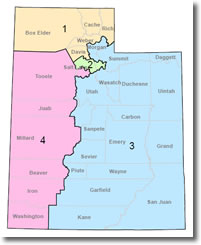
Map L. is it!, we shall see by next Monday's session


Posted Wednesday, November 29, 2006, The Senate Site


Map L
To get a real sense of what happened, you need to listen to this morning's meeting. Find the audio link here.In a nutshell:Responding to requests, opinions and information gathered at the public hearings, the Redistricting Committee has morphed the plan formerly known as J into a new Map L.The new map refines Map J in the following areas:
Changes the Second District boundary to encompass Snyderville Basin (just over 7000 people), so they can vote with their neighbors in Park City. Several people at the public hearing in Park City requested this.
Makes Morgan County (about 7000 people) part of the Third District.
Includes the City of Eureka in the Third District.
Puts North Salt Lake in the Second District but keeps Bountiful in the First.
Adjusts the lines in South Salt Lake County in such a way that the population of the four congressional districts are in exact balance. Each congressional district will have an equal population of 558,292, with the exception of District One, which will have a population of 558,293.The Redistricting Committee approved this map 10-1.Next steps: We anticipate being called into a Special Session on Monday, December 4. Then it’s up to Congress.
posted by The Senate Site at 10:46 AM 18 comments

Tuesday, November 28, 2006

Dads Against Drug Dealers

Everyone knows that ‘drugs kill’. Everyone knows that the dealers who sell drugs, actually sell death. You probably know someone who has overdosed. If not, based on current trends, you will, unless we all stand up and do something about it! Our children DO NOT HAVE TO DIE! There are more good people than bad around us. But many are scared to stand up and do something about this monster of addiction. So many people are afraid that by calling the police on their “local drug dealers”, or their children’s friends, the will face violent retaliation! DADDS gives everyone a risk free way of joining the fight. The youth and the users know who the dealers are. Please give us their names. No one will ever find out where the police get the information. You can make a difference!
FIGHT BACK! Help take back our families and our homes!

Please click on this link and read the entire story. This could be your kid....

http://dadsagainstdrugdealers.com/

Monday, November 27, 2006

Spyglass Switching to Commerical List Server


As I had mentioned in a previous post, I have been trying to use the New Google Groups Beta in handling my subscription database for the Spyglass. Even after several attempts to work out the bugs with Google support, I have decided to subscribe to a commercial service that can do exactly what I want without the hassles.

Later this week I will be sending out a formal announcement, including a simple check box to continue receiving The Spyglass email for the day. Un-subscription will be very easy and automatic.

Mark Towner,
The Spyglass

Sunday, November 26, 2006

Fusion Arena?


I have an idea for a new name for the Jazz Arena.

Energy Solutions: Jazz Fusion Arena

What do you think?

The Spyglass

Saturday, November 25, 2006

Congress unlikely to act on Utah/D.C. bill


By Bob Bernick Jr.Deseret Morning News
Next week, a special legislative committee will begin taking around the state three U.S. House redistricting plans. On Dec. 1, GOP Gov. Jon Huntsman Jr. will call a special legislative session where one of these plans — or some variation drawn up by Republican legislators behind closed doors — will officially be approved. That plan will be given to Congress during its lame-duck session with the hope that House and Senate members will approve a bill that gives Utah one extra U.S. House seat and gives the District of Columbia a full-voting House seat. The U.S. House will go from 435 to 437 members, and the long-sought-after goal of giving full representation to residents of Washington, D.C., will be achieved. Or not. And the "or not" side seems to be winning, if you believe Sen. Bob Bennett, R-Utah. Bennett, a member of the GOP-controlled U.S. Senate leadership, says that the Utah/D.C. bill has little chance of passage in the two-week lame-duck session of Congress. Huntsman says if the Utah/D.C. bill is not passed before the first of the year — when Democrats take over control in both the U.S. House and Senate — then Utah is "out of business." He sees little chance of Utah getting an extra seat, as Democrats try to just give D.C. a full-voting seat — something Republicans will no doubt oppose. If all the lame-ducks do line up for Utah, however, then officials say there could be new U.S. House elections in Utah next spring — as all four newly drawn seats must find representatives. Politics is always part of redistricting. But redrawing the seats in mid-decade throws another curve — who in the current Legislature may want to run for office in the newly drawn district? First to the plate may be Utah House Speaker Greg Curtis, R-Sandy. Ironically, Curtis barely survived re-election to his state House seat several weeks ago, a canvass this week showing he won by just 16 votes. There will be a recount, but in this age of electronic voting, recounts usually hold up. Curtis has around $200,000 in his personal campaign account, clearly more than he needs to run his own (if overly close) Utah House race. Leaders often donate to their party candidates so newly elected lawmakers will support them in leadership races. But Curtis had no challenger to his second, two-year term as speaker. So he's sitting on a lot of cash — and most likely will be in the new 4th Congressional District. Others who could be in the race on the GOP side include state Rep. LaVar Christensen, R-Draper, who just lost to U.S. Rep. Jim Matheson in the 2nd Congressional District. There's John Swallow, who lost to Matheson twice, and a slew of other would-be congressmen. All three redistricting plans being taken out for public comment have the southern part of Salt Lake County as the population base of the fourth seat. And two of the plans — Plans I and J if you are watching closely — make Matheson's 2nd District more Democratic. In heavily Republican Utah that may not be saying much — but Matheson won re-election three weeks ago with nearly 60 percent of the vote, his best-ever showing. So it is clear that — at least until the 2011 normal redistricting — Matheson would be better off politically under two of the plans. That doesn't satisfy Utah Democratic Party Executive Director Todd Taylor, who says the quick redistricting now is just another example of a "corrupt system" run by the majority Utah Republicans. Plan A — the third plan going out for comment — is the four-seat plan adopted by the lawmakers in 2001. Back then, legislators adopted a four-seat alternative because state lawyers were suing to get a fourth seat. The U.S. Supreme Court ruled against Utah, and so since then we've been electing three, not four, U.S. House members. And Plan A does not necessarily help Matheson. In fact, it could hurt him politically because he — as he did in the 2001 redistricting plan — will get a whole bunch of new constituents. If Utah gets a fourth seat in the lame-duck Congress, and there are new U.S. House elections in the spring, Matheson could face a bunch of GOP-leaning voters who have not had the chance of casting a ballot for him before. But there are a lot of "ifs" that have to become "facts" before that happens. Most likely, Congress will not act on the Utah/D.C. bill in December. And when Democrats take control in 2007, they could just decide to let things ride until the 2010 Census gives Utah another U.S. House seat.
Deseret Morning News political editor Bob Bernick Jr. may be reached by e-mail at bbjr@desnews.com

Wednesday, November 22, 2006

Official vote count rewards two Democrts

Originally posted on Friday, November 10, 2006:

I was present at The County Building on tuesday night as a ballot count observer. It was very interesting to watch the new process. PCMI cards came in in sealed bag's and workers organized and transferred these to a tray that was taken into the counting room where six cards at a time were read and downloaded on two machines. I assumed these were dibold workers, not clerk staff. The problem I had with the process, was there was no way to know what was happening. The only thing we as observers could see was the cards being placed into the machines, the button being pushed, and the screen line entry for each card would go from red to green. Only then could you see what polling location was being uploaded. The real problem was there was no actual way to verify counts by precinct in real time. This is a flaw that must be corrected in the future, because all we have to go on is the computer spitting out total numbers race wide. We were not able to tell what precincts were already counted, or not counted like in the past.Based on some calculations on the close races in Salt Lake County, several including the House Speaker’s is still up for grabs. There are nearly 10,000 absentee ballots to be counted, and this process will not even start until this weekend.The races that could still go either way are: In my opinion, based on the statistics and percentages, the following races I feel will change when the canvass is performed and all the paper ballots are counted. I sure hope the candidates have someone watching each ballot being counted….State Senate District 9State Representative’s 22, 29, 36, 45,County Council District 3County AuditorMark Towner, the Spyglass Moderator


Article Last Updated:11/21/2006 05:37:44 PM MST

Posted: 5:17 PM- Nearly 10,000 outstanding ballots counted during Tuesday's official canvas in Salt Lake County handed two Democrats victories and forced recounts in three other tight races. Magna Democratic Rep. Carl Duckworth will remain a state legislator after the provisional and absentee ballots counted Tuesday gave him a 33 vote victory over Republican challenger Deena Ely. On Election Day, Ely had 25 more votes than Duckworth. Duckworth's victory ensures Democrats a one-seat pickup in the Utah House, increasing their caucus membership to 20. And Democrat Salt Lake County Auditor candidate Jeff Hatch beat out Republican incumbent Sean Thomas by a 1,235 vote margin. Before Tuesday's canvas, Thomas had a 344 vote lead. House Speaker Greg Curtis from Sandy retained the victory, but his 46 vote advantage dwindled to just 19 votes, within the margin for a recount. Rep. Mark Walker, R-Sandy, also will face a recount, beating Democratic challenger Laura Black by just 18 votes, before the canvas Walker had 32 more votes than Black. A recount will also take place in the Jordan School Board race between Tracy Cowdell and Lynette Phillips. Cowdell's 27 vote margin dwindled to just 12 over Phillips.

Tuesday, November 21, 2006

California court expands immunity for bloggers


2 hours, 41 minutes ago
SAN FRANCISCO (Reuters) - Individuals who use the Internet to distribute information from another source may not be held to account if the material is considered defamatory, the California Supreme Court ruled on Monday in a reversal of a lower court decision.

The ruling supports federal law that clears individuals of liability if they transmit, but are not the source of, defamatory information. It expands protections the law gives to Internet service providers to include bloggers and activist Web sites.
"We acknowledge that recognizing broad immunity for defamatory republication on the Internet has some troubling consequences," California's high court justices said in their opinion.
"Until Congress chooses to revise the settled law in this area, however, plaintiffs who contend they were defamed in an Internet posting may only seek recovery from the original source of the statement," the decision stated.
The opinion, written by Associate Justice Carol Corrigan, addressed a lawsuit by two doctors who claimed defendant Ilena Rosenthal and others distributed e-mails and Internet postings that republished statements the doctors said impugned their character and competence.
Rosenthal operates a San Diego-based Web site known as the Humantics Foundation (http://www.humanticsfoundation.com), which is critical of silicone breast implants.
Rosenthal had countered that her statements were protected speech and immune under the Communications Decency Act of 1996. It holds that: "No provider or user of an interactive computer service shall be treated as the publisher or speaker of any information provided by another information content provider."
A California appeals court had ruled that Internet service providers and users could be held liable if they republish a statement if it is known to be defamatory.
California's high court took that decision up for review because the lawsuit against Rosenthal involved an individual instead of a service provider, and opted for a broad view of immunity under the Communications Decency Act.
"Requiring providers, users, and courts to account for the nuances of common law defamation, and all the various ways they might play out in the Internet environment, is a Herculean assignment that we are reluctant to impose," the court's justices held in their opinion.
"By declaring that no 'user' may be treated as a 'publisher' of third party content, Congress has comprehensively immunized republication by individual Internet users," they added.
Mark Goldowitz, the defense counsel who represented Rosenthal, said in a statement that the ruling offers protection against those who would chill free speech on the Internet.
"The soapbox is not liable for what the speaker has said," said Kurt Opsahl, a staff attorney with the Electronic Frontier Foundation who filed a brief arguing free speech protections should cover individuals, not just Internet service providers.
(Additional reporting by Eric Auchard in San Francisco)

Monday, November 20, 2006

Chaos out of the gate for Democratic majority in Congress

by Charlotte Raab Sun Nov 19, 4:57 PM ET
WASHINGTON (AFP) - Infighting among US Democrats after their victory in the November 7 elections has led some to wonder if the party is up to the task of controlling Congress.

The first week of legislative work since the elections brought a personal defeat to incoming speaker of the House of Representatives, Nancy Pelosi, who will become the first woman to be number three in the constitutional line of succession -- behind the president and the vice president.
While trying unsuccessfully to impose a close ally as her right-hand man, she gave her followers reason to doubt her political skills.
"Nancy Pelosi has managed to severely scar her leadership even before taking up the gavel as the new speaker of the House," The New York Times commented in an editorial. "The new majority -- led by a presumably wiser speaker -- must realize by now that intramural vendetta is hardly a substitute for productive government."
In spite of the lack of clarity of their legislative agenda and the limited powers granted them the by the US Constitution, congressional Democrats have received a mandate from US voters.
An opinion poll published Thursday revealed that 51 percent of Americans are counting on Democrats to take the initiative in leading the country as opposed to 29 percent who expect it from
President George W. Bush' name=c1> SEARCHNews News Photos Images Web' name=c3> President George W. Bush.
With all eyes now on the upcoming 2008 presidential race, Democrats' ability to create a credible alternative to the Bush presidency will be crucial in convincing voters to allow them to take back the White House in two years.
For the moment, the Democrats, who will be sworn in in January, have two months to prepare for operating from the position of strength.
The problem, however, is that Democrats have campaigned throughout the country on the theme of change.
"They didn't have a detailed plan and they're now having to assemble one, and they have a small majority, so it's not like they can be very bold in what they propose," said Darrell West, professor at Brown University.
For the moment, new Democratic leaders confirmed only a handful of priorities they plan to pursue in the coming weeks: an increase in the minimum wage, a new energy policy that is less favorable to oil companies, and efforts to combat the greenhouse effect.
Bush has already indicated that he is open to raising the minimum wage as long as measures are taken to shield small businesses from the effects of the measure.
However, their more ambitious proposals risk bumping against a presidential veto or fall victim of internal divisions among the Democrats themselves who hold disparate political positions on various issues.
And their majority in the Senate will be particularly precarious: 51 Democrats versus 49 Republicans.
It also is counting on cooperation from people with a pronounced independent streak such as former Democrat Joseph Lieberman, who was re-elected with strong support from Republican voters, and a former Reagan administration official, Jim Webb.
Political scientist Larry Sabato from the University of Virginia has a simple piece of advice: "Narrow their focus, concentrate on just a few things and recognize that they're not going to be able to get much done until they have a Democratic president."

Sunday, November 19, 2006

Rep. Rangel will seek to reinstate draft


By JOHN HEILPRIN, Associated Press Writer Sun Nov 19, 5:53 PM ET
WASHINGTON - Americans would have to sign up for a new military draft after turning 18 under a bill the incoming chairman of the House Ways and Means Committee says he will introduce next year.
Rep. Charles Rangel (news, bio, voting record), D-N.Y., said Sunday he sees his idea as a way to deter politicians from launching wars.
"There's no question in my mind that this president and this administration would never have invaded
Iraq' name=c1> SEARCHNews News Photos Images Web' name=c3> Iraq, especially on the flimsy evidence that was presented to the Congress, if indeed we had a draft and members of Congress and the administration thought that their kids from their communities would be placed in harm's way," Rangel said.
Rangel, a veteran of the Korean War who has unsuccessfully sponsored legislation on conscription in the past, has said the all-volunteer military disproportionately puts the burden of war on minorities and lower-income families.
Rangel said he will propose a measure early next year. While he said he is serious about the proposal, there is little evident support among the public or lawmakers for it.
In 2003, Rangel proposed a measure covering people age 18 to 26. It was defeated 402-2 the following year. This year, he offered a plan to mandate military service for men and women between age 18 and 42; it went nowhere in the Republican-led Congress.
Democrats will control the House and Senate come January because of their victories in the Nov. 7 election.
At a time when some lawmakers are urging the military to send more troops to Iraq, "I don't see how anyone can support the war and not support the draft," said Rangel, who also proposed a draft in January 2003, before the U.S. invasion of Iraq. "I think to do so is hypocritical."
Sen. Lindsey Graham (news, bio, voting record), a South Carolina Republican who is a colonel in the U.S. Air Force Standby Reserve, said he agreed that the U.S. does not have enough people in the military.
"I think we can do this with an all-voluntary service, all-voluntary Army, Air Force, Marine Corps and Navy. And if we can't, then we'll look for some other option," said Graham, who is assigned as a reserve judge to the Air Force Court of Criminal Appeals.
Rangel, the next chairman of the House tax-writing committee, said he worried the military was being strained by its overseas commitments.
"If we're going to challenge
Iran' name=c1> SEARCHNews News Photos Images Web' name=c3> Iran and challenge
North Korea' name=c1> SEARCHNews News Photos Images Web' name=c3> North Korea and then, as some people have asked, to send more troops to Iraq, we can't do that without a draft," Rangel said.
He said having a draft would not necessarily mean everyone called to duty would have to serve. Instead, "young people (would) commit themselves to a couple of years in service to this great republic, whether it's our seaports, our airports, in schools, in hospitals," with a promise of educational benefits at the end of service.
Graham said he believes the all-voluntary military "represents the country pretty well in terms of ethnic makeup, economic background."
Repeated polls have shown that about seven in 10 Americans oppose reinstatement of the draft and officials say they do not expect to restart conscription.
Outgoing Defense Secretary Donald H. Rumsfeld told Congress in June 2005 that "there isn't a chance in the world that the draft will be brought back."
Yet the prospect of the long global fight against terrorism and the continuing U.S. commitment to stabilizing Iraq have kept the idea in the public's mind.
The military drafted conscripts during the Civil War, both world wars and between 1948 and 1973. An agency independent of the Defense Department, the Selective Service System, keeps an updated registry of men age 18-25 — now about 16 million — from which to supply untrained draftees that would supplement the professional all-volunteer armed forces.
Rangel and Graham appeared on "Face the Nation" on CBS.
___
On the Net:
Selective Service System: http://www.sss.gov

Saturday, November 18, 2006

Democrats Split on How Far to Go With Ethics Law!


Why are Democrats Split on How Far to Go With Ethics Law, why do you even need to ask?

From left, Senator Barack Obama, Senator Harry Reid, Senator Richard J. Durbin and Representative Nancy Pelosi, all Democrats, are proposing new ethics rules for Congress.


By DAVID D. KIRKPATRICK
Published: November 19, 2006
WASHINGTON, Nov. 18 — After railing for months against Congressional corruption under Republican rule, Democrats on Capitol Hill are divided on how far their proposed ethics overhaul should go.

Kate Phillips and The Times's politics staff are analyzing the midterm elections and looking ahead to 2008.
More Politics News

Democratic leaders in the House and the Senate, mindful that voters in the midterm election cited corruption as a major concern, say they are moving quickly to finalize a package of changes for consideration as soon as the new Congress convenes in January.
Their initial proposals, laid out earlier this year, would prohibit members from accepting meals, gifts or travel from lobbyists, require lobbyists to disclose all contacts with lawmakers and bar former lawmakers-turned-lobbyists from entering the floor of the chambers or Congressional gymnasiums.
None of the measures would overhaul campaign financing or create an independent ethics watchdog to enforce the rules. Nor would they significantly restrict earmarks, the pet projects lawmakers can anonymously insert into spending bills, which have figured in several recent corruption scandals and attracted criticism from members in both parties. The proposals would require disclosure of the sponsors of some earmarks, but not all.
Some Democrats say their election is a mandate for more sweeping changes, and many newly elected candidates — citing scandals involving several Republican lawmakers last year — made Congressional ethics a major issue during the campaign. After winning the House on election night, Representative Nancy Pelosi, the House Democratic leader, promised “the most honest, most open and most ethical Congress in history.”
Senator Barack Obama, an Illinois Democrat tapped by party leaders last year to spearhead ethics proposals, said he was pushing for changes with more teeth. “The dynamic is different now,” Mr. Obama said Friday. “We control both chambers now, so it is difficult for us to have an excuse for not doing anything.”
He is pushing to create an independent Congressional ethics commission and advocates broader campaign-finance changes as well. “We need to make sure that those of us who are elected are not dependent on a narrow spectrum of individuals to finance our campaigns,” he said.
Sweeping change, however, may be a tough sell within the party. Representative John P. Murtha, Democrat of Pennsylvania, was embarrassed by disclosures last week that he had dismissed the leadership proposals with a vulgarity at a private meeting. But Mr. Murtha is hardly the only Democrat who objects to broad changes.
Senator Dianne Feinstein, the California Democrat who will oversee any proposal as the incoming chairwoman of the Rules Committee, for example, said she was opposed to an independent Congressional ethics watchdog. “If the law is clear and precise, members will follow it,” she said in an interview. “As to whether we need to create a new federal bureaucracy to enforce the rules, I would hope not.”
Other Democratic lawmakers argued that the real ethical problem was the Republicans, not the current ethics rules, and that the election had alleviated the need for additional regulations. “There is an understanding on our side that the Republicans paid a price for a lot of the abuses that evolved,” said Representative Barney Frank, Democrat of Massachusetts, alluding to earmarks. Senator Tom Harkin, an Iowa Democrat and a senior member of the Appropriations Committee, said the scandals of the current Congress were “about the K Street Project for the Republicans,” referring to the party’s initiative to put more Republicans in influential lobbying posts and build closer ties to them.
“That was incestuous from the beginning. We never had anything like that,” Mr. Harkin said of Democrats. “That is what soured the whole thing.”
Democrats, of course, have also cultivated close ties to lobbyists, who play a major role in campaign fund-raising for members of both parties. Indeed, ethical violations and house-cleaning efforts have both been bipartisan activities over the years. Congress has seesawed between public calls for changes and a reluctance to cramp incumbents’ campaign fund-raising and political power.
The Republicans who took over the House in 1994 adopted some of the same policies the Democrats now propose, including a ban on gifts and travel, only to relax the rules later. In 2002, Senators John McCain, Republican of Arizona, and Russell D. Feingold, Democrat of Wisconsin, pushed through a bipartisan law to restrict campaign donations and spending. The advocates of that bill are now pushing to close loopholes around so-called 527 groups.
And Republican leaders in the House and the Senate also vowed to pass what they called comprehensive ethics and earmark reform bills earlier this year. Critics complained that lawmakers had watered them down, and the two bills were never reconciled. (The Democratic proposals would also require a combination of internal House and Senate rules changes and legislation in both chambers.)
The current Congress, however, has set a high watermark for corruption scandals. One Republican, Representative Randy Cunningham of California, is in jail and another, Representative Bob Ney of Ohio, is on the way. The former House majority leader, Tom DeLay, resigned under indictment, and the payoff scandal surrounding the lobbyist Jack Abramoff may ensnare others as well. On the Democratic side, Representative William J. Jefferson of Louisiana faces bribery charges.
Advocates of an overhaul believe the reaction to the Congressional embarrassments make the Democratic takeover of Capitol Hill their best chance for significant change since the aftermath of Watergate, when Congress created the presidential campaign finance system. But they consider the Democratic proposals just the beginning of a cleanup.
“A ban on gifts, meals, corporate jet flights — a lot of that resonates with the public because people think there is just a lot of free giveaways in Congress,” said Chellie Pingree, president of the ethics advocacy group Common Cause. “A lot of this is sort of skirting the issue of how campaign funds are shaping the legislative process.”

Friday, November 17, 2006

Say it aint' so Joe!


Joe Cannon resigns as state GOP chief
Greene to take party reins until a new chairman is selected

By Bob Bernick Jr.Deseret Morning News
Joe Cannon said Thursday that he's resigning as chairman of the Utah Republican Party immediately. Vice Chairwoman Enid Greene, a former U.S. House member from Utah, will take over the chairman's duties until the party's central committee can pick a new chairman, probably some time in February, Cannon said. That person will serve out his term until August, when state party delegates will pick new party leaders for two-year terms. Greene said as of now she has no plans to run for chairman next summer. "I want to finish the job Joe and I started" when she was first picked as vice chairman three years ago. "If there is a draft-Enid movement, we'll see. But when was the last time that's happened in our party?" she said, joking about some of the controversial GOP intra-party activities of recent years. Cannon, who is also a member of the board of directors of the Deseret Morning News, told a group of GOP leaders of his decision Thursday morning as they met to discuss party finances.

"I actually thought about this for several months," Cannon said. "I decided some months ago, in the summer, that it was time for me to step away from a public partisan profile. I didn't want to do it before the election — after all, I was elected (party chairman) to help the party during this election." Cannon said he believes Utah Republicans did "very good" in last week's election. If other state GOP parties had done as well, the U.S. Congress wouldn't be going to Democrats, he added. Cannon was elected chairman for three terms. He told delegates in August 2005 that he wouldn't be seeking re-election. Both Greene and GOP executive director Jeff Hartley are more than capable of directing the party's operation, Cannon said. "I wouldn't be stepping down if I did not have absolute confidence in Enid and Jeff," he said. The Thursday morning meeting of GOP leaders was called to get input on how to retire some $100,000 of party debt, left over from this year's campaigns. Cannon said it is not unusual to have some debt after a big election, and his leaving now has nothing to do with that. "Enid has her hand to the plow" and is ready to help fund-raise to get the party moving financially forward, said Cannon. An attorney and lobbyist, Cannon is often in Washington, D.C., and in other states advocating for his clients. But he's been doing that job for several years now, and he said work-related pressures is not the reason he's leaving early. Asked what his major accomplishment has been over the past 5 1/2 years at Utah's major party post, Cannon said when he first took over in 2001 "there were any number of tensions" among different GOP factions. He said he believes he's calmed some of those by trying to have a more open party decisionmaking process. On the political front, Cannon has overseen a large-candidate field for the 2004 governor's race and seen GOP incumbents and candidates win races up and down the ballot. And it was during Cannon's tenure that the party decided to close primary elections to only registered Republicans, even though Cannon was opposed to the move. Gov. Jon Huntsman Jr., a Republican, believes Cannon "was an effective chairman for our party," the governor's spokesman, Mike Mower, said. "We're pleased here in Utah Republicans were able to hold their own in the last election. Part of that success needs to be attributed to our state party and our state party chairman, Joe Cannon." Utah's senior Sen. Orrin Hatch praised Cannon for "his strong leadership and reasonable voice. "Joe has been a terrific leader of the Utah Republican Party."
E-mail: bbjr@desnews.com

Thursday, November 16, 2006

What Now America?


SPECIAL REPORT: What Now?
CongressDaily examines the impact that a Democratic majority would have on key committees and legislation for these issues:
-->The Democratic Party took advantage of ailing polling figures and Iraq war concerns to regain control of Congress. With the election now behind them, what will Democrats do with their majority? In this special report, CongressDaily examines the impact the shift will have on Capitol Hill committees and key legislation on the budget, trade, energy policy and more:
The Budget: A return to balanced budgets within the next decade?
Defense: A battle with Rumsfeld's legacy, but without cuts in funding?
Energy: A push for renewable energy and energy efficiency plans?
Environment & Transportation: Turning up the heat on global warming?
Finance: A different approach in leadership styles?
Health: An expansion of insured coverage, albeit slowly?
Homeland Security: A boost for rail and transit security funds?
The Judiciary: An end to the ongoing push for tort reform?
Labor & Education: A focus on the minimum wage and worker safety?
Congressional Reform: An overhaul of ethics and lobbying policies?
Taxes: Seeking out common ground for overhauling the tax code?
Telecommunications: Closer scrutiny for the FCC?
Trade: A fight over presidential trade negotiating authority?

Wednesday, November 15, 2006

Mark Twain on Government


"Suppose you were an idiot. And suppose you were a member of Congress. But I repeat myself.”
“No man’s life, liberty or property are safe while the legislature is in session.”

“The only difference between a tax man and a taxidermist is that the taxidermist leaves the skin.”

“There is no distinctly native American criminal class save Congress.”

$36 MILLION?, and how much did Sen. Hatch spend?


November 15, 2006
$36 MILLION?....Hillary Clinton spent $36 million for a Senate race in which she had essentially no competition? Compared to $14 million for the next most expensive race? Wow.
Was this because she really, really wanted to win by a landslide and figured anything under 65% of the vote would be humiliating? Did she have a bet with Dianne Feinstein? (If so, she won. Feinstein won her race with an anemic 59% of the vote.) Was she trying to scare off her 2008 competition by showing that she has so much money she can literally afford to throw it away?—Kevin Drum 1:40 AM Permalink Trackbacks Comments (30)

Tuesday, November 14, 2006

Health-care panel fizzles after 2 years and $300K


Task force on Utah's insurance and HMOs agrees on nothing
By Linda Fantin The Salt Lake Tribune
Article Last Updated:11/14/2006 01:33:08 AM MST

We met. We learned. We adjourned. That is the self-assessment of a health-care task force that spent two years and $300,000 dissecting Utah's health-care system. But don't expect to see it in print. The Privately Owned Health Care Organization Task Force concluded its business Monday without so much as a memo detailing what lawmakers did with their time and your money. Which is not to say they did nothing. Task force members logged more than 63 hours in 21 meetings, gathering information about the fairness and affordability of Utah's health care and insurance markets. They provided doctors, patients and advocates for the uninsured a public forum for voicing frustrations, including concerns about the dominance and business tactics of Intermountain Healthcare. In doing so, they nudged the health-care giant to soften its debt-collection tactics, open its networks to more physicians, and work more amicably with competitors. But mostly, task force members disagreed over the direction of the task force and lamented its lack of focus. Monday was no exception. Lawmakers spent more than an hour debating the wording of a few innocuous conclusions to a draft report that would have outlined the areas of study and stated the obvious: Health care in Utah is complicated, many issues remain unresolved, and the task force can't agree on any solutions. At one point, House Speaker Greg Curtis, R-Sandy, agreed to vote for another lawmaker's substitute motion - or was it a substitute substitute motion? - if it would end the task force's existence. Sen. Michael Waddoups, a Taylorsville Republican who co-chaired the task force, said the failure to agree on a final analysis was indicative of the complexity of the problems at hand, in Utah and nationally.


"I make no apologies for this task force," Waddoups said. "We met frequently. We studied a lot of issues that were difficult to understand and get our arms around . . . and I'm the first to say we don't completely understand them even today. "It would have been wonderful to come out of this task force with a perfect system, but no one expected us to do that." The Legislature does, however, expect a progress report; the statute that created the task force requires a final written report to two interim committees. The group did draft a report, a seven-page memo summarizing the topics tackled by the task force:

* Competition in Utah health-care markets;

* Tax exemptions for charitable health-care organizations;

* A law that guarantees access to rural health care.


But the memo contained no conclusions or recommendations, and that disappointed some members, especially Waddoups. So he offered a couple of amendments. One said that information presented to the task force was "general in nature and not conclusive as to any recommended changes needed to our health-care delivery system," noting individual lawmakers should pursue "any remedy they feel is necessary." It was rejected without a vote. The other, after numerous revisions, said: "Although some health-care systems have made efforts to change some of the perceived problems that precipitated the formation of the task force, issues related to patient choice, access to affordable care, and a level playing field for competition still persist in the view of some." It was voted down, as was the memo absent the amendments. Rep. Rebecca Lockhart, a nurse from Provo, said the panel had an obligation to come to some conclusion, "even if it says we can't agree." "The Legislature deserves to be told what we did," she added. As for recriminations from the rest of the Legislature, Rep. Jim Dunnigan, a task force member from Taylorsville, said he isn't worried, but added, "The ambiguity will hurt us." Divisiveness has plagued the panel from the get-go. Two years ago, the Legislature created the task force in a compromise with Intermountain, the target of two bills. The first, carried by conservative Sen. Chris Buttars of West Jordan, would have allowed patients to choose doctors and hospitals outside their insurance network without penalty, undercutting Intermountain's managed-care model. The other, sponsored by Waddoups, would have taxed the gross receipts of Intermountain to address complaints that the HMO exploits its tax-exempt status to undercut competitors. Both bills were dropped in favor of a 15-member task force that was promptly populated by lawmakers who were beset by conflicts of interest and, depending on their loyalties, appeared biased for or against Intermountain. At one point, 11 of the 15 legislators who sit on the panel had some affiliation with the health-care industry. That could explain the mixed response to a $297,000 independent study that, to the chagrin of Intermountain's critics, determined the company's ownership of insurance plans, hospitals and physicians helps - not hurts - competition. The consultant, David Argue of Economists Incorporated, also cautioned the Legislature against meddling in the marketplace. The report was met with skepticism by consumer advocates and some task force members. Many of its conclusions were refuted by a Regence Blue Cross Blue Shield consultant. Yet it remains the most defining record of the task force's work, and that is fine with Intermountain. "It was very fair and open and informative. It was an excellent opportunity to respond to questions and to tell our side of the story," said vice president and general counsel Douglas Hammer. On Monday, Hammer said hiring Argue was "the best decision" the task force made. As it turns out, it was the only one, too. lfantin@sltrib.com


By the numbers Privately owned health-care organization task force


* 15: Lawmakers on panel

* 59: Key speakers

* 84: Handouts

* 3,801: Minutes met

* 29,447: Words generated in meeting minutes

* 300,000: Dollars spent

* 0: Progress reports to the Legislature