Tuesday, December 19, 2006

Veteran Political Reporters Discuss New Technology


Veteran Political Reporters Discuss New Technology -- And How It's Changed Their Work -- Since 1970s

NEW YORK In the final stretch of the 2006 midterm elections, famed reporter Tom Edsall started his day with a virtual information overload � reading no less than 10 blogs to keep abreast of the 24-hour coverage of Senate and House races across the nation. It's as if he's been doing it for all 65 years of his life � instead of for the first time. In reality, neither he nor anyone else in politics had even heard of a blog during the last midterm election � and since then, it's hard for many reporters to remember the time when they were considerably less connected.
"Technology, along with 24/7 cable and YouTube, have accelerated the speed of campaigning," Edsall explained in an e-mail. "Events, comments, speeches, et cetera are all immediately available to all players, including editors back at the news desk who are now able to intrude and direct coverage much more actively."
But times indeed have changed. In just three decades, the emergence of computers, mobile phones, the 24-hour news cycle and the Internet have radically altered the way political reporters do their jobs. Generation after generation of journalist continues to grapple with the evolution of technology, a seemingly Darwinian plot that weeds out those reporters who resist change. Longtime users of the typewriter, scissors and glue, today's senior political reporters are more likely to be found with a Blackberry handheld device than a black pen.
A special correspondent for The New Republic and guest op-ed columnist for The New York Times the past month, Edsall said the breakneck pace of technology is both a blessing and a curse for reporters, campaigns, and most of all � voters.
"Technology has increased the 'value' of campaign staffers who can respond to and initiate story lines very quickly," Edsall wrote, "but it has also diminished the importance of thoughtful, considered presentations by campaigns in the heat of battle."
The Internet has fundamentally changed how political reporters cover news allowing them to use its constant availability of information to compile data on the fly, Edsall stated. "It has given journalists instant access to campaign finance records, background material and the ability to search histories of subjects and individuals, all from a campaign bus or hotel room," Edsall wrote. "E-mail has created instant contact with sources, as have cell phones.
"Cell phones and computers equipped to send and receive material from the Internet are especially important for reporters covering presidential and other candidates when much traveling is required. It is now possible to get a response from the opposition while on the road."
But it wasn't always so easy for political reporters. Dallas Morning News senior political writer Wayne Slater said an ornery computer at The Associated Press offices in West Virginia in 1973 often put his otherwise uncanny ability to turn in clean copy in jeopardy.
"The computer terminal was fairly primitive," Slater, 56, said. "Hit the wrong button and everything would be erased."
On more than one occasion, Slater said he would spend 25 minutes writing a newscast only to accidentally erase it just before he sent it to a waiting outlet. Panicked, Slater said he would hastily rewrite the story in the remaining five minutes and, without proofreading it, push the send button.
"On occasion, I would produce embarrassing typos � writing 'pubic' instead of 'public,' " Slater said. "At these early-morning rip-and-read operations, it was often a disc jockey reading the news. So when the copy said, 'The mayor said he would seek a pubic hearing,' that's what they read. And I heard about it."
Since then, Slater said he's grown accustomed to mastering new tools of his trade.
"My laptop is equipped with a phone card so I can send from anywhere there's a phone signal," said Slater, who once transported his stories by pneumatic tube. "Following the presidential campaigns in 2000 and 2004, I would write on the plane or at political events and send via a wireless card. Sometimes, I'd simply dictate on a cell phone."
Cox Newspapers White House correspondent Ken Herman said the convenience of mobile phones can't be understated. As a reporter for The Associated Press in Texas in the late 1970s, 52-year-old Herman said he often covered stories in rural areas, isolated from the "pay phones that were the link to the outside world" and the only way to file.
"At trials and other courthouse stories it used to be a race to the pay phones when other reporters were around," Herman said. "We learned tricks, such as staking out a pay phone in advance, unscrewing the mouthpiece and removing the device inside.
"Without it, the phone would not work for anybody else. With it in your pocket and ready to reinstall, the device provided a personal pay phone when you needed it. It also was a good way to annoy competitors."
The round-the-clock connectivity of the Internet can help in fact-checking, Herman said, but it can also diminish making true connections with sources and potential sources. "Used properly, it's an incredible tool," Herman said. "But I do fear it can cut down on the human contact that remains so crucial to our job."
Yet some political reporters have been slow to adapt.
Slater said one of his colleagues simply wouldn't give up the system that they first used for the 1986 Texas elections � a Radio Shack T100 computer that used a payphone to transmit the story.
"In Austin, a colleague was resistant to give up the Radio Shack and move up to a better laptop computer," Slater said. "[He] ultimately did so when the Radio Shack wore out and the company had long since abandoned making parts for them."
Slater said some of his colleagues were simply skeptical of the new technology. "I remember sitting on the floor of a sports arena in 1990 at the Texas Democratic State Convention and hooking my cell phone bearing a long antenna to my computer [and] sending stories to my newspaper," Slater said. "When a colleague walked by the table and saw my computer, cell phone and a mass of black wires, he said skeptically, 'Oh, now that ought to work.' It did."
For all of its benefits, 86-year-old White House correspondent and Hearst columnist Helen Thomas said the information overload that technology offers doesn't replace the minutia-catching eyes and ears of a seasoned reporter.
"Good reporting and great journalism demand being there on the spot, seeing and hearing [for] yourself," Thomas wrote in an e-mail. "The Internet helps, [but] blogs can be misleading. Good old-fashioned reporting one-on-one [and] good sources are the way to go. Accuracy above all, not technology."
--Andrew J. Nusca

Monday, December 18, 2006

Spacewalkers free jammed solar array


By RASHA MADKOUR, Associated Press Writer2 hours, 20 minutes ago
Two spacewalking astronauts finished folding up a stubborn, accordion-like solar array Monday, resolving the only complication in space shuttle Discovery's otherwise smooth mission to the international space station.
Shuttle astronauts Robert Curbeam and Christer Fuglesang managed to get the last section of the 115-foot array folded into a box about five hours into the 6 1/2-hour spacewalk. It was the fourth venture outside for Discovery's astronauts during their visit to the orbiting outpost.
Workers in Mission Control applauded when the final section fell into the box. But Curbeam radioed back that a wire was still loose. About 30 minutes later, he managed to get it rolled up and the box latched.
"Great job by everybody up there and everyone on the ground here," Mission Control said.
The pair used a scraper to try to get the array unstuck, shook the panel and used pliers to tighten the wire that folds it up. It was a stop-and-go process with astronauts inside the space station repeatedly sending remote-controlled commands to fold up the array. Curbeam worked from the end of the space station's robotic arm.
The addition of Monday's impromptu spacewalk forced NASA to delay Discovery's return home by a day to Friday. It was put together on the fly, and unlike the mission's three other spacewalks, the astronauts had no training on the ground for it. The result thrilled NASA managers and members of the ground crew.
"It's another great day in space," said flight director John Curry. "I'm very, very proud and relieved and thankful that things worked out the way they did."
The electricity-generating array became stuck Wednesday in the halfway-retracted position as it was being folded up by remote control. After repeated efforts to get it to retract — including attempts to shake it loose by having an astronaut exercise vigorously aboard the space station — NASA decided to send two cosmic mechanics out to fix it.
It was Curbeam's fourth spacewalk of the mission, the most by any astronaut during a single shuttle flight.
The array was part of the space station's temporary power source. The space agency had to retract it to make room for a newly installed array that will be part of the space station's permanent power source.
The array posed no danger in the half-retracted position. But NASA wanted to take advantage of the extra hands on deck to get it taken care of now, instead of asking the space station crew members to make a spacewalk.
Also, another array on the station is scheduled to be similarly retracted on a future mission, so NASA figured it would use this opportunity to learn how to troubleshoot the problem.
In a worst-case scenario, NASA could simply jettison the array.
Grommets — metal eyelets through which a guidewire runs — were the source of the problem. Bunches of the grommets stuck together.
The Discovery crew awoke to the Beach Boys hit "Good Vibrations."
"We sort of thought that the wake-up music this morning summed up our hopes for the day," Mission Control said.
The astronauts, scheduled to land on Friday after a 13-day mission, have completed their main tasks: rewiring the station; installing a 2-ton, $11 million addition to the orbiting space lab; and replacing space station crew member Thomas Reiter of Germany with American astronaut Sunita Williams, who will spend the next six months in orbit.
___
On the Net:
NASA: http://www.spaceflight.nasa.gov

Utah Could Save the Airline Industry!


Liquid coal: A cheaper, cleaner 21st century fuel?
By Steve JamesSun Dec 17, 1:18 PM ET
When railroads ruled, it was the sweating firemen shoveling coal into the furnace who kept the engines running.
Now, nearly two centuries after Stephenson's "Rocket" steam locomotive helped usher in the Industrial Revolution, that same coal could be the fuel that keeps the jet age aloft.
But with a twist: The planes of the future could be flown with liquid fuel made from coal or natural gas.
Already the United States Air Force has carried out tests flying a B-52 Stratofortress with a coal-based fuel.
And JetBlue Airways Corp. (Nasdaq:JBLU - news) supports a bill in Congress that would extend tax credits for alternative fuels, pushing technology to produce jet fuel for the equivalent of $40 a barrel -- way below current oil prices.
Major coal mining companies in the United States, which has more coal reserves than Saudi Arabia has oil, are investing in ways to develop fuels derived from carbon.
The technology of producing a liquid fuel from coal or natural gas is hardly new. The Fischer-Tropsch process was developed by German researchers Franz Fischer and Hans Tropsch in 1923 and used by Germany and Japan during World War II to produce alternative fuels. Indeed, in 1944, Germany produced 6.5 million tons, or 124,000 barrels a day.
And coal-to-liquid (CTL) fuel is already in use elsewhere, like South Africa, where it meets 30 percent of transportation fuel needs.
In addition to being cheaper than oil, advocates point out that the fuel is environmentally friendlier and would also help America wean itself of foreign oil imports.
"America must reduce its dependence on foreign oil via environmentally sound and proven coal-to-liquid technologies," said JetBlue's founder and chief executive, David Neeleman. "Utilizing our domestic coal reserves is the right way to achieve energy independence."
In a recent briefing to power and energy executives, Luke Popovich, a spokesman for the National Mining Association, said bio-diesel fuels offer little in the way of reduced carbon dioxide emissions, have enormous production costs and present "serious transmission and infrastructure" problems.
In contrast, CTL transportation fuels are substantially cleaner-burning than conventional fuels.
Popovich warned that the United States risks falling behind economic competitors such as China, which plans to spend $25 billion on CTL plants.
America is "already behind the curve" when it comes to tapping the vast liquid fuel potential that coal offers, said John Ward, of natural resources company Headwaters Inc. (NYSE:HW - news), which builds CTL plants.
He said plants in America would likely each produce 40,000 barrels of CTL fuel per day, with a typical plant using 8.5 million tons of coal per year. In contrast, China is focused on building plants capable of producing 60,000 barrels of CTL fuel per day, he said.
"There is significant investor interest in what could be a major growth opportunity," said Paul Clegg, an alternative energy analyst with Natexis Bleichroeder.
"It is a viable technology, but the question is where do hydrocarbon prices go now? Will we continue to see oil above $40 a barrel forever?"
In October, Montana Gov. Brian Schweitzer and a consortium of energy and technology companies announced the state will be home to one of America's first CTL energy plants.
The $1 billion Bull Mountain plant is slated to produce 22,000 barrels per day of diesel fuel and 300 megawatts of electricity -- enough to power 240,000 homes -- in six years.
Schweitzer and the companies behind the plant, including Arch Coal (NYSE:ACI - news) and DKRW Advanced Fuels LLC, say the production of fuel and electricity will not release the greenhouse gases associated with coal-generated electricity.
Arch has a 25-percent stake in DKRW and the companies are also developing a CTL plant in Medicine Bow, Wyoming.
At a recent coal industry conference, the heads of two of America's Big Four producers talked up CTL development.
Arch Coal Chairman and Chief Executive Officer Steven Leer said it "could be a game-changer." Chemical companies and railroads were asking him about using coal-based liquid fuels.
"It's a whole new group of potential customers," he said.
Peabody Energy (NYSE:BTU - news) Chief Executive Gregory Boyce said of CTL: "Stay tuned, as the sector continues to evolve.
"I have heard reports that China can produce oil for $25 per barrel from coal. We see it more in the $45 range here."
Peabody recently announced an agreement with Rentech (AMEX:RTK - news) to evaluate sites in the Midwest and Montana for CTL projects. The plants could range in size from producing 10,000 to 30,000 barrels of fuel per day and use approximately 3 million to 9 million tons of coal annually.
Another alternative fuel company, Syntroleum (Nasdaq:SYNM - news), said recently that its ultra-clean jet fuel was successfully tested in a USAF B-52 at Edwards Air Force Base, Calif. The bomber flew with a 50/50 blend of CTL and traditional JP-8 jet fuel.
"The program ... is the first step in opening up new horizons for sourcing fuel for military purposes," said Bill Harrison, a fuels expert with the Air Force Research Laboratory at Wright-Patterson Air Force Base in Ohio.
The flight test was part of the Department of Defense's Assured Fuel Initiative to develop secure domestic sources for the military's energy needs. The Pentagon hopes to reduce its use of crude oil and foreign producers and get about half of its aviation fuel from alternative sources by 2016.

Sunday, December 17, 2006

The active Army is about broken


Article Last Updated:12/17/2006 06:17:40 PM MST
Posted: 6:16 PM- WASHINGTON - Former Secretary of State Colin L. Powell said Sunday that the United States is losing what he described as a "civil war" in Iraq and that he is not persuaded that an increase in U.S. troops there would reverse the situation. Instead, he called for a new strategy that would relinquish responsibility for Iraqi security to the government in Baghdad sooner rather than later, with a U.S. drawdown to begin by the middle of next year. Powell's comments broke his long public silence on the issue and placed him at odds with the administration. President Bush is considering options for a new military strategy - among them a "surge" of 15,000 to 30,000 troops added to the current 140,000 in Iraq, to secure Baghdad and to accelerate the training of Iraqi forces, as Sen. John McCain, R-Ariz., and others have proposed; or a redirection of the U.S. military away from the insurgency to focus mainly on hunting al-Qaeda terrorists, as the nation's top military leaders proposed last week in a meeting with the president. But Bush has rejected the dire conclusions of the Iraq Study Group and its recommendations to set parameters for a phased withdrawal to begin next year, and he has insisted that the violence in Iraq is not a civil war. "I agree with the assessment of Mr. Baker and Mr. Hamilton," Powell said, referring to the study group's leaders, former Secretary of State James A. Baker III and former Indiana congressman Lee H. Hamilton (D). The situation in Iraq is "grave and deteriorating, and we're not winning, we are losing. We haven't lost. And this is the time, now, to start to put in place the kinds of strategies that will turn this situation around." Speaking on CBS's "Face the Nation," Powell seemed to draw as much from his 35-year Army career, including four years as chairman of the Joint Chiefs of Staff, as from his more recent and difficult tenure as Bush's chief diplomat. The summer's surge of U.S. troops to try to stabilize Baghdad failed, he said, and any new attempt is unlikely to succeed. "If somebody proposes that additional troops be sent, if I was still chairman of the Joint Chiefs of Staff, my first question ... is what mission is it these troops are supposed to accomplish? ... Is it something that is really accomplishable? ... Do we have enough troops to accomplish it?" Although he said he agreed with Gen. John P. Abizaid, the top U.S. commander in the Middle East, that there should be an increase in U.S. advisers to the Iraqi military, he said that "sooner or later you have to begin the baton pass, passing it off to the Iraqis for their security and to begin the drawdown of U.S. forces. I think that's got to happen sometime before the middle of next year." Before any decision to increase troops, he said, "I'd want to have a clear understanding of what it is they're going for, how long they're going for. And let's be clear about something else. ... There really are no additional troops. All we would be doing is keeping some of the troops who were there, there longer and escalating or accelerating the arrival of other troops." He added: "That's how you surge. And that surge cannot be sustained." The "active Army is about broken," Powell said. Even beyond Iraq, the Army and Marines have to "grow in size, in my military judgment," he said, adding that Congress must provide significant additional funding to sustain them. Powell also agreed with the study group's recommendation that the administration open talks with Syria and Iran as it gropes for a solution to the Iraq problem. Bush and Secretary of State Condoleezza Rice have explicitly rejected talks until Syria ends its destabilizing influence in Lebanon and its support for anti-Israel militants, and until Iran suspends its nuclear enrichment program. The administration has charged both countries with aiding the Iraqi insurgency. "Do they get marginal support from Iran and Syria? You bet they do," Powell said of the Iraq militants. "I have no illusions that either Syria or Iran want to help us in Iraq. I am also quite confident that what is happening in Iraq is self-generated for the most part. The money, the resources, the weapons are in Iraq already." He added: "Are Iran and Syria regimes that I look down upon? I certainly do. But at the same time, I've looked down on many people over the years, in the course of my military and diplomatic career, and I still had to talk to them." During Bush's first term, Powell was often on the losing side of disagreements with then-Defense Secretary Donald H. Rumsfeld, Vice President Dick Cheney and the president over a range of foreign policy issues, including the Arab-Israeli peace process, North Korea and Iraq. Although he ultimately supported the 2003 invasion of Iraq - and played a major role in building public backing for war when he delivered a U.N. Security Council speech saying Saddam Hussein possessed weapons of mass destruction - he objected to the administration's detention and interrogation policies for "enemy combatants" and privately questioned the lack of planning and troop strength for postwar Iraq. His low-key departure from office in January 2005, following Bush's request for his resignation, stood in contrast to Friday's ceremonial farewell to Rumsfeld, whose retirement festivities at the Pentagon were attended by Bush and Cheney. Asked Sundayy whether he agreed with Cheney's assessment that Rumsfeld was "the finest defense secretary of defense this nation has ever had," Powell demurred. "Well, that's the vice president's judgment," he said. "I've known many fine secretaries of defense. ... But it's history that will judge the performance of all of us in this troubling time ... and it is a history that I think will ultimately be written as a result of what happens in Iraq." - By Karen DeYoung, The Washington Post

Reid: Brief troop increase OK in Iraq


By HOPE YEN, Associated Press WriterSun Dec 17, 4:01 PM ET
The Senate's top Democrat offered qualified support Sunday for a plan to increase U.S. troops in Iraq, saying it would be acceptable as part of a broader strategy to bring combat forces home by 2008.
President Bush's former secretary of state, however, expressed doubts any troop surge would be effective, noting U.S. forces already are overextended. "The American Army isn't large enough to secure Baghdad," said Colin Powell, Joint Chiefs of Staff chairman during the 1991 Gulf War.
Yet more American soldiers in Baghdad is precisely what Iraq's Sunni vice president said is necessary to quell sectarian violence — even though the Shiite-dominated government has proposed shifting U.S. troops to the capital's periphery and having Iraqis take the primary role for security.
"Who is going to replace the American troops? ... Iraqi troops, across the board, they are insufficient, incompetent, and many of them (are) corrupted," said Tariq al-Hashemi, who met with Bush in Washington last week.
There are about 140,000 U.S. troops in Iraq and about 5,000 advisers. Combat troops make up less than half of U.S. forces in Iraq.
Incoming Senate Majority Leader Harry Reid, whose party campaigned in the November congressional elections on changing course in Iraq, said he would be open only to a short-term increase.
"If the commanders on the ground said this is just for a short period of time, we'll go along with that," said Reid, D-Nev., citing a time frame such as two months to three months. But a period of 18 months to 24 months would be too long, he said.
"The American people will not allow this war to go on as it has. It simply is a war that will not be won militarily. It can only be won politically," Reid said.
At least three other Democrats did not support Reid's position on the additional troops.
Sen. Jack Reed (news, bio, voting record), D-R.I., said that if it were a short-term increase, "won't our adversaries simply adjust their tactics, wait us out and wait until we reduce again? So I think you'd have to ask very serious questions about the utility of this."
Sen. Edward Kennedy (news, bio, voting record), D-Mass., said, "I respect Harry Reid on it, but that's not where I am."
Kennedy, like Reed a member of the Senate Armed Services Committee, said there would be widespread opposition by members of his committee if Bush proposed a troop increase.
Sen. Joseph Biden (news, bio, voting record), D-Del., the incoming chairman of the Senate Foreign Relations Committee, said any proposal to send more troops should only follow a political solution that will end civil unrest. "The president and others who support the surge have it exactly backwards," Biden said during a speech in Manchester, N.H.
Powell said if more troops were proposed, commanders would need to make their mission clear, determine whether they can accomplish it and what size force is appropriate. "We have to be very, very careful in this instance not just to grab a number out of the air," Powell said.
He noted that the Iraqi leadership wants to take control of security for Baghdad. While saying he does not know if that is possible now, "This is the time to say to them, `Fine, you think you can do that. Show us not only the political will to do that, show us the political means you're going to use.'"
Increasing troops would run counter to recent recommendations by the bipartisan Iraq Study Group, which set a goal of withdrawing combat troops by early 2008 in support of more aggressive regional diplomacy.
Powell said that U.S. troops should not act as policemen. He described the active U.S. Army as "about broken," with a shortage of equipment, officers going on repetitive tours and gaps in military coverage elsewhere in the world.
"The current active Army is not large enough and the Marine Corps is not large enough for the kinds of missions they're being asked to perform," he said. "And the Congress has a serious task ahead of it, to make sure that the Army and the Marine Corps get the funds they need to sustain themselves and to sustain their equipment and their ammunition."
Asked if victory was possible, Powell said: "If victory means you have gotten rid of every insurgent, you have peace throughout the country, I don't see that in the cards right now. What we are going to have to do is try to bring a sense of order and security to the country, even if there continues to be low-level violence and insurgency."
He said such a victory must increasingly become the responsibility of the Iraqi leadership.
"If they can't pull it off, if they can't demonstrate the political will and means to go after the militias, to create a military force that is answerable and confident in the government, and to root out the corruption that exists in the police forces — if they are unable to do that, the United States is not going to be able to do it for them," Powell said.
Reid spoke on ABC's "This Week," Kennedy was on "Fox News Sunday," Powell appeared on CBS' "Face the Nation" and Reed and al-Hashemi were on "Late Edition" on CNN.
Copyright © 2006 The Associated Press. All rights reserved.

Saturday, December 16, 2006

Daddy's Home!

Weary medics' war ends
For month after month, the Utah-based hospital unit saw soaring numbers of soldiers wounded during Mideast duty
By Matthew D. LaPlante The Salt Lake TribuneSalt Lake Tribune
Article Last Updated:12/16/2006 01:26:43 AM MST
Each day, a long blue bus pulled into the roundabout at Landstuhl Army Regional Medical Center, off-loading the day's collection of casualties from Iraq and Afghanistan. At the hospital in southern Germany, the parade of wounded warriors never ended. It just got longer. About 100 medics in a Salt Lake City-based Army unit returned home Friday from nearly two years of duty at the U.S. hospital where troops evacuated from the battlefronts are treated. Though they were excited to come home, the emotional burden of their mission, especially over the last months, still appeared to weigh heavily on the soldiers. Stepping off the escalator at Salt Lake City International Airport, Pam Longley fell into the arms of family members waiting along the rail. "Being there two years, we had a certain perspective," said Longley, a surgical intensive care nurse. "The last year, especially, has been very bad." The months before departing, she said, were the worst she'd seen. Pentagon data provides a cold testament to Longley's observations: In the three-month period following the arrival of soldiers from the 328th Combat Support Hospital, the wars in Iraq and Afghanistan produced about 470 casualties each month. In the three-month period before they departed Germany last week, that rate had risen to nearly 760. September was the worst month for U.S. casualties in nearly two years. October was second-worst. Longley cut her teeth on tragedy in the University of Utah Medical Center Intensive Care Unit, and yet she cried Friday as she recalled the months of seeing patient after patient burned, broken or torn with shrapnel. "It's so much different there," she said. "We all ended up turning to our buddies and friends to get us through." In the final, excruciatingly busy months of her tour of duty, Shannon Green called her best friend, Rachel Paul, in Sandy. "I think I've got post-traumatic stress disorder," Green said. Standing next to Paul near the airport baggage claim on Friday, Green said she came to know her condition as "compassion fatigue." "At some point, you just can't do it anymore," Green said. "I was having anxiety. I wasn't sleeping. I was having bad dreams . . . I saw the blood, the burns, the body parts." Ultimately, she decided, she could handle the pressures of nursing wounded soldiers no longer, and asked for a transfer to the hospital's mother and infant care ward. Melinda Merckley said she was spared from much of the hospital's increased workload over the past few months because she worked in a clinic, rather than in emergency care. "Any time it got really bad, the clinics got slower," she said. "But we always knew, because you hardly ever saw the surgeons." mlaplante@sltrib.com

Friday, December 15, 2006

Those Who Do Not Learn From The Mistakes of History...?


The Left has been trying for some time now to morph the War on Terror into another Vietnam.

Here's what Victor David Hanson of National Review says:
"Vietnam, My Lai, pullout, deadline, cutoff -- all the old remembrances are returning, as the graying antiwar generation of the 1960s will not go quietly into the night. Abu Ghraib and Haditha are the new Tiger Cages and napalm; George Bush is the Johnson or Nixon of our age; and 'no blood for oil' is similar to the old mythical conspiracies of why we were in Vietnam."
And the report gives the Left just what it wants -- surrender; albeit with high-minded words and a pretty package.

And what will happen if we follow the report's recommendations and leave before the job is done... before the Iraqis are able to handle this situation themselves... before we have reasonable assurances that Americans will be safe from future terrorist attacks?
Hanson has a few words on that as well:

"Once we leave, the killing starts in earnest, not 20 or 30 per day, but wholesale slaughter of any Iraqis who taught school, or were clean shaven and wore Western dress, or fought to save Iraq. Millions of refugees flee to the West. Those who stay are killed or 'reeducated.' Islamism, like Communism, is empowered with the American defeat... Americans abroad will be ripe targets, since, like the Iranian hostage taking of 1979, there will be an unspoken assurance that the United States would not dare risk another Iraq/Vietnam."

Remember what happened when we let politicians run the war in Vietnam from thousands of miles away and pulled out before the South Vietnamese were ready to defend themselves?
Mass murderer Ho Chi Minh executed and imprisoned numberless Vietnamese. Millions died. Hundreds of thousands fled the country, including the desperate boat people, many of whom drowned or died of exposure.

With American troops gone, the Khmer Rouge led by Pol Pot, a communist terrorist, took control of Cambodia; and during his reign of terror, 2 million Cambodians died of starvation, torture or execution -- approximately 30% of the Cambodian population.
It can happen again! If we accept the recommendations of this report and cut and run, radical Islam will win and it WILL happen again!
But it could be much worse this time!

Osama bin Laden, Iran's President Mahmoud Ahmadinejad, Syria's leader Bashar Assad, the suicide bombers who kill in the name of Allah -- will see our withdrawal as the final defeat of America ("the Great Satan").

America will be humiliated by a bunch of third-world thugs -- drunk on ideology -- who will win because they believed while Americans doubted.

And we will see brutality that will shock the world as America's enemies realize they can strike at us at home and abroad with impunity because our political leaders lack the will to do what must be done!

That's why patriotic Americans MUST take action NOW!

Whats' happening in today's Military?


What’ happening in today’s Military?

I received a nice email today from the Public Affairs Office of the US Central Command. My recent postings on winning the War on terror, and suggestions on what we could do in Iraq, apparently got to the right person.

They sent me a website www.centcom.mil that I think all Americans should spend several hours reading, and see what our Military is actually doing around the World.

Please click on the link below for the U.S. Central Command, and do what you can to show our men and women in uniform that we back home appreciate their sacrifice.

Mark (Mustang) Towner,
The Spyglass

Thursday, December 14, 2006

GOP could regain the US Senate


Could get very Interesting
Mark Towner, The Spyglass

McCain agrees, Deploy more US Troops to Iraq


McCain: Deploy more troops to Iraq
By THOMAS WAGNER, Associated Press Writer2 hours, 8 minutes ago
Sen. John McCain (news, bio, voting record) said Thursday that America should to deploy 15,000 to 30,000 more troops to Iraq to control its sectarian violence, and give moderate Iraqi politicians the stability they need to take the country in the right direction.
McCain made the remarks to reporters in Baghdad, where he and five other members of Congress were meeting with U.S. and Iraqi officials.
"The American people are disappointed and frustrated with the Iraq war, but they want us to succeed if there's any way to do that," McCain, a possible 2008 presidential candidate, said at a news conference at the U.S. Embassy in Iraq's heavily fortified Green Zone.
The Arizona Republican said five to 10 more brigades of U.S. combat soldiers must be sent to Iraq. Brigades vary in size but generally include about 3,000 troops, meaning he was recommending 15,000 to 30,000 additional forces.
Connecticut Sen. Joseph Lieberman (news, bio, voting record) said the delegation had met with Prime Minister Nouri al-Maliki, a Shiite, and urged him to break his ties with anti-U.S. cleric Muqtada al-Sadr and disarm his Mahdi Army militia.
Al-Sadr controls 30 of the 275 parliament seats and is a key figure in al-Maliki's coalition.
Currently, the U.S. military has about 140,000 troops in Iraq, and President Bush is considering a change of strategy in the country, including Baghdad, where stepped-up efforts to curtail sectarian violence failed this summer. The current U.S. force includes about 15 combat brigades made up of 50,000-60,000 soldiers, the U.S. military said Thursday.
McCain has joined other legislators and military analysts in saying that Bush sent far too few American troops to Iraq after the coalition toppled Saddam Hussein in March 2003, leading to widespread violence at the hands of Sunni Arab insurgent groups and Shiite militias.
But McCain said U.S. military commanders in Iraq had not asked the delegation for more U.S. troops, and one of the senators traveling with him didn't seem to accept his argument.
"Iraq is in crisis. The rising sectarian violence threatens the very existence of Iraq as a nation," said Sen. Susan Collins (news, bio, voting record), a Republican from Maine. The current U.S. strategy in Iraq has failed, but "I'm not yet convinced that additional troops will pave the way to a peaceful Iraq in a lasting sense," she said.
"My fear is that if we have more troops sent to Iraq that we will just see more injuries and deaths, that we might have a short-term impact, but without a long-term political settlement," Collins said.
Gunmen in military uniforms kidnapped dozens of people Thursday from a commercial area in central Baghdad, police said, and a car bomb killed two policemen who were trying to defuse it in Baghdad's Sadr City section, where officers were on high alert after receiving tips that militants were moving more bombs into the Shiite slum.
McCain said he realizes that only about 15 percent to 18 percent of Americans favor deploying more U.S. troops to Iraq, and that if such a move proved unsuccessful in the unpopular war it could hurt his presidential ambitions.
But the Vietnam War veteran also said that Americans must realize that if U.S. troops leave Iraq in a state of chaos, insurgent groups such as al-Qaida in Iraq "will follow us home."
Lieberman said the U.S. delegation left its meetings with al-Maliki, President Jalal Talabani and other Iraqi officials believing "there is a force of moderates within the context of Iraqi politics coming together to strengthen the center here against the extremists."
"We need more, not less, U.S. troops here" to improve Iraq's security, he said.
Lieberman said the U.S. delegation was "quite explicit" about "how important it is that the Iraqis themselves begin to take aggressive action to disarm the militias, to stop the sectarian violence and to involve all the people in country to governance," including promised provincial elections.
Last month, Lieberman won re-election to the U.S. Senate as an independent after losing the Democratic primary in his state of Connecticut in part because he supports the Iraq war.
The delegation also included Lindsey Graham of South Carolina, John Thune of South Dakota, and Republican Rep. Mark Kirk (news, bio, voting record) of Illinois.
The Congress members were scheduled to travel on Thursday to Iraq's southern port city of Basra and to Ramadi, the capital of Anbar province, a dangerous area where many insurgent groups are fighting U.S. and Iraqi forces.

Tuesday, December 12, 2006

How to Win Over Iraq and the War on Terror


By Mark E. Towner, Salt Lake City Utah


To show the people of Iraq that the United States wants their country to be free from terrorists and allow them to pursue peace, happiness, and prosperity the United States should propose to the people of Iraq the following.

The United States will agree to deploy US forces to Iraq totaling (500,000) from January 1, 2007 to January 1, 2009. The President will then ask all healthy former servicemen and women up to age 65 including all former Vietnam veterans, reserve, and current military to re-up for a six month to a one year rotation in Iraq. The President would call upon young Americans to volunteer a 1 year service mission to assist the rebuilding of the infrastructure of Iraq. The United States Military will totally seal off the boarders of Iraq, not allowing any entry into Iraq. All supplies into Iraq will be brought in by US convoy. The reserve and older ex military personal would secure the Iraq boarders using the latest technology available and guard and protect the oil fields and pipelines. This experience will also help us to perfect how to secure our own boarders here in the United States. I would expect over 1 million signups of former military alone. I would expect 1-2 million US volunteer’s to assist in rebuilding Iraq if they can be assured of security in the nation. The active Military would completely seal Baghdad and other hot zones in Iraq. They would also surround small remote towns and order its evacuation, giving the residents 48 hours to leave. Then the military would do a clean sweep of any terrorists. Once the town was secure, the US volunteer’s would move into the town and rebuild the homes, infrastructure, electricity, phone service, internet etc. and just like on the TV show, these efforts would be documented and reported 24 hours a day worldwide. When completed, the residents would be allowed to return to their homes where they would have clean water, sewer, electricity, etc.

After this procedure has been repeated over and over, the minds and hearts of the people will be changed. The people will turn against the terrorists and they themselves will police their own neighborhoods and once again take pride in their community and country.

In December 2008, all the troops including all the Old Vietnam Veterans, the Volunteer’s, everyone can come home to the arms of a grateful nation, and the people of the world will again respect and thank America.


Mark E. Towner
The Political Spyglass
801.502.9134

Just Follow the Money

2008 Whale List Grows

As regular Fix readers know, we're keeping a close eye on the courtship of elite GOP fundraisers by the new crop of potential 2008 Republican presidential candidates. We're particularly interested in the wooing of Bush "Pioneers and Rangers" -- the elite fundraisers who raised wads of money for the president during his last two campaigns.
In yesterday's Washington Post, Michael Fletcher and I documented efforts by Gov. Mitt Romney (R-Mass.) and Sen. John McCain (R-Ariz.) to win over these money men and women.
The Post did an exhaustive examination of the connections between Bush and his top campaign cash collectors back in the spring of 2004; it's an invaluable research tool that shows how a fundraising machine is built. If you haven't already, bookmark it now.
In our work on Sunday's story, we collected many more names of Pioneers and Rangers who have committed to McCain, Romney and former New York City Mayor Rudy Giuliani. The list of those who have committed to a 2008 candidate is included below. We've dubbed these 2008 big spenders "whales."

THE WHALE LIST
Rudy Giuliani (4 Rangers, 8 Pioneers)Bruce Gelb, retired Bristol Meyers Squibb (N.Y.) PIONEERCathy Govan, DGM & Associates (Mich.) PIONEERMichael Govan, Legacy Group (Va.) PIONEERJim Lee, James H. Lee Investments (Texas) PIONEERLinda Maynor, Blach & Bingham (Ala.) RANGERTerry Neese, Terry Neese Enterprises (Okla.) RANGERSteve Payne, Payne Consulting (Texas) RANGERJ. Bryan Pickens, Pickens Investments (Texas) RANGERPaulette Pyle, Oregonians for Food & Shelter (Ore.) PIONEERPaul Singer, Elliott Associates (N.Y.) PIONEERBarron Thomas, Barron Thomas Aviation (N.J.) PIONEERBarry Wynn, Colonial Trust Group (S.C.) PIONEER

John McCain (12 Rangers, 9 Pioneers)Lawrence Bathgate II, Bathgate Wegener (N.J.) RANGERWayne Berman, Berman Strategies (D.C.) RANGERHarold Beznos, Beztaks Cos. (Mich.) PIONEERMark Broxmeyer, Fairfield Properties (N.Y.) PIONEERBill Clements, former Texas Governor (Texas) PIONEERPatrick Durkin, Credit Suisse First Boston (Conn.) RANGERDavid Girard Carlo, Blank Rome (Pa.) RANGERLew Eisenberg, Granite Capital International Group (N.J.) RANGERRobert Fannin, Steptoe & Johnson (Ariz.) RANGERJon Hammes, retired Hammes & Co. (Wis.) RANGERKent Hance, former Congressman (Texas) PIONEERChuck Larson, Iowa state Senator (Iowa) RANGERTom Loeffler, lobbyist (Texas) RANGERJames Nicholson, PVS Chemicals (Mich.) RANGEREric Nye, TXU (Texas), PIONEERGerald Parsky, Aurora Capital Group (Calif.) PIONEERCarter Pate, PricewatershouseCoopers (D.C./Texas) PIONEERGerry Perenchio, Univision (Calif.) PIONEERSergio Pino, Century Partners Group (Fla.) RANGERSig Rogich, Rogich Communications Group (Nev.) RANGERRon Weiser, former Slovakia Ambassador (Mich.) PIONEER

Mitt Romney (9 Rangers, 7 Pioneers)Bruce Benson, Benson Mineral Group (Colo.) RANGERAl Cardenas, Tew Cardenas (Fla.) RANGERChristopher Collins, Collins Nickas & Company (Mass.) RANGERHerb Collins, Boston Capital Partners (Mass.) RANGERBill Danhof, Miller Canfield (Mich.) PIONEERAlan Fabian, Southwest Medical Center (Md.) PIONEERDavid Fischer, The Suburban Collection (Mich.) PIONEERJohn Harris, Harris Farms (Calif.) PIONEERRon Kaufman, Dutko Group (D.C.) PIONEERHoward Leach, Leach Capital (Calif.) RANGERJoe O'Donnell, Boston Concessions Group (Mass.) PIONEERJohn Rakolta, Walbridge Aldinger (Mich.) RANGERRaul Romero, S&B Infrastructure (Texas) RANGERL.E. Simmons, SCF Partners (Texas) PIONEEREric Tanenblatt, McKenna Long Aldridge (Ga.) RANGERTom Tellefsen, Tellefsen Investments (Calif.) RANGER

Monday, December 11, 2006

Champions of middle class often filthy-rich


By Star Parker Scripps Howard News Service
Now that Democrats are back in power, the politics of fear and envy are back in vogue. It's hard to open a newspaper or watch the news without hearing about the "income gap" or the "wealth gap." CNN anchor Lou Dobbs, well-dressed and well-fed (Lou certainly is up in that 1 percent of the population earning 20 percent of the income), goes on and on, night after night, about the "War on the Middle Class." Whose war, Lou? Who's running it? Exactly who is it that is attacking our middle class? Is it those folks who, instead of sitting on the couch and listening to Lou, are actually working and taking responsibility for their lives? Rep. Barney Frank, D-Mass., who will take over as chairman of the House Financial Services Committee, says he wants to hold hearings on "How do you do a better job of sharing overall economic growth with the average worker?" and calls this the "No. 1 problem" facing the country. Perhaps Frank should check with his colleagues on Capitol Hill, who seem to be surviving the assault on working Americans quite well. Roll Call newspaper has just completed its annual survey of the 50 wealthiest members of Congress. The cutoff at No. 50, at $4.67 million, is up 12 percent from last year's survey. The top four wealthiest members are all Frank's fellow Democrats: John Kerry ($750 million), Herb Kohl ($243 million), Jay Rockefeller ($200 million) and Jane Harman ($172 million). The top five would have been Democrats but John Corzine ($262 million) departed the U.S. Senate to become governor of New Jersey. New Speaker Nancy Pelosi comes in at No. 15, at a paltry $14.25 million net worth. How about Hillary Clinton? No. 25 at $10.05 million. Illinois Democrat Rahm Emmanuel, who wants to scrutinize executive compensation and champion activist government for the poor and middle class, is worth $8.52 million. Two relevant questions to ask are: Is the stuff about the growing gaps in income and wealth true? And, second, even if it is, does it matter? Without trying to answer the first question, it is worth pointing out that what the press cranks out daily as gospel is far from accurate. Cato Institute economist and columnist Alan Reynolds challenges the conventional wisdom a gap exists in a new textbook called "Income and Wealth." Reynolds demonstrates the statistical complications and vagaries in compiling data on income and wealth. He shows that this is a field of dreams for politicians who can come up with whatever they want to and can show whatever they want to show. Reynolds himself thinks that the country is in great shape and that American workers are really the envy of the rest of the world. Regarding the second question, my answer is that this information is important if what you really care about is what your neighbor has. However, I would suggest that there is a reason that the Tenth Commandment is "Thou Shalt Not Covet." Fear and envy create wealth for politicians who use these levers, as Democrats want to do now, to activate and grow government as a pretense for solving problems that people can only solve for themselves. A recently released study by the Goldwater Institute in Arizona examines, state by state, changes in the rates of poverty from 1990 to 2000. The study shows that in the last decade, the 10 states with the lowest per capita government spending had an 11.2 percent decline in poverty rates and the 10 states with the highest per capita spending had a 7.3 percent increase in poverty rates. The 10 states with the lowest levels of taxation had a 13.7 percent decline in poverty rates and the 10 states with the highest level of taxation had a 3.04 percent increase. Individuals who work create jobs. It's an issue of freedom and values not social engineering. What can politicians do? Help get government out of the way. If the newly crowned Democrats want to do better than Republicans, they should start with education. Barney Frank thinks that the nation's No. 1 problem is worrying what everyone else is earning. The nation's No. 1 problem is the public school monopoly and what it is doing to inner city kids. The New York Times reports that new studies show that, despite the ambitious goals of No Child Left Behind, reading and math performance gaps between white and black and Hispanic children are virtually unchanged. According to the Times, these new tests show "African-American and Hispanic students in high school can read and do arithmetic at only the average level of whites in junior high school." Bust the public school monopoly. Get freedom in education. This is what Democrats can do to help.
Star Parker is president of CURE, Coalition on Urban Renewal and Education (http://www.urbancure.org/) and author of "White Ghetto: How Middle Class America Reflects Inner City Decay"

Friday, December 08, 2006

Remember Pearl Harbor, and my Dad Elverne G. (Hap) Towner


Photo #: 80-G-19933Pearl Harbor Attack, 7 December 1941USS Vestal (AR-4) beached on Aiea shoal, Pearl Harbor, after the Japanese raid. She is listing from damage caused by two bombs that hit her during the attack.Official U.S. Navy Photograph, now in the collections of the National Archives.

Photo #: 80-G-258905Battle of Kolombangara, 13 July 1943USS Saint Louis (CL-49) comes alongside USS Vestal (AR-4) for initial repair of torpedo damage received in the action. Photographed at Tulagi, Solomon Islands, about 20 July 1943.Official U.S. Navy Photograph, now in the collections of the National Archives.

My father Elverne G. (Hap) Towner joined the Navy at 17 during the depression. He traveled all over the world. He was stationed in Hawaii along with my Mom and oldest brother on December 7, 1941. My father was an officer aboard the USS Vestal during the attack. His ship was one of only a few that had got up enough steam to get under way .They had to beach the ship as she was a repair ship and the captain wanted her not to sink in the channel. The Vestal was so important it was one of the first in drydock to have repairs done. Repairs were done by their own crew. The Vestal saw just about every surface engagement in the Pacific and did repair on hundreds of our ships. Then came 7 Dec. 1941. The Vestal was alongside the USS Arizona when the Arizona was blown up. The Vestal was hit twice, got away from the Arizona and beached at McGrew's Point.

Below are the ship’s log recordings for the USS Vestal on December 7th 1941: 0-400 hours - Moored port side to Arizona’s port side in berth F-7 in 7 fathoms of water with standard mooring lines in use. #3 boilers in use for auxiliary purposes. Naval ships present: SubBase(CinCPAC-SOPA), ARGONNE (Compasefor) and various other units of the US Pacific Fleet. 4 to 8 & 8 to 12 Moored as before. 0730 DOWNEY, F. G., 201 02 61, CMsmth returned aboard from 10 days leave. 0755 Surprise air attack by Japanese planes. Sounded general quarters. 0800 All guns manned including 30 caliber machine guns. 0805 Opened fire with 3" A.A. and machine guns. Japanese planes were bombers and torpedo planes. Their main objective in the harbor appeared to be the battleships. VESTAL struck by bomb at frame 110 port side, a second hit at frame 44 starboard side. Each hit killed one man and injured several. They apparently punctured the ship. The first bomb struck at frame 44 starboard side, starting a fire in G.S.K. lower hold. The fire parties fought this and additional smaller fires started in various parts of the ship by debris from the ARIZONA. At least six torpedoes were counted which apparently hit the WEST VIRGINIA and OKLAHOMA moored in berths astern of the VESTAL. 0820 One torpedo passed astern of this vessel and apparently hit the ARIZONA in the bow which extended beyond the VESTAL's stern. Observed direct bomb hit in a forward turret of the ARIZONA. These were followed by an explosion in her forward magazine. This explosion started fires aft and amidships on the VESTAL. 0830 ARIZONA was observed to be settling and fuel oil on the water between ARIZONA and VESTAL was ignited. VESTAL's after lines parted, making preparations for getting underway. 0845 Cut forward lines. Underway on both engines, no steering gear. Tug pulled VESTAL's bow away from the ARIZONA. VESTAL started to list to starboard and taking water aft. Shipfitter and Blacksmith shop filling with water. 0910 Maneuvered to position S>E> of McGrew's Point bearing 30 degrees distance 910 yards, 35 feet water. Extinguished all fires except in G>S>K> lower hold. 0945 Ship settling. Draft increased to 27 ftaft the list to starboard gradually increasing, decided to ground ship. Underway and maneuvered to position with Old Aiea Railroad Station bearing 73 degrees T and W. tangent of McGrew's Point bearing 320 degrees T. #2 whitespar close alongside amidship starboard side. Dropped anchor underfoot. Ship resting in mud, ship's heard 92 degreesT. Depth of water forward 11 feet, amidships 18 feet, aft 27 feet. Draft forward 15 feet, aft 27 feet. Casualties: dead identified: Duane, W., USN, killed when bomb struck forward Reid, W.H., USN, killed when bomb struck aft. Three unidentified, one on 3" A.A. platform and two on stern of VESTAL. Those men may have been either the ARIZONA personnel blown over or VESTAL personnel so badly burned as to be unable to indentify. Additional personnel may be lost at time of explosion of ARIZONA's forward magazine. Some men were blown over the side and some jumped. the majority were picked up. an accurate check of all personnel cannot be made until the return of all hands from ashore. Unable to determine the full extent of damage until return of divers now employed ashore. The fire in the G.S.K. lower hold, compartment A-9, the after bulkhead of which is the forward bulkheading of the forward magazine, compartment A-6-M, raised the temperature of the magazine. An attempt was made to remove the powder. Thirty-seven charges were removed when the fumes became so strong that removal had to be discontinued. 3 men were overcome, necessitating removal of two to the SOLACE after administering first aid. 1115 Flooded forward magazine. ADDENDA to 8-12 watch. 1000 Pay Clerk L. Webb, USN, reported on board from 8 days leave. 12 to 16 Beached as before. 1405 General quarters. 1435 Transferred five bodies to 1010 dock, Reid, Duane and 3 unidentified bodies. flooded magazines A-5-M, A-6-M and A-7-M because of severe fire in G.S.K. storerooms A-9 and A-14 1/2 caused by bomb in it. 16 to 20 Beached as before. 1610 Set condition TWO. 1615 Fire still burning in G.S.K. lower hold. Flooded forward magazine. 20 to 24 Beached as before. 2110 Air raid alarm, crew at general quarters. 2115 Ceased firing. 2130 Set condition TWO (A.A. gun, machine guns and #3 5" gun manned).

Tuesday, December 05, 2006

The Purpose of the Political Party


Editorial Opinion: The purpose of the Political Party

What exactly is the purpose of a Political Party? The short version goes something like this. To create an organization that selects its candidates to be placed on a public ballot, and assist those candidates in winning elections by volunteering time or giving money to campaigns or the party.

Candidates are usually selected by several processes in other parts of the United States using mostly the primary system. But here in Utah, most political parties have nominating conventions. The primary system works well in most other States because the number of major party registered voters is about equal. This means that anyone who is registered with a specific party like Democrat or Republican simply places their name on the ballot and starts campaigning for votes. The primary election is held and the field is cut down to either a overall winner by obtaining a specific percentage of the vote, or a runoff election is held before the general election to determine who gets placed as the party representative on the General Election Ballot.

Our Utah convention system essentially fulfills the same purpose of the primary elections in most states. Should Utah change from a delegate/convention system to a straight open primary? It would probably not work well in this state. Outside of Salt Lake County the clear majority of voters are Republican, and since Democrats in Utah usually do not need primaries to select their candidates, this could open the door to some meddling.

So who should be running these Political Parties? Just as we have separation of powers between the three branches of the Government, Executive, Legislative, and Judicial with its various sub categories, we also should have separation of powers between elected officials, and the political party they represent. Additionally elected officials who act irresponsive, or are convicted of crimes should have their party affiliation stripped, and not allowed to run for public office again under the banner of that party ever again.

I also feel strongly that elected officials and staff; including Legislative, Executive, or Judicial at all levels of Government should not be allowed to seek party leadership positions. These positions like chair, vice chair, secretary, treasurer, National Committeeman and Committeewoman Etc. should be reserved to rank and file members of the party so as to involve as many people in the process, and to remove any question of special dealing for a specific person or branch of government. I would hope the major parties adopt these principles, and create a more transparent process in electing our party leaderships.


Mark E. Towner, Chair Utah GOP Audit Committee
Member Utah GOP State Central Committee
Republican State Delegate
Salt Lake County Delegate

Monday, December 04, 2006

President Valentine breaks GOP bylaws

Posted by Utah Conservative, Friday, December 01, 2006

Members of the Granite School District received the following e-mail:
Dear fellow board members, I met with Senator John Valentine last Monday and among other things he asked me to contact the board members in your district 12 to vote for Democrat Brent Goodfellow over Republican Christy Achziger. He said that Brent would help us out and Christy would be intertwined so much with Margaret Dayton that it would head the Senate down a path he does not want to go. I hope this helps . Thanks for all you do. JoDee Sundberg - Alpine School District

This is a clear violation of the GOP bylaws by Senator Valentine. The bylaws state:
After the Utah County Republican Party has a nominee, any elected office holder or candidate who supports (i.e. money or in-kind contributions, posting signs, public endorsements, etc.) or runs as a non-Republican Party candidate will be ineligible to run as a Republican during the next election cycle for any Utah County Republican Party office or partisan elected office nominated by the Utah County Republican Party. (http://www.utahgop.org/documents/2005_Bylaws_as_amended_April_30_2005.pdf)

So, are the County GOP leadership finally going to get a backbone and follow the bylaws? John Valentine should not be eligible to run for office next cycle as a Republican. I strongly urge the GOP to follow their own rules!! Additionally JoDee Sundberg, Alpine School District President, endorsed the Democrat as well; and she is a GOP delegate. Although the bylaws do not prohibt a delegate from openly endorsing a Democrat, it is bad form.
posted by Utah Conservative @ Friday, December 01, 2006

Sunday, December 03, 2006

State GOP Leadership abandoning Ship?


Next Week the Republican Party State Central Committee will be meeting up at capital hill for its quarterly meeting. After the recent resignation of State Chairman Joe Cannon, it is now reported that State Party Secretary Candace Daly will also be resigning her position. This now places acting Chair Enid Greene in the position of holding the party leadership together with two of the four members of the leadership gone.

We have not held an executive committee meeting since Joe and Enid were re-elected over a year ago, and the party has serious financial problems to resolve.

In my opinion, to wait until February or March to resolve these issues would be irresponsible. I feel interim leadership should formally be put into place by the central committee. Our governing documents do not address succession of the vice chair to become the acting chair if the chair resigns. This should be clearly defined in our documents and be addressed.

In the race for Governor for 2004, there were many including myself that felt Enid should have resigned as the vice chair once she was placed on the ballot against Huntsman/Herbert in the primary. The leave of absence by Enid tactic I felt smelled to high heaven, and that loop-hole should forever be closed.

I would hope the State Central Committee takes these issues up next Saturday, and we as a party get our rudder pointed in the right direction for 2007?, and 2008.

Mark E. Towner
Member, State Republican Central Committee, Salt Lake County

Just Say NO Elected Officials!


As a member of the Salt Lake County Republican Party central committee, I attended Saturday’s quarterly meeting. The fireworks started early by an embarrassing motion submitted by Utah GOP National Committeewoman Nancy Lord calling for the resignations of Chair James Evans and Vice Chair Dana Dickson. With a quorum of over 250 members present, we overwhelmingly rejected even placing this motion on the agenda.

The real news of the meeting was a resolution submitted to the central committee that requests that GOP elected officials reject plans in Washington DC to provide DC a voting seat in congress, even if Utah were to receive an additional 4th seat in the bargain.

The following is the “Resolved” text of the resolution. I think tomorrow’s special session may end very quickly in the Senate and House when Senator Stephenson, and Representative Hughes announce from the floor the sentiments of the elected GOP central committee representatives, from the largest County in the state.


Resolved, the Salt Lake County Republican Party does not support current efforts to immediately secure a Fourth Congressional Seat for the State of Utah;

Resolved, That the Salt Lake County Republican Party admonishes Governor Jon M. Huntsman, Jr. and the state legislature to be prudent and patient by waiting until after the 2010 census to change congressional boundaries;

Resolved, That the Salt Lake County Republican Party admonishes Senator Orrin Hatch and Senator Robert Bennett, Congressman Chris Cannon and Congressman Rob Bishop to be prudent and patient by waiting until after the 2010 census to secure a Fourth and possible Fifth seat for Utah; and,

Resolved, that a copy of this resolution be mailed to each member of our Republican state and federal delegation.

Could be interesting in the morning….

Mark Towner,
The Spyglass

Friday, December 01, 2006

Republican "brand" needs repair, governors told


By Jane Sutton 2 hours, 1 minute ago
MIAMI (Reuters) - The Republican "brand" has been tarnished by corruption and poor performance and governors from the party who have presidential ambitions must return to its traditions of tight spending and smaller government.

So concluded Republican governors and their advisers gathered in Miami for a conference that ended on Friday.
The "Grand Old Party" lost control of both houses of Congress and six governorships in the November election. Republican
President George W. Bush' name=c1> SEARCHNews News Photos Images Web' name=c3> President George W. Bush has seen his job approval rating drop 3 more points to 31 percent since then, according to a Harris Poll.
Outgoing
Republican National Committee' name=c1> SEARCHNews News Photos Images Web' name=c3> Republican National Committee Chairman Ken Mehlman, who helped steer Bush's 2004 re-election, blamed the electoral drubbing partly on discontent with the
Iraq' name=c1> SEARCHNews News Photos Images Web' name=c3> Iraq war and on some candidates' scandals and ethics problems.
But pollsters said voters told them the election was more about competence than war, scandal or any shift in ideology.
They said voters now viewed Democrats as more likely to rein in government spending, cut taxes for the middle class and trim the budget deficit -- things Republicans promised when they took control of Congress in 1994.
"The image and brand of the GOP and conservatives has taken a hit and needs repair," pollster Neil Newhouse of Public Opinion Strategies told the Republican Governors Association.
"The next president has to be a fiscal hawk," said pollster Wes Anderson of OnMessage Inc., a Republican campaign consulting firm.
"They (voters) didn't fire us because they don't believe what we believe. They fired us because we didn't do what we said we were going to do," he said.
That may hurt Republican presidential hopefuls in Congress more than those in governors' mansions.
It has become common political wisdom that it is very difficult for someone in Congress to win the presidency because congressional voting records provide so much ammunition for opponents, including votes larding the federal budget with pet projects for home districts.
FROM STATEHOUSE TO WHITE HOUSE
By contrast, state governors, who function largely as chief executives and are prohibited in many states from running deficits, can point to balanced budgets and claim credit for pretty much anything good that happens under their watch.
Four of the past five presidents, including Bush, have used governorships to vault to the presidency.
Anderson said the three Republican governors considering a 2008 presidential campaign -- Mitt Romney of Massachusetts, Mike Huckabee of Arkansas and George Pataki of New York -- had good records on controlling spending and improving health care in their states, issues important to voters.
"In all three cases they can run on 'I'm one of those Republicans who lived up to what I said I'd do,"' he told Reuters.
Democrats dispute that and noted the Republicans loss of governorships under Romney's tenure as chairman of the Republican Governors Association, including in Romney's home state of Massachusetts, where his handpicked successor lost by more than 20 points.
Democratic National Committee' name=c1> SEARCHNews News Photos Images Web' name=c3> Democratic National Committee spokesman Luis Miranda cited complaints from Republican gubernatorial candidates that Romney had not done enough to aid their cause.
"He put his own presidential aspirations ahead of his own party," Miranda said in a telephone interview.
Romney, who attended the conference, agreed on the importance of job performance, saying, "There's nothing that's going to yield a bigger swat, or thumping if you will, than saying one thing and doing another."

Wednesday, November 29, 2006

Real Republican Majority


Principles of the Real Republican Majority


Principles of the Real Republican Majority
I BELIEVE that the strength of our nation lies with the individual and that each person's liberty, dignity, freedom and privacy must be honored and respected.

I BELIEVE that the role of government is to practice fiscal responsibility and allow individuals to keep more of the money they earn.

I BELIEVE that strong national security and safety of Americans at home and abroad must be a top priority of our Party and our government.

I BELIEVE in the Constitutional protection of the separation of church and state-- that official policies of our Party and our country should not be dictated by personal religious beliefs.

I BELIEVE that medical and moral choices are individual and family decisions not government decisions.

I BELIEVE that we build a strong Party by consensus, not by forcing an agenda on issues that are divisive, personal and best left at home.

I BELIEVE that the Republican National Committee should focus on our traditional agenda of smaller government, lower taxes, and a pro-growth economy.

I BELIEVE that the Republican Party Platform should be welcoming and respectful of differing views on issues of disagreement and promote the 'Big Tent' philosophy.

Iraq is Dems' tar-baby


THE HILL November 29, 2006
An old Democratic friend of mine stopped by the Monocle last week and while there ran into a Democratic senator of long acquaintance. The Senator was, of course, quite pleased with the outcome of the election and is looking forward to the perks and responsibilities that go with being in the majority.The two talked for a few minutes, but the Senator was more than a little taken aback when my friend asked him what he and his fellow Democrats intend to do with the war they managed to acquire with their new majority. "What do you mean?" he said. "Iraq is Bush's war and his problem.""Oh, no," my friend responded, "it was his war until Nov. 9, but your party ran condemning the war, Bush's management of it and promised to end it in one way or another. Now, you guys are going to have to come up with a plan because you are in the majority and with the majority comes responsibility . especially on problems voters believe you promised to solve."It was a sobering thought and the senator was momentarily speechless, but then got very, very cautious and assured my friend that most Democrats believe it would be dangerous to do anything precipitous. Fortunately, there was no one from MoveOn.Org at the next table.To be fair, my friend overstated the degree to which Democrats have to single-handedly solve the Iraq problem, but voters are not likely to long tolerate their pre-election act of attacking Bush at every turn while offering nothing, or less than nothing, in the way of a realistic alternative.After all, while there was more to the election than the war, most of the 20 percent or so of those who voted and said the war was their No. 1 concern voted this year for Democrats because they don't like the way things have turned out for us in Iraq and are hoping for better.It is true that many of the Democratic Party's ideological allies and financial supporters seem to actually believe that the problem is nutcases who would pervert their religion to justify terror, torture and genocide, all on account of the U.S. They would argue, one suspects, that since it is our presence in the region that "creates" terrorists, all we have to do is leave and the problem will vanish.This reasoning may be persuasive within the fever swamps of the left, but most elected Democrats tend to be more realistic and few of them share this view of a world that would be a better place but for us. Moreover, as politicians they have to worry about what might happen if they "get us out of Iraq" and the forces we are fighting there decide to take us and our friends on elsewhere, or the Iranians and others look at the debacle there as evidence of our lack of will to oppose whatever it is they decide to do with their nuclear weapons once they develop them.Some of them are hoping former Secretary of State Jim Baker's Iraq Commission will save their bacon as well as Bush's by coming up with a magical strategy and end game that will both work and satisfy their base. That, however, doesn't seem likely given the intractability of the problem and the vehement insistence on the left that the war has to be ended now or that we at least begin withdrawing or "redeploying" troops soon.Some Democrats in Congress are already responding by rejecting the idea that anything but getting out matters. They dismiss the importance of whatever might happen there after we leave and seem to buy into the notion that everyone will be so happy that we're out that no one will blame them for "losing Iraq" or for the acts of an emboldened terrorist movement.Others are trying to satisfy their base by suggesting that all we have to do is seek support from our allies or the U.N., as if the Bush administration hasn't tried. Still others suggest that we do more to "train" the Iraqis but blanch at the thought that this course could require committing more U.S. forces, at least in the short term.And then, finally, there are those who denounce the Bush administration's "imperialist empire-building" on the one hand, while suggesting that what "we" ought to do is sit down and redraw the map of the Middle East along more "rational" lines.The lack of any unified Democratic stance on a crucial national security and foreign policy issue - on which the party's candidates ran and won control of Congress - means that my friend is at least partially right.Iraq is many things, including a tar-baby that congressional Democrats are going to find as difficult to get away from as the Republicans they so gleefully beat up over the last few years.
David Keene is the chairman of the American Conservative Union and a managing associate with the Carmen Group, a Washington, D.C.-based governmental-affairs firm.

Map L. is it!, we shall see by next Monday's session


Posted Wednesday, November 29, 2006, The Senate Site


Map L
To get a real sense of what happened, you need to listen to this morning's meeting. Find the audio link here.In a nutshell:Responding to requests, opinions and information gathered at the public hearings, the Redistricting Committee has morphed the plan formerly known as J into a new Map L.The new map refines Map J in the following areas:
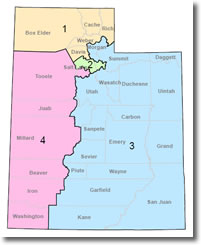
Changes the Second District boundary to encompass Snyderville Basin (just over 7000 people), so they can vote with their neighbors in Park City. Several people at the public hearing in Park City requested this.
Makes Morgan County (about 7000 people) part of the Third District.
Includes the City of Eureka in the Third District.
Puts North Salt Lake in the Second District but keeps Bountiful in the First.
Adjusts the lines in South Salt Lake County in such a way that the population of the four congressional districts are in exact balance. Each congressional district will have an equal population of 558,292, with the exception of District One, which will have a population of 558,293.The Redistricting Committee approved this map 10-1.Next steps: We anticipate being called into a Special Session on Monday, December 4. Then it’s up to Congress.
posted by The Senate Site at 10:46 AM 18 comments

Tuesday, November 28, 2006

Dads Against Drug Dealers

Everyone knows that ‘drugs kill’. Everyone knows that the dealers who sell drugs, actually sell death. You probably know someone who has overdosed. If not, based on current trends, you will, unless we all stand up and do something about it! Our children DO NOT HAVE TO DIE! There are more good people than bad around us. But many are scared to stand up and do something about this monster of addiction. So many people are afraid that by calling the police on their “local drug dealers”, or their children’s friends, the will face violent retaliation! DADDS gives everyone a risk free way of joining the fight. The youth and the users know who the dealers are. Please give us their names. No one will ever find out where the police get the information. You can make a difference!
FIGHT BACK! Help take back our families and our homes!

Please click on this link and read the entire story. This could be your kid....

http://dadsagainstdrugdealers.com/

Monday, November 27, 2006

Spyglass Switching to Commerical List Server


As I had mentioned in a previous post, I have been trying to use the New Google Groups Beta in handling my subscription database for the Spyglass. Even after several attempts to work out the bugs with Google support, I have decided to subscribe to a commercial service that can do exactly what I want without the hassles.

Later this week I will be sending out a formal announcement, including a simple check box to continue receiving The Spyglass email for the day. Un-subscription will be very easy and automatic.

Mark Towner,
The Spyglass

Sunday, November 26, 2006

Fusion Arena?


I have an idea for a new name for the Jazz Arena.

Energy Solutions: Jazz Fusion Arena

What do you think?

The Spyglass

Saturday, November 25, 2006

Congress unlikely to act on Utah/D.C. bill


By Bob Bernick Jr.Deseret Morning News
Next week, a special legislative committee will begin taking around the state three U.S. House redistricting plans. On Dec. 1, GOP Gov. Jon Huntsman Jr. will call a special legislative session where one of these plans — or some variation drawn up by Republican legislators behind closed doors — will officially be approved. That plan will be given to Congress during its lame-duck session with the hope that House and Senate members will approve a bill that gives Utah one extra U.S. House seat and gives the District of Columbia a full-voting House seat. The U.S. House will go from 435 to 437 members, and the long-sought-after goal of giving full representation to residents of Washington, D.C., will be achieved. Or not. And the "or not" side seems to be winning, if you believe Sen. Bob Bennett, R-Utah. Bennett, a member of the GOP-controlled U.S. Senate leadership, says that the Utah/D.C. bill has little chance of passage in the two-week lame-duck session of Congress. Huntsman says if the Utah/D.C. bill is not passed before the first of the year — when Democrats take over control in both the U.S. House and Senate — then Utah is "out of business." He sees little chance of Utah getting an extra seat, as Democrats try to just give D.C. a full-voting seat — something Republicans will no doubt oppose. If all the lame-ducks do line up for Utah, however, then officials say there could be new U.S. House elections in Utah next spring — as all four newly drawn seats must find representatives. Politics is always part of redistricting. But redrawing the seats in mid-decade throws another curve — who in the current Legislature may want to run for office in the newly drawn district? First to the plate may be Utah House Speaker Greg Curtis, R-Sandy. Ironically, Curtis barely survived re-election to his state House seat several weeks ago, a canvass this week showing he won by just 16 votes. There will be a recount, but in this age of electronic voting, recounts usually hold up. Curtis has around $200,000 in his personal campaign account, clearly more than he needs to run his own (if overly close) Utah House race. Leaders often donate to their party candidates so newly elected lawmakers will support them in leadership races. But Curtis had no challenger to his second, two-year term as speaker. So he's sitting on a lot of cash — and most likely will be in the new 4th Congressional District. Others who could be in the race on the GOP side include state Rep. LaVar Christensen, R-Draper, who just lost to U.S. Rep. Jim Matheson in the 2nd Congressional District. There's John Swallow, who lost to Matheson twice, and a slew of other would-be congressmen. All three redistricting plans being taken out for public comment have the southern part of Salt Lake County as the population base of the fourth seat. And two of the plans — Plans I and J if you are watching closely — make Matheson's 2nd District more Democratic. In heavily Republican Utah that may not be saying much — but Matheson won re-election three weeks ago with nearly 60 percent of the vote, his best-ever showing. So it is clear that — at least until the 2011 normal redistricting — Matheson would be better off politically under two of the plans. That doesn't satisfy Utah Democratic Party Executive Director Todd Taylor, who says the quick redistricting now is just another example of a "corrupt system" run by the majority Utah Republicans. Plan A — the third plan going out for comment — is the four-seat plan adopted by the lawmakers in 2001. Back then, legislators adopted a four-seat alternative because state lawyers were suing to get a fourth seat. The U.S. Supreme Court ruled against Utah, and so since then we've been electing three, not four, U.S. House members. And Plan A does not necessarily help Matheson. In fact, it could hurt him politically because he — as he did in the 2001 redistricting plan — will get a whole bunch of new constituents. If Utah gets a fourth seat in the lame-duck Congress, and there are new U.S. House elections in the spring, Matheson could face a bunch of GOP-leaning voters who have not had the chance of casting a ballot for him before. But there are a lot of "ifs" that have to become "facts" before that happens. Most likely, Congress will not act on the Utah/D.C. bill in December. And when Democrats take control in 2007, they could just decide to let things ride until the 2010 Census gives Utah another U.S. House seat.
Deseret Morning News political editor Bob Bernick Jr. may be reached by e-mail at bbjr@desnews.com