Saturday, October 07, 2006

Landslide Revisited

Kevin Drum

October 8, 2006

LANDSLIDE REVISITED....Republicans are in a death spiral:
Democrats now outdistance Republicans on every single issue that could decide voters’ choices come Nov. 7. In addition to winning — for the first time in the Newsweek poll — on the question of which party is more trusted to fight the war on terror (44 to 37 percent) and moral values (42 percent to 36 percent), the Democrats now inspire more trust than the GOP on handling Iraq (47 to 34); the economy (53 to 31); health care (57 to 24); federal spending and the deficit (53 to 29); gas and oil prices (56 to 23); and immigration (43 to 34).
How should Democrats take advantage of this? I boiled down my advice to 200 words for the New York Times two months ago, but it just got printed today. I think it holds up pretty well.—

Friday, October 06, 2006

Democrat ads attack GOP over scandal


By ANDREW TAYLOR, Associated Press Writer Fri Oct 6, 9:19 PM ET


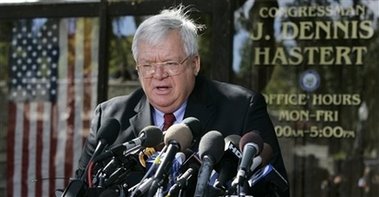
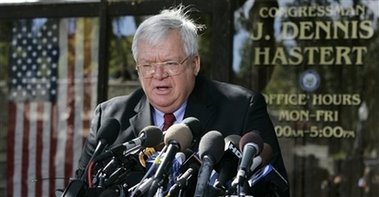
WASHINGTON - More Democrats went on the attack Friday with campaign ads linking Republican candidates to the Mark Foley House page scandal while GOP candidates moved to distance themselves from embattled Speaker
Dennis Hastert' name=c1> SEARCHNews News Photos Images Web' name=c3> Dennis Hastert.

On Saturday, Democrat Patty Wetterling, a candidate for an open House seat in Minnesota, will continue the attack in the Democratic response to
President Bush' name=c1> SEARCHNews News Photos Images Web' name=c3> President Bush's weekly radio address as the party looks to reap political gains in coming midterm elections.
"Foley sent obvious predatory signals, received loud and clear by members of congressional leadership, who swept them under the rug to protect their political power," Wetterling said in the prerecorded address. "We must hold accountable all those complicit in allowing this victimization to happen."
Republican New Jersey Senate candidate Tom Kean Jr. Friday became the first major GOP candidate to call for Hastert to resign, while additional campaign appearances by Hastert for House GOP candidates got canceled. Hastert has come under heavy attack within his party's rank and file for damage inflicted on the party just weeks before the Nov. 7 elections.
"Hastert should resign as speaker," Kean said. "He is the head of the institution and this happened on his watch."
Shelley Sekula-Gibbs, a Republican write-in candidate in the race to replace
Tom DeLay' name=c1> SEARCHNews News Photos Images Web' name=c3> Tom DeLay in Texas, decided not to pursue plans to invite Hastert to raise money for her campaign after the Foley scandal broke.
"We just made a decision not to have" a fundraiser with Hastert, said Sekula-Gibbs' campaign manager, Lisa Diamond.
Democrats stepped up their attacks.
"What is going on in Washington? ... Deborah Pryce's friend Mark Foley is caught using his position to take advantage of 16-year-old pages. Speaker of the House Dennis Hastert looked the other way," says an ad for Democrat Mary Jo Kilroy, challenging seven-term Rep. Deborah Pryce (news, bio, voting record), R-Ohio, the No. 4 Republican in the House in a particularly competitive race.
And in culturally conservative southern Indiana, former Democratic Rep. Baron Hill (news, bio, voting record) took to the airwaves Friday with an ad attacking freshman Republican Mike Sodrel for taking thousands of dollars in donations from House GOP leaders, "who knew about but did nothing to stop sexual predator congressman Foley."
At the same time, Hastert canceled plans to raise money for Sodrel on Tuesday.
Earlier, Rep. Ron Lewis (news, bio, voting record), R-Ky., a Baptist preacher and social conservative, canceled plans for a fundraiser with Hastert, who also dropped an appearance with Ohio GOP candidate Joy Padgett, who is in an uphill race to replace the disgraced Rep. Bob Ney (news, bio, voting record).
The nonstop news cycles for over a week have been filled with details of Foley's lurid messages to former pages and accusations by former top Foley staff aide Kirk Fordham that top GOP aides, including some in Hastert's office, knew about Foley's problems and the issue of the pages years ago.
But with no significant developments Friday, GOP strategists hoped the party could catch its breath and gain traction on issues like lower gas prices, the peaking stock market and the economy. Great skittishness remained about unforeseen developments in the Foley saga, nevertheless.
Democrats are increasingly optimistic that they will retake the House and possibly even the Senate. Even a prominent Senate Republican, John Cornyn of Texas, seemed pessimistic about his party keeping its hold on the House.
"It's happened in the past that we've had divided government in terms of the House and Senate," Cornyn said. "I'm sure we'll do our best to work together to try to address the nation's problems."

What Did Sherri know and when did she know it?


Mark E. Towner, The Spyglass:

The current flap going on in Washington is when did the GOP Leadership know about the pervert Foley, and what did they do about it. The same case can be made here in the County Clerks office. The following is just the tip of the iceberg of the activities that was happening under Sherrie's watch. We had a corrupt auditor and the GOP replaced him. Where is the moral outrage from Rob Miller and the band down at the Utah Democratic HQ....

http://www.oppositionnews.com/sherrie/sherrie.php


The campaign has just now begun, and the gloves are comming off Sherrie.

Wannabe Alienated Establishment said...
I am not the "anonymous" who posted the preceding link to the Carrie Dickson campaign website, nor am I responding to it as part of a contrived and coordinated stunt. However, I must disclose that I am in complete sympathy with its apparent purposes.I have read several of the newspaper articles listed under the "News about Sherrie Swensen" link before. One of them, however, contains a quote that hits me everytime I read it. I think it is very telling:"It's not just the activities of Nick Floros that make me mad," said Democratic County Councilman Jim Bradley. "What really makes me angry is that he got away with it for years. It may be that the good ol' boy network protected him." ("Cronyism is hinted in sealed sex probe - Harassment allegation: Some say a former employee is being protected by his colleagues." Christopher Smart, Salt Lake Tribune, December 18, 2004)Firstly, I am impressed with the integrity of Democrat Jim Bradley in addressing the corruption of fellow Democrat Nick Floros and the "good ol' boy network" that protected him.I think most of us political junkies have a pretty good idea of who he is talking about when he refers to a certain "good ol' boy network." (Democrat insiders, David Yocum, Randy Horiuchi, Joe Hatch, and Sherrie Swensen come to mind.) The fact that Bradley would call them out is impressive. Some things are more important than party affiliation and he seems to get it. God bless him.Secondly, I am frustrated with the lack of quality journalistic coverage of county government issues and races. Because of this defficiency, the average voter in our community has no idea of who they're voting for when they walk into the booth on election day.Yes, the press was there to cover David Yocum's prosecuting of Nancy Workman when she used county funds to subsidize the services of an employee for her daughter at the Boys and Girls Club. (She, of course, was later exonerated of any criminal wrong doing.) But, where were they when David Yocum allegedly used his office to provide official favors for his son?There have been allegations that David Yocum made his son's recent DUI arrest quietly go away. This is the same son, Jason Yocum, who took Nick Floros' place as Sherrie Swensen's chief deputy. If this "good ol boy network" that Jim Bradley refers to really does exist, then why doesn't Salt Lake's media cover it?If they did, maybe the voters could provide a little housecleaning this year. Goodness know that it is far overdue.


4:59 PM

ICEBERG AHEAD Captain Hastert....


by Rebecca Sinderbrand


ICEBERG AHEAD?: This town is full of gloomy Republicans these days; on my way down H Street a couple of hours after the Hastert press conference, I ran into one of them, a young veteran of half a dozen races since high school, including the last Bush campaign. He's been biding his time till 2008 in the lucrative lobbying-industrial complex over on K Street ("Gotta stop renting someday," he says.) I asked him: in his opinion, would congressional leadership changes now could make a difference for Republican prospects this fall? "Sure," he said. "Like re-arranging deck chairs on the Titanic probably made for a smaller splash."
Dennis Hastert may have thought his Thursday statement struck the perfect note of stalwart defiance -- but a little something may have gotten lost in the delivery. Because what Republicans actually heard, according to this GOP operative, was something along the lines of: "OK, everybody. On my mark... time to panic!" (Apparently, FOX News picked up on the message, too.) —Rebecca Sinderbrand 9:57 AM Permalink Trackbacks Comments (0)

HASTERT'S Bonanza, where's little Joe

Mark E. Towner, The Spyglass, from just a few minutes ago....

October 7, 2006

HASTERT'S BONANZA....I made a brief, snarky reference to this a couple of days ago, but Norman Ornstein and Scott Lilly give Dennis Hastert's shady real estate dealings the attention they deserve in the New Republic today.

Here's the nickel summary: In 2002 Hastert bought some land for a house along with some adjoining fields. He paid about $5,200 per acre for the fields.

Eighteen months later, he formed a land trust with a couple of local Republican politicos. The trust bought 69 acres of land adjacent to Hastert's for about $15,000 per acre (it was nearer a road and therefore more valuable) and Hastert then added 69 acres of his own land to the trust. Although his 69 acres had been worth only $5,200 per acre a year and a half earlier, the trust valued his land at the same $15,000 per acre as the new land, three times its original price. Sweet, huh?

Then, Dennis Hastert decided to enter the earmark hall of fame. A highway bill was wending its way through Congress at the time, and Hastert took a special interest in it:

There was no better object lesson in the case against earmarks than the Prairie Parkway Corridor, pushed by none other than Denny Hastert. This new highway, designed to connect the counties west of Chicago to the metropolis itself, had neither the support of the public nor the Illinois Department of Transportation....But the Prairie Parkway did offer one important convenience: It was located just over a mile from the property owned by Hastert's trust.

....In December of 2005, four months after the signing of the new Federal Highway Bill containing the $207 million inserted by Hastert for construction of the nearby Prairie Parkway, the 138 acres held by the trust were sold to a developer as part of planned 1600 home housing development. The trust received $4,989,000 or $36,152 an acre for the parcel of which 62.5 percent or $3,118,000 went to Hastert. Klatt and Ingemunson also did well. Their profit equaled 144 percent of their original investment. Hastert, however, received six times what he had paid for his investment, a profit equal to 500 percent of his original investment.
What's more, Hastert still has over a hundred acres left from the parcel he originally bought in 2002. That land is worth double, or maybe more than double, what he originally paid for it. Ornstein and Lilly finish up with this observation:

The speaker hasn't exactly helped his case with his accounts of the transaction. His office has, for instance, described the Prairie Parkway as located over five miles from his property. But U.S. Geological Survey aerial photographs clearly show it to be about four miles closer than that.
We cannot say at this juncture whether the actions taken by the speaker are illegal. We can say that they do not meet the standards we expect — or should expect — from a member of Congress. And they certainly do not meet the standards we expect from the speaker of the House.

No, they don't.—Kevin Drum 1:08 AM Permalink Trackbacks Comments (7)

Thursday, October 05, 2006

Mark "Mustang" Towner wants a check ride?


Mark "Mustang" Towner says: New jet is good news for Hill base
Air Force's decision to deploy F-35 in Utah is a major boost
By Robert Gehrke and Matthew D. LaPlante The Salt Lake Tribune

Shad Stromberg is eager to get his hands on the controls of the Air Force's newest plane, the F-35A Lightning II. As a pilot at Hill Air Force Base, he is likely to be one of the first. The Air Force announced Wednesday that Hill has been selected to receive one of the first three squadrons of F-35s, a major boost for the future of the base. As many as two dozen of the so-called "Joint Strike Fighter" jets are due to arrive sometime after 2009. The decision would give Hill the Air Force's latest, stealth-equipped jets that cost $112 million apiece. Designed to replace the aging F-16 Falcon, the Lightning is expected to be a front-line weapons system created to hit ground targets without being detected, while still having air-to-air combat capabilities. Former U.S. Rep. Jim Hansen, recently released as a commissioner in the military facility review process known as Base Realignment and Closing, said the decision may significantly insulate Hill from future cuts. He said the Lightning would give Hill an operational mission for decades to come - much the way the Falcon did when it arrived in Utah in the mid-1980s. "At that time, the F-4 was a vanishing breed - it was a great airplane, it had done a wonderful job in Vietnam, but we could see it was going out and the F-16 was coming on," said Hansen, who sat on the House Armed Services Subcommittee as the military debated where to base its Falcons. "Now the F-16s are getting older and everyone wants to be the first base to have the F-35s, and so we're very fortunate to get it. What it means is that Hill is going to be in pretty darn good shape." It's unclear how long Hill has been in the running for the jets. Pentagon officials said the decision materialized over the past few months, while Hill insiders said the base had been selected as early as January. As late as April, however, base officials claimed to have no record of any discussions that had taken place about Utah's suitability to house a Lightning squadron, but then said Wednesday that the process may in fact have been under way earlier than that. Obtaining a Lightning squadron for Hill has been a longtime goal of the Utah Defense Alliance, which has lobbied to keep Hill viable by bringing new missions, technologies and weapons systems to the Davis County base. Vickie McCall, a member of the alliance's executive committee, said the goal took on added importance after Hill was passed over as a location for the Air Force's F/A-22 fighter. Now she thinks Utah got the better end of the deal: A fighter jet, expected to be produced in quantities far greater than the F/A-22 fleet and anticipated to be adaptable to a variety of missions. "It will certainly carry us well into the future," she said. "This is the most modern fighter aircraft. If certainly gives us a workload and mission for Hill Air Force Base for years to come." Retired Gen. Lester Lyles, a former commander of the Air Force Materiel Command at Hill Air Force Base, said he was delighted by the news. The Lightning, he said, "is absolutely state-of-the-art. It is going to be more than just the F-16 of the future. It is going to be the mainstay for years to come." Not everyone agrees with that assessment, though. Initially intended to go into production at about $30 million per plane, the cost of development has ballooned over the past years, to a point where some have suggested that the jet is no longer a viable option for the military. Each plane, manufactured by Lockheed Martin, is now expected to cost about $50 million. But when research and development costs are factored in, the projected price tag already reaches about $112 million, according to a report from the Congressional Research Service. "It's still a paper airplane. We have no clue what the actual performance is. We do know the weight and cost have gone way up," said Winslow Wheeler, director of the Straus Military Reform Project at the Center for Defense Information. "It looks like it's going to be a dog." But the military remains confident enough in the aircraft that leaders expect it to meet a variety of future needs across three service branches. Several allied nations also will receive variations of the jet, which may bring foreign air forces to Hill for training. To get the Lightning, Hill still must pass an environmental study, which can take up to two years, although Air Force officials said it is unlikely that the effect of the F-35 will be much different than the F-16s that frequent the Beehive State skies. That obstacle appears so surmountable, in fact, that Utah politicians eagerly heralded the announcement as the dawning of a new era in the state's long military history. "This is terrific news for Hill and for Utah," said Sen. Orrin Hatch, R-Utah. "It's going to keep Hill strong for decades." Said Rep. Rob Bishop, R-Utah: "Not only is the F-35 vital for the future flying mission of Hill Air Force Base, but it is also the foundation of future jobs at the base." "This designation marks Hill Air Force Base as a base that well represents the future of the Air Force for generations to come," added Gov. Jon Huntsman Jr. Nearly every official contacted by The Salt Lake Tribune said Hill's proximity to the Utah Test and Training Range likely played heavily into the Air Force's decision. Hatch said the Utah delegation's willingness to help the Air Force also may have helped. "The Air Force knows we've been carrying a lot of mail for them," Hatch said, pointing most recently to the Utah delegation's fight to win the Air Force the authority to sign a multiyear procurement contract it wanted for the F/A-22, over the objections of senior senators on the Senate Armed Services Committee. "It made it clear to the Air Force who their friends are." Hatch said he also had pressed Utah's case with Defense Secretary Donald Rumsfeld, Air Force Secretary Michael Wynne and Gen. Mike Moseley, the Air Force's chief of staff. The deal does come with some consequences, though. It could mean that Hill pilots and their new F-35s could be among the first to be thrust into future conflicts with the United States' best-armed enemies. "If it's a relatively low-threat area - Afghanistan, Iraq, that type of stuff - they may be inclined to send A-10s and F-16s. If it's a higher threat area, they're going to hope the F-35 meets its performance promises," Wheeler said.

Charlie Cook says US leaning Democrat now


Mark Towner, The Spyglass:

Shift Toward the Democrats
With a disastrous last several days, including the Foley scandal, momentum that had been shifting toward the Republicans in maintaining control of Congress has turned back in favor of the Democrats, says Charlie Cook in his “Off to the Races” NationalJournal.com column. ... Remember the bar scene in Star Wars? That’s what the U.S. Congress is beginning to resemble as it is engulfed in scandals and an inability to get much done. And that is reflected in its approval ratings, as noted by the Washington Post’s The Fix blog. ... Utah’s Legislature doesn’t make any list of legislatures in danger of changing party control in Lou Jacobson’s state legislative races outlook.


Busy in New Hampshire
Mitt Romney’s Commonwealth PAC has issued a press release (no link available) announcing a New Hampshire steering committee consisting of no less than 58 prominent leaders from every county in the state. … Romney gets a lot of support in comments by conservatives (scroll down to comments) in response to Dr. James Dobson’s comments that conservative Christians won’t support Romney.

Democrats GOT PAID BIG TIME FROM ABRAMOFF

Mark Towner, The Spyglass says:
OK LIBERAL BLOGGERS EXPLAIN THIS ONE AWAY!!!
I LOVE BLOGGING THE TRUTH!!

Most Senate Dems Took Abramoff CashNearly ninety percent of Senate Democrats took money linked to disgraced "Republican" lobbyist Jack Abramoff, according to a list compiled by the Republican National Committee.Though reporters continue to insist that the Abramoff imbroglio is "a Republican scandal," 2008 Democratic presidential frontrunner Hillary Clinton took more than $12,000 in tainted cash.Compared to the party's 2004 standard bearer, however, she's a piker. John Kerry raked in nearly $100,000 in Abramoff-linked donations.In fact, 40 of the party's 45 U.S. senators made the Jack Abramoff dishonor roll, including:• Senator Max Baucus (D-MT) Received At Least $22,500 in Abramoff-linked cash.• Senator Evan Bayh (D-IN) Received At Least $6,500 in Abramoff-linked cash.• Senator Joseph Biden (D-DE) Received At Least $1,250 in Abramoff-linked cash.• Senator Jeff Bingaman (D-NM) Received At Least $2,000 in Abramoff-linked cash.• Senator Barbara Boxer (D-CA) Received At Least $20,250 in Abramoff-linked cash.• Senator Maria Cantwell (D-WA) Received At Least $21,765 in Abramoff-linked cash.• Senator Tom Carper (D-DE) Received At Least $7,500 in Abramoff-linked cash.• Senator Hillary Clinton (D-NY) Received At Least $12,950 in Abramoff-linked cash.• Senator Kent Conrad (D-ND) Received At Least $8,000 in Abramoff-linked cash.• Senator Jon Corzine (D-NJ) Received At Least $7,500 in Abramoff-linked cash.• Senator Chris Dodd (D-CT) Received At Least $14,792 in Abramoff-linked cash.• Senator Byron Dorgan (D-ND) Received At Least $79,300 in Abramoff-linked cash.• Senator Dick Durbin (D-IL) Received At Least $14,000 in Abramoff-linked cash.• Senator Dianne Feinstein (D-CA) Received At Least $2,000 in Abramoff-linked cash.• Senator Russ Feingold (D-WI) Received At Least $1,250 in Abramoff-linked cash.• Senator Tom Harkin (D-IA) Received At Least $45,750 in Abramoff-linked cash.• Senator Daniel Inouye (D-HI) Received At Least $9,000 in Abramoff-linked cash.• Senator Jim Jeffords (I-VT) Received At Least $2,000 in Abramoff-linked cash.• Senator Tim Johnson (D-SD) Received At Least $14,250 in Abramoff-linked cash. • Senator Ted Kennedy (D-MA) Received At Least $3,300 in Abramoff-linked cash. • Senator John Kerry (D-MA) Received At Least $98,550 in Abramoff-linked cash. • Senator Mary Landrieu (D-LA) Received At Least $28,000 in Abramoff-linked cash. • Senator Pat Leahy (D-VT) Received At Least $4,000 in Abramoff-linked cash. • Senator Carl Levin (D-MI) Received At Least $6,000 in Abramoff-linked cash.• Senator Joe Lieberman (D-CT) Received At Least $29,830 in Abramoff-linked cash. • Senator Blanche Lincoln (D-AR) Received At Least $14,891 in Abramoff-linked cash.• Senator Barbara Mikulski (D-MD) Received At Least $10,550 in Abramoff-linked cash.• Senator Patty Murray (D-WA) Received At Least $78,991 in Abramoff-linked cash.• Senator Bill Nelson (D-FL) Received At Least $20,168 in Abramoff-linked cash.• Senator Ben Nelson (D-NE) Received At Least $5,200 in Abramoff-linked cash. • Senator Barack Obama (D-IL) Received At Least $7,500 in Abramoff-linked cash.• Senator Mark Pryor (D-AR) Received At Least $2,300 in Abramoff-linked cash.• Senator Jack Reed (D-RI) Received At Least $3,500 in Abramoff-linked cash.• Senator Harry Reid (D-NV) Received At Least $68,941 in Abramoff-linked cash.• Senator John Rockefeller (D-WV) Received At Least $4,000 in Abramoff-linked cash. • Senator Ken Salazar (D-CO) Received At Least $4,500 in Abramoff-linked cash. • Senator Paul Sarbanes (D-MD) Received At Least $4,300 in Abramoff-linked cash. • Senator Chuck Schumer (D-NY) Received At Least $29,550 in Abramoff-linked cash.• Senator Debbie Stabenow (D-MI) Received At Least $6,250 in Abramoff-linked cash. • Senator Ron Wyden (D-OR) Received At Least $6,250 in Abramoff-linked cash.Senate Minority Leader Harry Reid (DEMOCRAT-Nev.), who received at least $68,941

HAFB likely to get new jet fighters

Mark "Mustang" Towner, The Spyglass says: Ok Rob B, Orrin H, Chris C and Bob B, I want a check ride the first day they land at HFB OK?


F-35A squadron would ensure future of the base
By Suzanne Struglinski and Joseph M. DoughertyDeseret Morning News
WASHINGTON — A squadron of the Air Force's most cutting-edge fighters could arrive at Hill Air Force Base in 2009, securing the base's future and potentially boosting the state's economy, the Air Force said Wednesday.

The Air Force plans to begin an environmental analysis with the aim of using Hill to house operational squadrons for the F-35A Lightning II, a stealth fighter intended to be the replacement for F-16 and A-10 fighters, which will eventually be phased out. >No A-10 squadrons are based at Hill, although the base does maintenance work on the planes for other bases. But Hill is home to three squadrons of F-16s, or about 70 of those planes. The study could take up to two years, and the first plane could be delivered by 2009, the Air Force said. As many as 24 of the F-35A aircraft, also known as Joint Strike Fighters, could come to the Utah base. Just last week, the defense spending bill passed by Congress included $5.5 million for a public-private partnership by Utah-based Alliant Techsystems Inc. and Hill's Ogden Air Logistics Center to improve production of composite-technology parts needed for the F-35A. Rep. Rob Bishop's senior policy adviser on defense, Steve Petersen, said the environmental study is just a formality, meaning the planes are more than likely to come to Utah. "We don't foresee any show-stoppers there," Petersen said. He said the Air Force's announcement was as big for Utah as when Hill learned it would get F-16s in 1979. The new jets will bring personnel and resources to the base, and will almost certainly protect the base from future closure considerations, he said. "It cements the role of Hill Air Force Base and the Ogden Air Logistics Center in the future as the premier fighter depot," Petersen said. Bishop, R-Utah, represents the 1st District, which includes Hill Air Force Base. He said he always believed the base was a "natural location" for the new jets but "never wanted to take it for granted."

"As the Air Force aircraft inventory ages and budget pressures increase, obtaining the latest and most technologically capable weapons system at our base is crucial," Bishop said. Rick Mayfield, executive director of the Utah Defense Alliance, agreed that the F-35As will help shore up the future of Hill Air Force Base. The alliance, which has been in existence since 1993 to fight periodic rounds of base realignments and closures, most recently lobbied to keep Hill off the Department of Defense's chopping block in 2005. If Hill had closed in 2005, it would have devastated the economy in northern Utah. As the largest employer in Davis County, Hill employs about 23,000 people and pumps $2 billion into Utah's economy, Mayfield said. Retired Army Col. Gary Harter, director of the defense and homeland-security division in the Utah Governor's Office of Economic Development, said the Defense Department now spends less than 1 percent of its budget — about $3.5 billion — on its installations, contractors and services in Utah. He hopes Utah businesses can compete for more contracts and bring more military jobs to the state to the point that the Defense Department is spending $7 billion by 2011. The F-35A is "a nice shot in the arm for us, no doubt about it," Harter said. Petersen said last year's approval of Bishop's bill to create the Cedar Mountain Wilderness Area that protects the Utah Test and Training Range — where Hill's pilots train — was a "key component" of the Air Force's decision to put the jets at Hill. Bishop's bill, supported by the entire congressional delegation, blocked a rail line that would have brought nuclear waste to a proposed storage site in Tooele County and preserved the training-range land from development. Petersen said the time frame for the F-35As' arrival at Hill depends on the plane's production schedule and decisions on funding from Congress. For 2007, the president requested enough money for five planes, but the final defense spending bill approved last week included enough for only two, according to the office of Sen. Orrin Hatch, R-Utah. The final bill included $4.3 billion for continued research into the F-35A, and the conference committee noted that it wanted more testing on the jets before the government buys them on a large scale. The planes cost about $50 million apiece, and they represent "brand new, state-of-the-art technology," Hatch said. "It's going to keep Hill strong for decades." Bishop and Hatch lobbied the Air Force hard for the planes to come to Hill, spelling out that there would be no better place to put them. "Ever since we heard this was coming up, we made the case it should be at Hill," Hatch said. The Air Force intends to purchase more than 1,700 of the F-35As over a 16-year period, beginning in 2009. Kadena Air Base, in Japan, and Shaw Air Force Base and McEntire Air National Guard Station, in South Carolina, will also be studied as bases for the fighters, according to the Air Force. "The capabilities we provide the joint warfighter are in high demand, yet we have the oldest aircraft inventory in our history," said Gen. T. Michael Moseley, Air Force chief of staff. "The Air Force will continue to invest in advanced capabilities needed to defeat the emerging technological advances of our adversaries." Lt. Beth Woodward, spokeswoman for the 388th Fighter Wing at Hill Air Force Base, said teams plan to analyze the various bases for suitability and hear community concerns over the next few months. More information on the F-35A can be found at www.jsf.mil/.
E-mail: suzanne@desnews.com; jdougherty@desnews.com

Wednesday, October 04, 2006

House leader to resign, take economic development post

Mark Towner, The Spyglass says: You will be missed Jeff


By Josh LoftinDeseret Morning News
The floor general for the House Republicans will be stepping down before the end of the year to help attract corporate headquarters to the state. Jeff Alexander House Majority Leader Jeff Alexander, R-Provo, announced Tuesday that he plans to relinquish his legislative post sometime in November or December to begin serving as the headquarters adviser for the Governor's Office of Economic Development. Primarily, his duties will be helping develop a strategy to attract corporate headquarters to Utah and to eventually market the state to executives looking to relocate. When he wins his unchallenged race for District 62 in November, he will have been elected to his eighth term in office, after first being elected in 1990. When he resigns, Republican delegates in his district will choose a new representative who will then serve essentially a full term. Because the Office of Economic Development position is part time and unpaid, Alexander will be able to focus on running his printing business. While legislative work is also ostensibly part time, being a member of the House leadership team had become essentially a full-time job. "I've always had an interest in economic development and in helping (Gov. Jon Huntsman Jr.) further his initiatives," he said. "It sounded like a great opportunity." Jason Perry, executive director of the Office of Economic Development, said that they recruited Alexander because of his 30 years experience running a business and his political experience. Because "he speaks the language" of business, he can also help highlight the benefits of moving to the state. "He can really help sell us and answer the question of 'why Utah?,"' Perry said. House Minority Leader Ralph Becker, D-Salt Lake, said he was surprised because of Alexander's lengthy history in the Legislature. As far as a leader, Becker described him as "both quick-witted and quick to decide what needed to be done" and said he always found Alexander amiable.

"He was somebody that I could always reach across the aisle and have very straight conversation with," Becker said. Alexander's resignation will spare him a fierce fight with at least Rep. Dave Clark, R-Santa Clara, to retain his leadership position, which some political insiders were saying he would lose. Part of Alexander's problem is a backlash against the heavy Utah County representation in leadership, which some Republicans felt was disproportionate, and his clashes with some members during the past general session. Out of all of his legislative accomplishments, he is most proud of the work done in the last session, when Republican leaders from the House and Senate and Huntsman spent hours crafting a last-minute budget compromise that reduced the sales tax on food by 2 percent, cut $20 million in business input taxes and provided $70 million for an income tax reduction.
Contributing: Bob Bernick Jr.E-mail: jloftin@desnews.com

Monday, October 02, 2006

Meet the New Senate Bossman


This ia a very long article, but it says alot about the current attitude in Washington.


Meet the New BossQuietly, Senate Republicans have already chosen Mitch McConnell as their next leader—because Congress just isn’t partisan enough. By Zachary Roth & Cliff Schecter

One of the Senate’s quirkier traditions was inaugurated in the late 1990s by then-Majority Leader Trent Lott (R-Miss.). On certain summer Thursdays, Lott decreed, members should leave their customary dark blue and gray suits at home and, as a tribute to southern fashion, instead conduct the people’s business in pale blue seersucker. Sen. Bill Frist (R-Tenn.), a fellow southerner and Lott’s successor as leader, has kept the ritual alive. Lawmakers no doubt welcome the chance to don a cooler fabric in the sweltering Washington heat, but the style doesn’t always produce the best optics: On a Thursday in mid-June, many of the Republicans who gathered to discuss the situation in Iraq—where the American death toll had that day hit 2,500—looked less like U.S. senators gravely weighing issues of war and peace, and more like Pat Boone.But in their suggestion of a party dangerously out of touch with popular sentiment, the outfits were, perhaps, appropriate. Over the previous few weeks, positions on Iraq had begun to harden in a way that left the GOP politically vulnerable. Thanks to pressure from the White House and a short-lived uptick in support for the war in the wake of the killing of the Jihadist leader Abu Musab al-Zarqawi, House Republicans were rapidly lining up behind a resolution affirming support for President Bush’s “stay-the-course” approach. Meanwhile, Senate Democrats were unifying behind a resolution of their own, backed by leadership, calling for troop withdrawals to begin this year. With the public already favoring a pullout and growing only more frustrated with the war effort every day, the coming clash between these two positions looked likely to favor Democrats. The party was not in total agreement, however. Earlier that week, Sen. John Kerry (D-Mass.) had filed a sweeping amendment to a defense bill requiring all U.S. troops to be pulled out of Iraq by July 2007. Knowing his measure would attract little support as written, and hoping to maintain a unified Democratic message, Kerry had informed Sen. John Warner (R-Va.), who was managing the defense bill, that he was not yet ready to offer it for a vote. Warner agreed to give Kerry more time, then left the Capitol building to attend a memorial service at the Pentagon for victims of 9/11.

Soon afterwards, Sen. Mitch McConnell (R-Ky.), the Senate number two, rose to speak, his light blue tie elegantly setting off the pinstripes. A pale, graying, and somewhat slight man of 64, McConnell looks more like a financial planner than a politician. He has an unblinking, vaguely android-like stare and gives the impression, even when speaking, of wanting to avoid being noticed. But today, he could not keep a hint of a smile from flickering across his normally impassive features. “Colleagues on the other side have said they were going to offer an amendment to advocate withdrawal by the end of the year,” he reminded the chamber. “Let’s have that debate.” With that, McConnell took Kerry’s measure, scratched out the Democrat’s name, replaced it with his own, and offered it for a vote.The move seemed to take even McConnell’s Republican colleagues by surprise. Frist, who had just arrived on the floor—white spats complementing the seersucker—referred to the “Kerry amendment,” and appeared momentarily confused when told that the pending measure was now, in fact, the McConnell amendment. Even C-SPAN was fooled, informing viewers in an on-screen graphic that the Senate was considering the Kerry amendment. Whatever its name, the measure was rejected by a vote of 93-6. Democrats denounced what Kerry called a “fictitious vote,” and even Warner tried to distance himself from McConnell’s maneuver, informing his colleagues that it had been carried out in his absence.McConnell, though, was unashamed. He stood, grinning, on the Senate floor for a long time, his hands clasped placidly in front of him as if at church, as colleagues came up to chat—one gave him a congratulatory pat on the back as he passed. Then he took a victory lap around the press gallery, telling reporters “it has been interesting to watch the Democrats have this debate within their caucus,” while Kerry and Minority Leader Harry Reid (D-Nev.) struggled to respond. As McConnell anticipated, the storyline that emerged in news reports over the next few days was that the Senate had overwhelmingly rejected a quick Iraq pullout and that the Iraq issue was uniting Republicans and dividing Democrats.The maneuver was typical of McConnell, the Senate Majority Whip, who over a 22-year Senate career has earned a reputation as a shrewd parliamentary tactician and a ruthless partisan warrior. Those qualities are a major reason why, while the outcome of the November midterms remains up in the air, one election has already been all but decided. In January 2007, Frist will step down, and for the last two years, almost below the radar, McConnell has had the race to replace him as Senate Republican leader—and if Republicans maintain control, Senate Majority Leader—virtually locked up.That someone with McConnell’s political style stands to assume what is arguably the third-most-powerful elected post in the federal government speaks volumes about the state of the contemporary Republican Party—and about Washington in general. McConnell is a staunch conservative and a master of procedure, but no piece of landmark legislation bears his name. Almost the only issue on which he has a national profile is campaign-finance reform, and on that, he’s known as the man who fought it at every turn. Republican strategist Grover Norquist—who once compared bipartisanship to date-rape and played a key role in creating the system that uses corporate money to maintain Republican control—told us that if he could pick the president, McConnell would be among his top three choices. (Jeb Bush would be another, and Norquist was uncharacteristically coy about the third.) Indeed, McConnell’s political persona—with its focus on bare-knuckled partisanship and support for a money-driven legislative system—embodies the very qualities that have helped reverse Republican political fortunes so dramatically over the last year and a half, and have led directly to a series of government scandals and slipups. In uniting around Mitch McConnell, Republicans are, in effect, doubling down on the governing style that got them, and us, into this mess in the first place.
Not your father’s SenateThe Senate has long been the more deliberative, less partisan of the two houses of Congress—the saucer that’s used to cool the House’s legislation, as George Washington is said to have put it. For much of the 20th century, senators saw themselves less as creatures of their party than as independent actors—statesmen, even—charged with dispassionately weighing the issues of the day. In order to avoid having to hold countless votes on mundane procedural issues, senators often simply request, and receive, unanimous consent to proceed. Such a system requires a basic level of mutual cooperation and respect, since any recalcitrant member could, in theory, object, and thereby bring the whole chamber to a halt. Because 60 votes (at one time it was 67) are required to pass controversial legislation, leaders customarily have had little choice but to govern in a conciliatory spirit. The first significant sign of a shift away from this model occurred in 1989 with an event over in the House: the election of Newt Gingrich as Minority Whip. Gingrich and his followers, many of them backbenchers, sought an ideological revolution to ensure that Congress was run in accordance with strict conservative principles. They viewed their party’s leadership as overly accommodating to Democrats, and sought to overturn the established seniority-based system by which the House was governed. Gingrich soon began pressuring GOP moderates not to vote with the Democrats—not only to increase his party’s unity, but also to deny moderate and conservative Democrats the cover they needed to buck their own leaders. By forcing these Democrats, many of whom represented conservative districts, to vote with their more liberal party leadership, Gingrich reasoned, he could make them unpopular at home, and ultimately beat them, creating a Republican majority. “It was a deliberate strategy of emphasizing differences and becoming intolerant of compromise,” says Steven Smith, an expert on Congress at Washington University in St. Louis. It took a while for that strategy to filter into the Senate. Before the 1994 Republican takeover, the chamber still functioned under the assumption that you needed to work across the aisle to get anything significant accomplished. “Everything was totally bipartisan,” says a former senior Senate Democratic aide. “The first thing you did [when crafting legislation] was, ‘who’s your Republican?’ That was just how you operated.” But in the first year of the Clinton administration, conservative opinion leaders like William Kristol began urging Republicans to adopt a scorched-earth policy of opposition to the president—most prominently over his health-care plan, but also more broadly. Around the same time, Senate Republican leader Bob Dole, who was eyeing a presidential run and feeling the need to prove his conservative bona fides, announced that he intended to block Clinton at every turn. Soon after, freshmen Republican senators like Rick Santorum of Pennsylvania and James Inhofe of Oklahoma, who had cut their teeth in the House, began importing Gingrich’s tactics to their new home. Early in 1995, when moderate Sen. Mark Hatfield (R-Ore.) voted against a GOP-backed constitutional amendment mandating balanced budgets (those were the days!), angry colleagues lobbied to have him stripped of the chairmanship of the Appropriations Committee. By 2001, Sen. Jim Jeffords of Vermont was so fed up with the Republican move toward strict partisan discipline and away from the moderate, consensus-based deal-making on which he had always prided himself, that he left the party, briefly handing control of the Senate back to the Democrats. “I think the impetus for a lot of this came from Republicans,” says Norman Ornstein, a congressional expert at the conservative American Enterprise Institute and a co-author of The Broken Branch: How Congress is Failing America. “And it’s been exacerbated by having Republicans with all the reins of power.” The Senate’s shift toward increased party discipline has been accompanied by a growing willingness to use the legislative process to benefit the Republican Party’s financial backers. The more tightly the majority leadership controls the Senate’s agenda, the more likely it is that special interests will conclude that getting anything accomplished requires working with that leadership. Demands that lobbying firms hire only Republicans will carry more weight because lobbyists recognize that Republicans alone control the legislative process. Still, until now, Senate leaders have mostly been reacting to external forces pushing the chamber in a more partisan direction, rather than leading the shift themselves. George Mitchell, the Maine Democrat who ran the Senate from 1989 to 1995, and his successors, Dole and Lott, were all fierce partisans, but they saw themselves first and foremost as dealmakers, and defined success by the number of pieces of major legislation passed on their watch. Frist has been a very different kind of leader. As a newcomer considering a presidential run, he has had no objection to turning the chamber into an arm of the Republican governing machine. But his incompetence has prevented him from doing so. His weak grasp of Senate procedure has allowed his more senior counterpart, Harry Reid, to outmaneuver him time and again. “On many days with Frist in charge, the place is barely functioning,” says a Senate Democratic aide. As the gambit over Kerry’s Iraq amendment showed, McConnell has no such weaknesses. He’s a master of Senate rules and procedures, and he harbors no presidential aspirations that might distract him from his job. But unlike earlier leaders, he doesn’t keep score by legislative accomplishments. For the first time in recent memory, the Senate will be run by a leader with both the ability and the desire to use the institution entirely for partisan advantage.
The hustlerWhen Addison Mitchell McConnell was two years old, he was diagnosed with polio. Though he remained able to walk, doctors, fearing that pressure could make his legs develop abnormally, instructed his mother to keep her son off his feet for several years. Adhering to this stricture seems to have forged in McConnell a kind of dogged determination, as well as a faith that patient, disciplined effort will ultimately be rewarded. Today, the only sign of his childhood illness is a slight limp when he walks down steps.McConnell has been in training all his life for the job he will take over next year. He caught the political bug as a young man, getting elected student body president at the University of Louisville, then student bar president at the University of Kentucky law school. After poor eyesight kept him out of Vietnam, he came to Washington to intern with Kentucky’s Republican senator, John Sherman Cooper, and eventually worked in the Justice Department during the Ford administration. In 1978, McConnell won his first elective office, county judge executive for Jefferson County, but he had his eye on bigger things. A few years later, a group of Kentucky political journalists threw a birthday party for Louisville Times columnist Bob Hill. Hill had a famously poor relationship with McConnell, so, as a joke, Hill’s friends invited McConnell along. McConnell arrived with an attractive blonde on his arm (he would later marry Elaine Chao, now the Secretary of Labor), then proceeded, calmly and methodically, to lay out for the assembled reporters his plan to win a U.S. Senate seat in 1984 by using a socially conservative message and hard-hitting TV advertising. Few of McConnell’s listeners took him seriously—Kentucky was a solidly Democratic state, and his prospective opponent, Sen. Dee Huddleston, was popular. But McConnell followed his plan to the letter: To make the point that Huddleston was not spending enough time in the Capitol, McConnell ran TV ads that showed bloodhounds sniffing around Washington trying to pick up the senator’s scent, and ended with a shot of Huddleston’s name plaque visible on his unoccupied Senate desk. Helped by Ronald Reagan’s landslide presidential win that year, McConnell pulled off an upset victory by less than half a percentage point.Since arriving in Washington, McConnell has used two major tactics to get to the top. He has ensured himself a steady flow of campaign dollars by going all out on behalf of the Republican Party’s financial backers—and has then used these contributions to build his own, and his party’s, political power. At the same time, he seems to understand that with his grey demeanor and indifferent communication skills, he’s poorly suited to adopt the kind of high-profile, media-friendly causes that most U.S. senators (think John McCain) compete to associate themselves with. Instead—like the short, unathletic kid who wins a place on the high-school basketball team by hustling, playing defense, and washing the uniforms—he has gained the support of his colleagues by shrewdly focusing on the less glamorous, behind-the-scenes grunt work, while acting as a frontman for unpopular causes that bring negative publicity others would rather avoid. McConnell cut his teeth by running the Ethics and Rules committees in the ‘90s. These were low-profile positions, but ones that gave him crucial leverage with his colleagues on the quality-of-life issues—assigning office space, and overseeing the Senate restaurant, for instance—that senators care about. In 1997, he took over the chairmanship of the National Republican Senatorial Committee (NRSC)—a position that allowed him to decide which GOP candidates received money and other electoral help from the national party, and so helped build his support within the caucus. The following year, with voters angry over the Republican Congress’s impeachment of President Clinton, many expected the GOP to lose Senate seats. But McConnell counseled his candidates to adopt a strategy of barraging their opponents with negative advertising, and it proved enough to avoid any losses. (In the House, by contrast, Republicans lost five seats.) “He understands politics as well as anybody I’ve ever seen,” says Dave Hansen, who was the NRSC’s political director under McConnell. The Kentuckian’s colleagues seem to have appreciated his contribution: When Sen. Chuck Hagel (R-Neb.) challenged him for the NRSC job the following year, McConnell crushed him by 39 votes to 13.McConnell also used the NRSC position to protect and deepen the relationship between the Republican Party and its biggest financial backers. In 1998, John McCain was pushing legislation that would have raised cigarette taxes and increased regulation of the tobacco industry—which, aside from being by far the GOP’s biggest corporate backer, industry-wide, at the time, was also a major player in McConnell’s home state. Fearing that voters would punish Republicans in November if they appeared to be favoring their contributors over public health, McConnell at first advised Lott, then the Senate leader, to support a version of the bill. But McConnell’s calculus changed after a poll, sponsored by the tobacco industry, revealed that Americans placed a relatively low priority on fighting smoking. Republican senators up for reelection, he concluded, could oppose the bill with impunity. And at a closed-door meeting of the GOP Senate caucus, McConnell, in his role as NRSC chair, stood up to announce that the tobacco industry had agreed to run ads in support of Republicans, defending them against Democratic charges of killing the bill. “We can walk away from this,” McConnell now advised Lott, according to Time magazine. Days later, McCain’s bill was dead.McConnell also knows how to use threats. When a group of Republican senators signed onto a campaign-finance reform measure in the late ‘90s, McConnell, in his position as NRSC chair, advised them that they could expect no electoral support from the committee unless they switched their position. At least one, Sen. Sam Brownback (R-Kan.) did so after receiving McConnell’s warning. Then in 1999, when the Committee for Economic Development (CED)—a trade group representing large corporations—announced its support for a ban on soft money, McConnell wrote a furious letter, on NRSC letterhead, to leaders of companies belonging to CED, denouncing the group’s “all-out campaign to eviscerate private-sector participation in politics,” and urging them to quit the organization. “I hope you will resign from CED,” he scribbled at the bottom of one copy. Many recipients of the letter saw in it an implicit threat that, unless they withdrew from CED and stopped supporting reform efforts, their companies would receive unfavorable treatment from Congress.The campaign-finance fight also brought out McConnell’s willingness—even eagerness—to absorb negative attention on behalf of colleagues. For all of his personal colorlessness, he appeared to relish his role as the bete noir of the reform movement. After the good government group Common Cause labeled him the “Darth Vader of campaign-finance reform” in 1997, he opened a press conference by declaring, with a hint of a smile, “Darth Vader has arrived.” But the humor concealed a serious purpose. McConnell understood at the time that many GOP senators feared the end of soft money but were afraid of the negative publicity that opposing McCain’s crusade would bring. By volunteering to play the bad cop—confident about his own reelection prospects as the most powerful political figure in an increasingly red state (see “Bluegrass Baron”)—McConnell gained crucial support within the caucus. “There were a lot of his colleagues who supported the same goal he had, who were appreciative that somebody was out there doing it and they didn’t have to,” says a former Senate leadership aide.McConnell has always contended that his position on campaign-finance reform derives from a belief in the importance of freedom of expression. Opponents of campaign-finance regulations argue that money is a form of speech, and banning or limiting it therefore contravenes the First Amendment. His claim to be standing on principle is supported by a history of voting—in defiance of his party leadership—against efforts to pass a constitutional amendment banning flag-burning, on similar grounds of free speech. But in 1999 he suggested a more partisan motive, telling The Washington Post, “Take away soft money and we wouldn’t be in the majority in the House and the majority in the Senate, and couldn’t win back the White House.” Whatever his motivation, McConnell’s full-throated defense of the right of politicians to take unlimited amounts of money from corporations helped make him a popular man among Senate Republicans, and put him in a position to make his move into the top ranks of leadership. In the shakeup that saw Frist replace Lott as leader in January 2003, McConnell was elected whip. But he didn’t stop there: Frist soon made clear that he planned to serve only two two-year terms. By early 2004, McConnell had begun his campaign for the top job, meeting discreetly with members, listening to their concerns, calling in his chits from the campaign-finance reform battle, and asking straight out for his colleagues’ support. “He has systematically and methodically gone to every member. The only real purpose of that meeting is for him to make sure that he’s got that vote,” says Tripp Baird, a former aide to Sen. Mel Martinez (R-Fla.) during this period. “When we came to town, same thing. I mean he went to all of the freshmen. The first meeting with them was about this. He was real quick. He went in and secured the vote. Done.” In addition, over the last five election cycles, his Bluegrass Political Action Committee has contributed to at least 40 of his 54 current Senate GOP colleagues. In September 2004, the month when he emerged as the only viable contender for the leader’s job, McConnell donated $250,000 from his campaign account to the NRSC, then the largest ever donation to the committee. (In return, he received a gold-plated trophy from NRSC chair George Allen.) By the end of the month, McConnell had used his PAC to donate more money to his colleagues than any other GOP senator except Frist. “Having a strong leadership PAC is very important in securing a leadership position, because senators remember that,” says Brian Darling, the conservative Heritage Foundation’s Senate liaison. “When they’re in trouble out on the campaign trail, when a senator gives them money…that is appreciated by senators.” But it’s not just the amount that it has distributed that makes McConnell’s leadership PAC noteworthy—it’s the donors from whom it has raised money. McConnell has essentially abandoned the traditional small-donor direct-mail Republican fundraising model, in favor of large corporate contributors seeking legislative favors. Last year, the Bluegrass PAC did not raise a single dollar from a contributor who gave less than $200. By contrast, almost half of the money raised by Frist in the same year came from such contributors. The strategy paid off. During the summer of 2004, Sen. Santorum openly expressed his interest in the leadership position—though he allowed that, “I am not as laser-beamed as Senator McConnell.” But by the end of September, Santorum, realizing that McConnell had already locked up enough support to be a virtual shoo-in, declared that he would instead seek the whip’s job. Since then, Trent Lott has publicly mused about making a run for his old post. Lott, an experienced legislator and smooth floor operator, retains a surprising degree of sympathy and respect amongst his colleagues, many of whom felt his punishment for expressing a fondness for segregation was excessive (overt racism is apparently low on many Senate Republicans’ list of sins). But no knowledgeable observers see Lott as a real threat to McConnell. Still, the Kentuckian is taking nothing for granted. Since November 2004, he has given over $300,000 to the campaigns and PACs of his Senate colleagues and GOP challengers. Two months before the election, he has already given the maximum amount to almost every Republican Senate candidate in a competitive race.
No surrenderA recent press conference at the Capitol, on the subject of energy legislation, gave some hint of the differences between McConnell and the man he will replace. Frist—a tall, immaculately coiffed, square-jawed Tennessee surgeon—seemed almost to glow as he preened before the cameras. Behind him and a little to the side, his deputy stood staring impassively into space. With his pale complexion and gray, shapeless suit, McConnell appeared to exist in black and white. When it was his turn at the microphone, he used a dry, deliberate, and slightly monotonous speaking style to praise a colleague for his work on the bill, then quickly stepped aside. He may not look as good as Frist, but many observers expect a more efficiently run Senate under McConnell. “I think you will not see Harry Reid run ‘Roberts Rules of Order’ circles around McConnell,” says Chuck Todd, the editor of National Journal’s Hotline, and a veteran Washington political observer. Indeed, of the few legislative successes that Frist has achieved, two of them—bills making it harder to bring class-action lawsuits and to file for bankruptcy—occurred when McConnell played a leading role. And it’s no accident that both were among the most eagerly sought items of the party’s corporate backers.McConnell will also likely do more than Frist to help Republicans maintain control of the Senate. Some observers say they expect him to pressure certain of his colleagues with safer seats to share more of their campaign funds, with the goal of preserving or increasing the GOP majority. Already, McConnell has created a program that solicits money from top donors and sends it to candidates in the most critical races. In November 2004, it gave the maximum $10,000 to every Senate Republican incumbent facing an even remotely challenging race.
If Republicans do hold onto the Senate—and they might not—McConnell will likely have a smaller majority than Frist has enjoyed. A leader hoping to get legislation passed would probably respond by being more conciliatory toward the minority—but Republicans didn’t pick McConnell because of his talent for conciliation. “I think he’ll be more likely to pick a fight,” says the Heritage Foundation’s Darling. With a confrontational Republican leader, a narrow Senate majority, and an unpopular, lame duck president, the next two years don’t figure to see much landmark legislation passed. Instead, if the past is any guide, Majority Leader McConnell will focus only on measures that support Republican power or drive a wedge between Democrats, and will do everything possible to keep campaign dollars flowing to the GOP. But if and when that happens, don’t blame McConnell. He’ll only be doing what he was elected to do.

Roberts Court May Be Defined in Second Term


By LINDA GREENHOUSE
Published: October 2, 2006
WASHINGTON, Oct. 1 — If Year 1 was the transition for the new Roberts court, Year 2 is likely to be the test.

During the first term under the leadership of Chief Justice John G. Roberts Jr., the justices were able to find common ground with some regularity by agreeing not to decide much. By the time the term ended in late June, the extent to which the members of the newly configured court were prepared to confront either precedent or one another remained unclear.
Chances are high that the new term, which begins on Monday, will be different. The cases that the court has agreed to decide — 38 so far — offer few off-ramps, requiring instead that the justices proceed to rulings that will define the new court in both substance and style.
Less than six weeks from now, for example, the court will hear the Bush administration’s defense of the Partial-Birth Abortion Ban Act of 2003. While there are some secondary issues, there is no escaping the fact that at the end of the day, the Supreme Court will have to declare whether the federal statute is constitutional. In doing so, it will have to grapple with the meaning of a 5-to-4 decision that struck down a similar state law six years ago. The administration will argue that if the federal statute cannot coexist with that precedent, the court should overrule the earlier case.
Two cases on whether public school systems can take race into account in maintaining balance in individual schools do not confront the court’s precedents quite as directly. But coming only three years after a sharply divided court permitted the continued use of race in university admissions, the decisions in these cases will provide the first clear indication of where the center now lies on questions of race and public policy after the retirement of Justice Sandra Day O’Connor. Justice O’Connor held the balance of power on such questions for years, and wrote the opinion three years ago in the case from the University of Michigan Law School.
The business community is watching several cases closely, particularly an appeal of a $79.5 million award of punitive damages against the cigarette maker Philip Morris, upheld by the Oregon Supreme Court on behalf of the family of a smoker who died of lung cancer.
Of all the areas of Supreme Court doctrine most likely to be affected by the court’s change in membership, punitive damages ranks high on the list. It is also something of a wild card, because the question of whether the constitutional guarantee of due process places any substantive limits on the award of punitive damages by state courts has divided the court in a way that follows no ideological pattern, and the inclinations of the new justices are unknown.
The consistent dissenters from the court’s effort to curb punitive damages have been Justices Antonin Scalia, Clarence Thomas and Ruth Bader Ginsburg. Chief Justice William H. Rehnquist and Justice O’Connor were in the majority in seeking to limit punitive damages. If their successors, Chief Justice Roberts and Justice Samuel A. Alito Jr., agree with the dissenters, the court’s shift could be abruptly and bitterly disappointing to those encouraged by the court’s halting but increasingly assertive steps in setting boundaries on punitive damages.
The new chief justice has made some notable administrative choices since the last term ended. As his administrative assistant, he hired Jeffrey P. Minear, a senior lawyer in the office of the solicitor general and a longtime familiar figure at the court.
The title of administrative assistant understates the role its holder plays in the day-to-day management of the court. Previous administrative assistants have come from a variety of backgrounds; Chief Justice Rehnquist’s last assistant, Sally M. Rider, had held several top-level positions as a government lawyer. But none has ever been the chief justice’s professional peer, as Mr. Minear clearly is. His 56 Supreme Court arguments, in fact, surpass Chief Justice Roberts’s 39. Both men are the same age, 51.
In another development, the court has revised its practice of waiting two or three weeks to post argument transcripts on its Web site. Beginning on Tuesday (in observance of Yom Kippur, the court has scheduled no arguments on Monday), the court will post transcripts on the day of argument at http://www.supremecourtus/ .gov. While the court continues to resist television coverage of its sessions, the change is a step toward public access that would have been unthinkable only a few years ago.

These are some of the leading issues for the new term:

Abortion Rights
Two federal appeals courts, in St. Louis and San Francisco, declared the federal Partial-Birth Abortion Act of 2003 unconstitutional, basing their rulings on the Supreme Court’s decision in Stenberg v. Carhart, which struck down Nebraska’s similar law six years ago. The new cases, Gonzales v. Carhart, No. 05-380, and Gonzales v. Planned Parenthood, No. 05-1382, are the Bush administration’s appeals of those rulings.
The statute outlaws a surgical procedure that doctors use to perform abortions after about 12 weeks of pregnancy. In its decision six years ago, the Supreme Court held by a vote of 5 to 4 that the law had to take into account medical judgments that the procedure was sometimes necessary for a pregnant woman’s health.
Congress responded by enacting a federal law without a health exception, declaring that the procedure was never necessary to protect a pregnant woman’s health. Among other issues, the new cases therefore present the issue of the respective roles of Congress and the court in defining the scope of constitutional rights, an issue on which Justice Anthony M. Kennedy, a dissenter in the case six years ago, has been particularly protective of the court’s role.

Racial Quotas in Schools
Federal appeals courts upheld student assignment plans in Louisville, Ky. (Meredith v. Jefferson County Board of Education, No. 05-915) and Seattle (Parents Involved in Community Schools v. Seattle School District No. 1, No. 05-908). Both cities have long struggled to achieve integration, and now seek to maintain it by taking race into account in limiting students’ choices of which schools to attend.
While many justices are wary of “this divvying us up by race,” as Chief Justice Roberts phrased it in a voting rights case last term, the same justices also tend to support local education policies. The National School Boards Association is filing a brief supporting the school systems, while the Bush administration is arguing that the assignment plans are unconstitutional.
Punitive Damages Limits
The court has laid down various markers for curbing the discretion of state court systems to award punitive damages. In Philip Morris USA v. William, No. 05-1296, the Oregon Supreme Court upheld the $79.5 million award, nearly 100 times the compensatory damages a jury had awarded the smoker’s widow.
This is far greater than the 10-to-1 ratio that the court’s most recent decision, State Farm v. Campbell in 2003, suggested as the outer limit of due process. On the other hand, earlier cases concerned economic rather than physical injuries. The court’s new membership aside, this case is sufficiently distinctive in several ways so as to make the outcome unpredictable.

Air Pollution Regulation
Two cases present interpretive issues under the Clean Air Act. In Massachusetts v. Environmental Protection Agency, No. 05-1120, 16 states and other parties are challenging the Bush administration’s view that Congress has not authorized federal regulation of motor vehicle emissions that contribute to global warming. The question in Environmental Defense v. Duke Energy Corporation, No. 05-848, is what the law requires of utility companies seeking to modernize aging power plants.

Sunday, October 01, 2006

Back to the future?

Which way blows the political breeze?

The Salt Lake Tribune
If you think Salt Lake City has the most liberal voting record in the Salt Lake County, you'd be right. But based on voting trends from 2000 and 2004, did you know that Murray has as much a liberal leaning as it does a conservative bent? The following is a look at the conservative and liberal voting spectrum in Salt Lake County, including the unicorporated regions that comprise much of the valley's periphery, as well as the townships of Kearns and Magna. Roll over each city for more on the area's political makeup.

Click on this link http://www.sltrib.com/utah/ci_3762929

Compare this information with the proposed 4 congressional districts....

Spyglass

Matheson layin low on purpose, critics say


Politics: The congressman says he has been busy doing his job and the campaign season is young
By Rebecca Walsh The Salt Lake Tribune

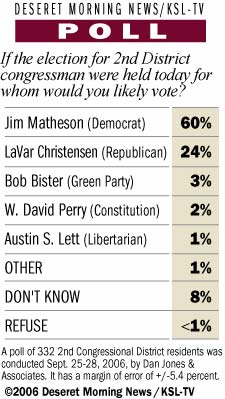
Before the advent of remote controls, television networks used to operate with a policy of avoiding "objectionable programming." Shows didn't have to be good. Just make sure there was nothing offensive enough on the air to make a couch potato get up and change the channel. Rep. Jim Matheson seems to have adopted a similar strategy this election. A three-term incumbent, he has a comfortable 36-point lead (based on a poll published Saturday for the Deseret Morning News and KSL-TV) over Republican challenger LaVar Christensen and the edge in fundraising. For the first time, Matheson apparently could do very little and still slide into office. That may be standard operating procedure for Sen. Orrin Hatch or Bob Bennett. But it's unfamiliar to Utah's lone Democrat in Congress. And he is operating like most safe incumbents - lying low, limiting his debate schedule, public comments and appearances. "He waging the win-by-making-no-comment strategy," says Hayden Hill, Christensen's spokeswoman. Matheson disputes that characterization, noting it is barely October, he has been in Washington doing his job, and he will be back in town to campaign - hard - this week. "There's no change from what we've done before," he says. "I like to campaign. I want to be out there. I always run hard. And I'm running hard this time too." But Matheson has been hard to find on particular issues this fall - Salt Lake City Mayor Rocky Anderson's charges that he is not liberal enough and, most recently, Utah's push for a fourth congressional seat. One Tribune reporter staked out the Capitol last week in an attempt to get a comment. "It's possible a lot of people could be offended," says Joe Cannon, Utah State Republican Chairman. "Nobody's going to be particularly offended if he doesn't say anything." Brigham Young University political scientist Kelly Patterson calls it "textbook" incumbent strategy. Matheson's popularity is high. He can reach out to voters through town meetings, e-mails, mailings. "It makes sense - a lower-risk strategy," Patterson says. And few political advisers would tell Matheson to stick his neck out, risking the election with an errant comment about a controversial issue or a heated debate that doesn't go well. He already has the people who voted for him two years ago. And those who didn't are equally entrenched. Matheson has little to gain and everything to lose with a misstep. Former Congresswoman Karen Shepherd says Matheson is simply being cautious - like all candidates. "Campaigns are contact sports. The one thing people think about on both sides is trying not to make a mistake," she says, noting congressional hopeful John Jacob's campaign-ending speech blaming Satan for his financial difficulties. Jacob's credible challenge of U.S. Rep. Chris Cannon was mortally wounded by the comments. "We have all sorts of examples of people putting their feet in their mouths," Shepherd adds. "And the media loves a mistake more than life itself. It's a candidate's nightmare. So candidates try not to expose themselves any more than they have to." It is frustrating Christensen and his camp. Because Matheson has declined the Salt Lake Chamber's invitation, Christensen can't speak to those business leaders either. The Congressman also declined debates at KBYU and the Hinckley Institute of Politics that Christensen wanted. Two years ago, Matheson challenger John Swallow made similar complaints. Christensen's spokeswoman says the public will suffer. "He's being politically expedient," says Hill, who explains that Christensen is "so busy," he's also hard to get hold of. "We'll debate anytime, anyplace. I'd like to hear [Matheson's] answers about why he's so hesitant to stand with LaVar and discuss his vision for Utah. We feel a little upset that we don't get to share our message." Matheson's camp says it can't be held responsible for the Chamber's nonpartisan rules. And, aides note, they have committed to four debates - the same number Matheson appeared at during the 2004 election. "I suspect in the end, there will be plenty of public opportunities to hear Matheson," says Todd Taylor, Utah State Democratic Party director.

Saturday, September 30, 2006

Congressman Joe Cannon?


Lisa, I think you made a little mistake here?
Poll shows challengers are significantly behind
Copyright 2006 Deseret Morning News
By Lisa Riley RocheDeseret Morning News
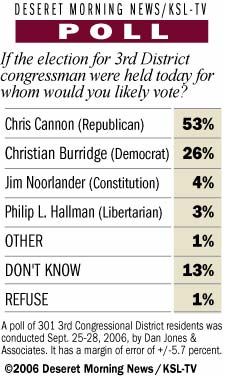
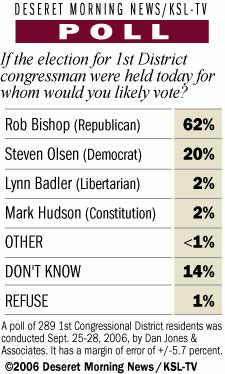
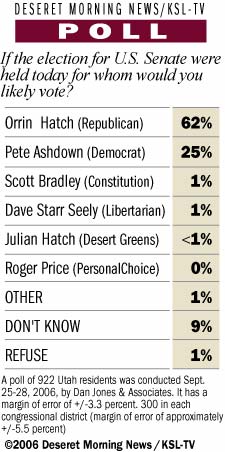
So far, voters are only moderately interested in the upcoming general election, according to a new poll — not surprising, since the incumbents at the top of the ticket all hold strong leads. Four of the five members of Utah's congressional delegation are up for re-election in November — Sen. Orrin Hatch, Rep. Rob Bishop and Rep. Joe Cannon, all Republicans, and Rep. Jim Matheson, the lone Democrat. A new Deseret Morning News/KSL-TV poll found that all but Cannon have the support of at least 60 percent of the Utahns surveyed. Cannon, the only incumbent who faced a primary election, had 53 percent. None of the opponents were favored by more than about one-fourth of the Utahns surveyed — a total sample of 922 registered voters statewide for the Senate race and 300 in each congressional district. Even in the most contested race, in the 2nd District, Matheson holds a 36 percent lead over his GOP opponent, state Rep. LaVar Christensen, R-Sandy. Sixty percent of the voters said they would pick Matheson if the election were held today and 24 percent would cast a ballot for Christensen. The poll was taken Sept. 25-28 by Dan Jones & Associates and has a margin of error of plus or minus 3 percent for the statewide race and approximately plus or minus 5.5 percent in each congressional district. Voters were also asked about their level of interest in the Nov. 7 general election. Most, 59 percent, expressed moderate interest. Those numbers did not vary much by congressional district. State Republican and Democratic party officials said the results are to be expected in what so far seems to be a pretty low-key election. "It is not an exciting political year," said Jeff Hartley, executive director of the Utah Republican Party. And unless the sales tax increase for transportation projects that's on the ballot in Salt Lake County generates a lot of interest, Hartley predicted a low voter turnout, something that typically favors sitting officeholders. "That's good news for incumbents," Hartley said. But not for Republicans who are trying to unseat Matheson in a largely GOP district. "To close the gap with Matheson, who is a strong incumbent, Christensen needs to remind people why they're Republican," Hartley said. And, he said, the GOP could lose its majority in Congress this election. "The House of Representatives literally hangs in the balance this time," Hartley said. "Although Matheson may be a likeable guy here in Utah, giving control of the House to Washington Democrats is not something Utah voters want to see." Todd Taylor, executive director of the Utah Democratic Party, said that could sway some GOP voters who back Matheson, but not enough to cost him the election. "It is probably their most effective argument for calling people home," Taylor said. Jones said Matheson needs 20 percent of the Republi- cans to vote for him in order to retain his seat. According to the poll, 35 percent of those surveyed who said they were Republicans backed Matheson. Just over half — 53 percent — of the GOP members polled said they would vote for Christensen, while 9 percent said they didn't know who they'd support. None of the respondents who identified themselves as Democrats said they support Christensen. Both Taylor and Hartley said they expect all the races to get closer as the election nears and voters start paying more attention. "I definitely expect things to tighten up a little bit," Taylor said. "People want to do their civic duty."

Western primary takes off - kind of


By Lisa Riley RocheDeseret Morning News
Not everyone is excited about the prospect of the Western states primary promoted by Gov. Jon Huntsman Jr. Feb. 5 is the date set for what backers hope will be a Western version of "Super Tuesday" during the 2008 presidential race. So far, only three states have committed to participate — Utah, New Mexico and Arizona. Nevada was selected this summer by the Democratic National Committee to hold a caucus in January 2008, the same month that voters will gather in Iowa, New Hampshire and South Carolina to register their presidential preferences at the polls or in party meetings. Huntsman told participants at the Western Presidential Primary Symposium sponsored by the University of Utah's Center for Public Policy and Administration that even with just four of eight states in the region participating in the process early, Utah will benefit. "We've never before forced the body politic, at least at a presidential level, to get smart about our issues," Huntsman said. For too long, he said, Utah and much of the rest of the West have been a fly-over zone for candidates seeking the nation's highest office. The regional primary will attract candidates and their campaign spending to the state, the Republican governor said, as well as focus attention on regional issues such as water development, public land use and immigration. New Mexico Gov. Bill Richardson also spoke at the symposium in favor of the primary. "The West has a new voice and a real choice in the selection of the next American president," Richardson, a potential Democratic presidential candidate, said. But several panelists at the symposium said that's not going to happen. "This is a pretty small part of the country," said Lance Tarrance, a senior strategist for Straight Talk America, the political action committee organized on behalf of Sen. John McCain, R-Ariz., a likely GOP presidential candidate in 2008. The way to bring attention to the region, Tarrance said, is to focus on a Western state better-known to the Eastern media and political establishment. "I think there's some star appeal to Colorado," he said, suggesting it could "symbolize a lot of the new West." Plus, the region tends to favor Republicans in presidential races, with a few exceptions. If the region isn't seen as competitive, candidates and media outlets trying to control costs aren't going to pay much attention, Tarrance said. Eddie Mahe, a Washington, D.C.-based political strategist whose clients have included former Rep. Enid Greene, also suggested there would be little interest generated by a regional primary in the West. "The more states you put in it, the less you're going to see of any of these candidates," he said, citing the great distances between population centers in the West. "They'll pick a state or maybe two states, and they'll invest all of their resources there." The price tag for the Utah primary is about $2.5 million, according to Lt. Gov. Gary Herbert, whose office oversees elections in the state. The 2006 Legislature came up with about a third of that amount. Daniel Kemmis, a senior fellow at the Center for the Rocky Mountain West and a former Montana lawmaker, said more states should participate. Montana's legislature has rejected funding for a presidential primary in 2008 but is expected to consider the issue again. The primary will help the region work more closely together, Kemmis said. He was a participant on the same symposium panel as the critics of the Western states primary, one intended to answer the question of whether the West had been overlooked by candidates. "I don't think the Rockies can expect either presidential candidates or the rest of the country to take us seriously until we take ourselves seriously as a region," Kemmis said. The primary "should only be viewed as one element of a broader Western strategy." Huntsman later dismissed the criticisms of the Western states primary, which has also been supported in the past with only limited success by former Utah Gov. Mike Leavitt and former Colorado Gov. Roy Romer. "It's just getting off the ground and to see the level of activity we've already seen — let the numbers speak for themselves," Huntsman said, citing visits already made to the state by Richardson, McCain and other hopefuls. "We're on the political map."
E-mail: lisa@desnews.com

Friday, September 29, 2006

4 Internet firms issued spam citations


E-mails violate new 'do-not-call' Child Protection Registry
By Geoffrey FattahDeseret Morning News
Four Internet companies have been cited by the state of Utah for sending spam e-mail to several Utah children, soliciting for gambling, alcohol and pornography. The Utah Department of Commerce said Thursday that it has issued citations against two U.S. companies, one company in the United Kingdom and one company in Singapore for sending adult-oriented solicitations to minors in Davis and Salt Lake Counties and Salt Lake City. The actions came in response to a relatively new law that went into effect last year and created the Utah Child Protection Registry. Seen as a "do-not-call" list to protect Utah residents and their children from Internet spammers, people can register their e-mail addresses with the state, which will require businesses to remove those addresses from their mailing lists. The state funds the program, which went into effect in July, 2005, by charging companies 1 cent per e-mail address to scrub their lists of registered Utah e-mail addresses.

The four companies are some of the first to be cited under the Utah Child Protection Registry. DOS Media Now LLC of Encinitas, Calif., has been fined $5,000 for e-mailing online gambling offers. Golden Arches Casinos of Overland Park, Kan., faces a $2,500 fine for also sending online gambling solicitations. A United Kingdom beer company faces a $2,500 fine for sending alcohol advertising, and a Singapore company faces a $20,000 fine for sending pornographic e-mails. All were sent to minors. "These companies ignored the law and sent illegal offers into the homes of Utah children," said Francine Giani, executive director for the Utah Department of Commerce. However, Utah hasn't seen a dime from any company. When asked what the chances were of getting any money out of foreign companies Giani said, "Zero to nil. We've been tasked by the Legislature to investigate. If they snub us, then we send the information to the AG's office, and they take the ball from here." To date, the department of commerce has cited one other company, an Internet porn vendor, in addition to the four announced Thursday. Utah Attorney General Mark Shurtleff said the five companies have been cited since the program started. "We'd like to give them time to comply," he said, before taking legal action. Shurtleff said he fully intends to seek judgments against those companies, including those overseas, even though odds of getting them to pay up are narrow. "It's slim, there's no doubt about that, but I think we have to try," Shurtleff said. "We'll push it as far as we can." Giani said the registry does bring awareness to parents. "It brings to light a critical issue that parents will hopefully see, and that is ultimately, they should be the number-one line of defense for their children." Giani said parents need to supervise what their children see and do over the Internet. Families interested in registering their e-mail addresses can go to http://www.dcp.utah.gov/ or http://www.kidsregistry.utah.gov/.
E-mail: gfattah@desnews.com

Good to see Tiani back in the game

Border Security Forum
The National Immigration Advisory Committee will hold a live forum on its website today from 11 a.m. to 12 noon on the topic of border security. NIAC Co-chairs Matt Throckmorton and Tiani Coleman will moderate. The NIAC encourages people interested in immigration policy from around the nation to join the discussion. Go here, create an account for active participation, click on "Border Security," then click on "Border Security before the 2006 Midterms?"